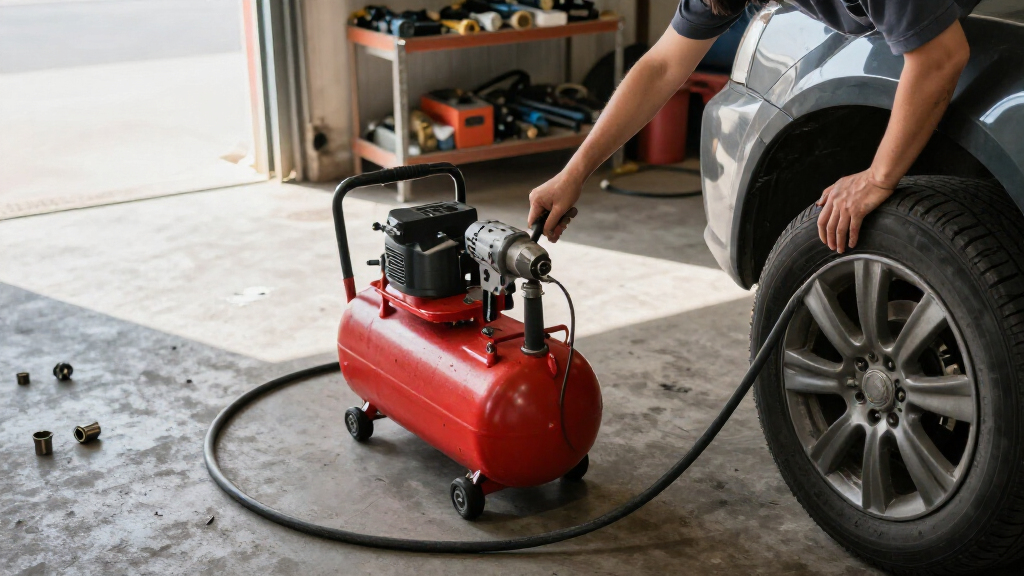
For most home garages, I’d start with the California Air Tools 8010A: its 8-gallon tank and ultra-quiet oil-free design balance useful capacity with a more comfortable sound profile. The CRAFTSMAN 26-Gallon Vertical is a better fit when you want more stored air without taking up as much floor space, while the DEWALT 60-Gallon suits a dedicated shop with demanding, sustained air needs. The main tradeoffs are tank capacity versus portability, noise versus output, and convenient 120V operation versus the demands of larger stationary equipment. Small pancake and portable models are easier to store but have less reserve for air-hungry tools. Continue reading for the full breakdown and guidance on matching a compressor to your tools and garage.

Get business pricing on garage and car supplies
- Business-only prices and quantity discounts
- Tax-exempt purchasing
- Multiple users, one account, clear invoices
Complete the kit


Key Takeaways
- The 8010A stands out for balancing shop utility and noise control: its 8-gallon aluminum tank offers more reserve than the compact 2- and 2.5-gallon options, while its ultra-quiet design is a defining advantage for an attached garage.
- Vertical tanks trade portability for a smaller footprint: the 26- and 33-gallon CRAFTSMAN models and the 29-gallon Klutch make more sense when floor space matters more than easy relocation.
- Tank size alone does not predict tool performance: airflow at working pressure matters for sustained use, so the VEVOR’s stated 4.6 SCFM at 90 PSI is more informative for tool matching than capacity by itself.
- Compact compressors fill narrow roles: the DEWALT 2.5-gallon and CRAFTSMAN 2-gallon models are easier to store and move, but their smaller air reserves suit intermittent tasks better than long, continuous tool use.
- The 60-gallon DEWALT is a different kind of purchase: it favors a permanent shop and higher-demand work, while most other picks use 120V power and are more readily suited to ordinary garage setups.


| garage air compressor | Maximum pressure | Tank capacity | Noise level | Motor power |
|---|---|---|---|---|
| California Air Tools 8010A 1.0 | 120 PSI | 8 gallons | 60 dB | 1.0 HP |
| CRAFTSMAN 26-Gallon Vertical O | 150 PSI | 26 gallons | 75 dB | 1.8 HP |
| VEVOR 13-Gallon Air Compressor | 125 PSI | 13 gallons | 66 dB | 2 HP |
| CRAFTSMAN 8-Gallon Oil-Free Ai | 150 PSI | 8 gallons | — | 1.8 HP |
| ECOMAX 6-Gallon 150 PSI Oil-Fr | 150 PSI | 6 gallons | 75 dB | 1.5 HP |
| RyanTek 15-Gallon Oil-Free Air | 125 PSI | 15 gallons | 66 dB at 4 m | 2 HP |
| CRAFTSMAN Wall Mount Air Compr | 125 PSI | — | 65 dB | — |
| Craftsman 20-Gallon Oil-Free A | 175 PSI | 20 gallons | 80 dB | 1.8 HP |
| Klutch 20-Gallon Air Compresso | 175 PSI | 20 gallons | 80 dB | 2 HP |
| DEWALT DWFP55130 2.5-Gallon Po | 200 PSI | 2.5 gallons | 71.5 dBA | — |
| CRAFTSMAN 33-Gallon Vertical P | 175 PSI | 33 gallons | 80 dB | — |
| Klutch 29-Gallon Oil-Free Air | 175 PSI | 29 gallons | 81 dB | 2.5 HP |
| CRAFTSMAN 2-Gallon Portable Oi | 125 PSI | 2 gallons | 78 dB | 1/3 HP |
| DEWALT 60-Gallon 175 PSI Stati | 175 PSI | 60 gallons | 70 dB | 5 HP |
More Details on Our Top Picks
California Air Tools 8010A 1.0 HP Ultra-Quiet Oil-Free Air Compressor, 8-Gallon Aluminum Tank
The California Air Tools 8010A is the strongest fit here for garages where compressor noise is a real constraint. Its 60 dB operation is far quieter than the 75 dB CRAFTSMAN 26-Gallon and ECOMAX models, making it more suitable for indoor work or shared spaces. At 37.3 pounds, with an aluminum tank and wheel kit, it is also easier to reposition than the much heavier CRAFTSMAN 26-Gallon. The tradeoff is capacity: its 8-gallon tank and 2.20 CFM at 90 PSI suit inflation, nailing, and lighter intermittent jobs better than prolonged use of air-hungry tools. I would choose it for a noise-sensitive garage, not as a substitute for a higher-output workshop compressor.
Pros:- 60 dB noise level is notably lower than the 75 dB CRAFTSMAN 26-Gallon and ECOMAX compressors.
- Oil-free dual-piston pump avoids routine pump-oil changes.
- 37.3-pound weight, aluminum tank, and wheel kit make it easier to move than larger steel-tank options.
- Delivers 2.20 CFM at 90 PSI and reaches 120 PSI for common garage tasks.
Cons:- The 8-gallon tank and modest 90-PSI airflow limit sustained use with air-demanding tools.
- Corded operation requires access to a suitable electrical outlet.
Best for: Homeowners who run an air compressor in an attached garage or other noise-sensitive space and mainly handle inflation, nailing, or light cleanup.
Not ideal for: Users who need sustained airflow for demanding pneumatic tools, since its 8-gallon tank and 2.20 CFM at 90 PSI limit longer high-demand work.
- Tank capacity:8 gallons
- Tank material:Aluminum
- Motor power:1.0 HP
- Pump:Oil-free dual-piston
- Airflow at 90 PSI:2.20 CFM
- Maximum pressure:120 PSI
- Noise level:60 dB
- Weight:37.3 lb
Our verdict“Choose the California Air Tools 8010A if quiet operation and easy repositioning matter more than long run time with demanding tools.”
CRAFTSMAN 26-Gallon Vertical Oil-Free Air Compressor, 1.8 HP, 120V
For a garage that needs a larger reserve of compressed air, the CRAFTSMAN 26-Gallon makes a different case from the compact picks in this group. Its 26-gallon vertical tank stores substantially more air than the 8-gallon California Air Tools 8010A or CRAFTSMAN 8-Gallon, while 5.0 CFM at 90 PSI supports a wider range of intermittent pneumatic work. It runs on 120V household power, so it does not require a dedicated higher-voltage supply. That capacity comes with a substantial footprint and a 125.9-pound weight; the wheels help with positioning, but this is not a grab-and-go unit. At 75 dB, it is also much louder than the California Air Tools model. I see it as a garage-station compressor, not a quiet portable choice.
Pros:- 26-gallon tank provides a larger stored-air reserve than the 8-gallon models in this batch.
- 5.0 CFM at 90 PSI offers higher stated airflow than the other listed compressors here.
- Vertical layout uses a narrower floor footprint than a comparable horizontal tank.
- Oil-free pump and 120V operation avoid routine pump-oil changes and special voltage requirements.
Cons:- At 125.9 pounds, it is difficult to move despite its wheels.
- Its 75 dB operating noise is substantially higher than the 60 dB California Air Tools 8010A.
- The description positions it for intermittent use; sustained high-air-demand work may exceed its capacity.
Best for: Garage owners who want a larger air reserve for tire service, blow-off cleaning, and intermittent compatible-tool use, with room to keep a heavy compressor parked.
Not ideal for: People who need a quiet compressor, frequently carry equipment between work areas, or run tools continuously at high airflow.
- Tank capacity:26 gallons
- Orientation:Vertical
- Motor power:1.8 HP
- Pump:Oil-free
- Airflow at 90 PSI:5.0 CFM
- Maximum pressure:150 PSI
- Noise level:75 dB
- Weight:125.9 lb
- Voltage:120V
Our verdict“Pick the CRAFTSMAN 26-Gallon if you want a higher-capacity garage unit on 120V and can dedicate space to a heavy, relatively loud compressor.”
VEVOR 13-Gallon Air Compressor, 2 HP, 4.6 SCFM @ 90 PSI, Oil-Free
The VEVOR 13-Gallon lands between the small, easy-to-store compressors and the large CRAFTSMAN 26-Gallon. Its 4.6 CFM at 90 PSI is a substantial airflow figure for this lineup, while the 13-gallon tank offers more reserve than either 8-gallon CRAFTSMAN or California Air Tools model. At 66 dB, it is quieter than the 75 dB ECOMAX and CRAFTSMAN 26-Gallon, though it cannot match the California Air Tools 8010A’s 60 dB. The stated under-three-minute tank fill and wheels support quick setup and repositioning, but 71 pounds still makes it a bulky portable unit rather than an easy carry. I would compare tool requirements carefully: its listed output broadens the range of jobs, but does not make it a continuous-duty compressor.
Pros:- 4.6 CFM at 90 PSI is higher than the stated output of the smaller compressors in this batch.
- 13-gallon tank provides more air reserve than the 6- and 8-gallon options.
- 66 dB operation is quieter than the 75 dB ECOMAX and CRAFTSMAN 26-Gallon.
- Oil-free pump and reinforced rubber wheels support lower routine pump maintenance and repositioning.
Cons:- At 71 pounds, it is heavy for a compressor marketed as portable.
- Its noise level is still higher than the California Air Tools 8010A.
- Requires a 120V outlet and is not suited to continuous high-demand work based on the stated use guidance.
Best for: DIY garage users who want more airflow than compact 6- or 8-gallon units provide for woodworking, nailing, or intermittent auto work.
Not ideal for: Buyers who need a lightweight compressor to carry upstairs or a very quiet unit for noise-sensitive indoor work.
- Tank capacity:13 gallons
- Motor power:2 HP
- Airflow at 90 PSI:4.6 CFM
- Maximum pressure:125 PSI
- Pump:Oil-free
- Noise level:66 dB
- Weight:71 lb
- Voltage:120V
Our verdict“Choose the VEVOR 13-Gallon for a middle-ground garage compressor with stronger stated airflow than the compact models, provided you can manage its 71-pound weight.”
CRAFTSMAN 8-Gallon Oil-Free Air Compressor, 1.8 HP, 150 PSI, with 10 Accessories
The CRAFTSMAN 8-Gallon is the convenient starter package in this group: it includes a hose and a selection of fittings and air tools, so buyers can begin with inflation and blow-off jobs without sourcing every connection separately. Its 24-pound weight is lighter than the California Air Tools 8010A and far below the 71-pound VEVOR 13-Gallon, making it easier to move around a home garage. The stated 4 CFM airflow and 150 PSI maximum pressure give it a useful range for intermittent tasks, but the 8-gallon tank still limits sustained tool use. Unlike the exceptionally quiet California Air Tools, this model has no stated low-noise advantage. I would choose it for convenience and included gear, not for long sessions with air-hungry tools.
Pros:- Includes a hose, tire gauge, blow gun, nozzle, fittings, and other accessories for varied starter tasks.
- 24-pound weight is lighter than the other wheeled compressors in this batch.
- Oil-free design avoids routine pump-oil changes.
- 150 PSI maximum pressure and stated 4 CFM airflow suit a range of intermittent garage jobs.
Cons:- The 8-gallon tank limits how long air-demanding tools can run before pressure drops.
- Requires a 120V electrical connection, so it cannot be used away from a suitable outlet.
- No low-noise performance figure is provided to support use in noise-sensitive spaces.
Best for: New garage owners who need a portable compressor and a ready-to-use accessory set for tire inflation, blow cleaning, air brushing, and occasional tool use.
Not ideal for: Users who run high-demand pneumatic tools for extended periods or prioritize low operating noise.
- Tank capacity:8 gallons
- Motor power:1.8 HP
- Airflow:4 CFM
- Maximum pressure:150 PSI
- Pump:Oil-free
- Weight:24 lb
- Voltage:120V
- Included accessories:Air hose, tire pressure gauge, blow gun, nozzle, fittings, and related accessories
Our verdict“Choose the CRAFTSMAN 8-Gallon if you want a lighter compressor with a broad accessory bundle for common, intermittent garage jobs.”
ECOMAX 6-Gallon 150 PSI Oil-Free Pancake Air Compressor with 10-Piece Accessory Kit
The ECOMAX 6-Gallon Pancake is the space-saving pick for a garage where the compressor needs to tuck away between jobs. Its compact pancake form, flip-up handle, and cord-storage bracket make storage neater than with the wheeled, upright CRAFTSMAN 26-Gallon. It also includes a 25-foot hose and a set of inflation and blow-off accessories. The tradeoff is a smaller 6-gallon tank and an unreliable airflow listing: the supplied specification says 3 cubic inches per minute at 90 PSI, a unit that does not provide a useful comparison with the CFM figures listed for the other models. At 75 dB, it is no quieter than the large CRAFTSMAN. I would treat it as a compact inflation and cleanup option, not a proven choice for demanding air tools.
Pros:- Compact pancake design, flip-up handle, and cord-storage bracket support tidy storage.
- Includes a 25-foot hose and accessories for inflation and blow-off tasks.
- Oil-free pump avoids routine pump-oil changes.
- 150 PSI maximum pressure is suitable for common inflation work.
Cons:- The 6-gallon tank provides less stored air than the 8-, 13-, and 26-gallon options in this batch.
- The listed airflow of 3 cubic inches per minute at 90 PSI is not directly comparable to the other models’ CFM figures.
- At 75 dB, it is substantially louder than the California Air Tools 8010A.
Best for: Garage users with limited storage who mainly inflate tires, use a blow gun, or need a compact compressor with an included hose and accessories.
Not ideal for: Buyers selecting a compressor for sustained pneumatic-tool work or comparing output by airflow, since the supplied airflow figure is listed in an unusual unit.
- Tank capacity:6 gallons
- Tank style:Pancake
- Motor power:1.5 HP
- Maximum pressure:150 PSI
- Listed airflow at 90 PSI:3 cubic inches per minute
- Pump:Oil-free
- Noise level:75 dB
- Weight:34.17 lb
- Hose length:25 ft
Our verdict“Pick the ECOMAX if compact storage and included accessories matter most, but choose another model when dependable airflow for pneumatic tools is the priority.”
RyanTek 15-Gallon Oil-Free Air Compressor, 2 HP, 125 PSI
The RyanTek’s 15-gallon vertical tank and 4.5 CFM at 90 PSI make it a middle ground between compact compressors and larger shop units. It can support common garage jobs such as nailing, tire inflation, and intermittent spraying without taking up the footprint of the Craftsman 20-Gallon. Its 66 dB rating is also lower than that model’s listed 80 dB, which may suit a shared or enclosed workspace better. The twin-cylinder, oil-free pump and dual outlets add flexibility, though airflow still sets a limit for tools that run continuously. At 68.3 pounds, the wheels help with rolling it around, but they do not make it easy to lift. I’d skip it if the main need is a lightweight compressor or a unit for sustained high-demand work.
Pros:- 15-gallon vertical tank offers more reserve than the DEWALT 2.5-Gallon while taking less space than a 20-gallon unit.
- Delivers 4.5 CFM at 90 PSI for a range of common pneumatic tools.
- Oil-free twin-cylinder pump avoids routine oil changes.
- Dual outlets, wheels, and an upward-facing gauge support practical workshop use.
Cons:- At 68.3 pounds, it is cumbersome to lift despite its wheels.
- The 110-volt corded design requires a suitable power source.
- Its airflow may fall short for tools that need sustained, high-volume air.
Best for: Garage owners who want a movable, medium-capacity compressor for intermittent nailing, inflation, and light spraying, with less noise than the listed 20-gallon Craftsman.
Not ideal for: Buyers who need an easy-to-lift compressor, sustained airflow for demanding tools, or a model that can run without a 110-volt outlet.
- Tank capacity:15 gallons
- Motor power:2 HP
- Airflow:4.5 CFM at 90 PSI
- Maximum pressure:125 PSI
- Noise level:66 dB at 4 m
- Power:110 V corded electric
- Pump:Oil-free, twin-cylinder
- Weight:68.3 pounds
- Air outlets:Dual
Our verdict“Choose the RyanTek if you want a quieter-feeling, medium-capacity garage compressor for varied intermittent jobs and can accommodate its weight.”
CRAFTSMAN Wall Mount Air Compressor with 8-Piece Accessory Kit
When garage floor space matters more than long runtimes, this wall-mountable CRAFTSMAN has a clear advantage over the wheeled RyanTek 15-Gallon and Craftsman 20-Gallon. Its retractable 30-foot hose reaches around a home garage without requiring the compressor itself to move, while the included accessories make it useful for tire inflation and quick cleanup tasks. The oil-free motor keeps routine upkeep simple, and the 125 PSI maximum covers many everyday jobs. The tradeoff is the 0.5-gallon tank and 1.8 CFM airflow: they are better suited to short bursts than tools that draw air continuously. I’d choose it for a tidy home setup, not as the main air source for a busy workshop or sustained spraying.
Pros:- Wall-mountable format frees floor space compared with the RyanTek and larger Craftsman tank models.
- Retractable 30-foot hose provides reach across a typical garage and stores neatly.
- Eight included accessories support common inflation and blow-gun tasks.
- Oil-free motor reduces routine maintenance.
Cons:- The 0.5-gallon tank limits runtime before the compressor must recover.
- 1.8 CFM airflow is a poor match for sustained, high-demand pneumatic tools.
- Wall mounting makes it less convenient to move between work areas.
Best for: Home garage owners who mainly inflate tires or use a blow gun and want a wall-mounted setup with a long retractable hose and included fittings.
Not ideal for: DIYers who regularly run air-hungry tools, need extended continuous operation, or want a portable compressor they can take to different work areas.
- Tank volume:0.5 gallons
- Maximum pressure:125 PSI
- Maximum horsepower:1.5 HP
- Airflow capacity:1.8 CFM
- Hose length:30 feet, retractable
- Noise level:65 dB
- Pump:Oil-free
- Weight:20.9 pounds
- Included accessories:8-piece kit
Our verdict“Pick this CRAFTSMAN for space-conscious home garages focused on short inflation and cleanup jobs, not continuous tool use.”
Craftsman 20-Gallon Oil-Free Air Compressor, 1.8 HP, 175 PSI, Red
The 20-gallon tank is the main reason to pick this Craftsman over the RyanTek: it stores more air for longer bursts of work, and its listed 4 SCFM at 90 PSI supports a broad set of garage tasks. Two quick couplers are useful when switching between tools or setting up two connections. Compared with the Klutch 20-Gallon, the Craftsman provides a similar tank size and pressure ceiling, but the Klutch lists higher airflow at 90 PSI and thermal overload protection. This Craftsman’s oil-free pump keeps maintenance straightforward, while the 80 dB noise level and nearly 41-inch height call for a spot where sound and storage space are manageable. It makes more sense for a fixed garage station than for a compact or quiet workspace.
Pros:- 20-gallon tank provides more stored air than the RyanTek 15-Gallon.
- 4 SCFM at 90 PSI supports a range of common garage tools.
- Two quick couplers allow convenient tool changes or dual connections.
- Oil-free pump reduces routine lubrication maintenance.
Cons:- Listed 80 dB noise level may be disruptive in an enclosed garage.
- Its 40.9-inch height and 20-gallon tank need substantial storage space.
- The six-foot hose length limits reach without an additional hose.
Best for: DIYers with room for a tall compressor who need a 20-gallon reserve for intermittent nailing, drilling, inflation, and spraying.
Not ideal for: People working in noise-sensitive enclosed garages, buyers with limited storage height, or users who prioritize higher listed airflow over this model’s simpler feature set.
- Tank capacity:20 gallons
- Motor power:1.8 HP
- Airflow at 90 PSI:4 SCFM
- Maximum pressure:175 PSI
- Noise level:80 dB
- Power:120 V corded electric
- Pump:Oil-free
- Dimensions:19.1 × 17.3 × 40.9 inches
- Quick couplers:2
Our verdict“Choose this Craftsman if you have the space and want a larger tank for varied intermittent garage work, but skip it if noise or airflow is your main concern.”
Klutch 20-Gallon Air Compressor, 2 HP, 120V
Among the two 20-gallon options here, the Klutch lists 4.2 SCFM at 90 PSI, edging the Craftsman 20-Gallon’s listed 4 SCFM. That small airflow difference may help when using tools that cycle frequently, though neither spec makes this a substitute for a compressor matched to sustained high-demand equipment. The Klutch adds thermal overload protection, rubber foot stabilizers, and large wheels, balancing workshop use with easier repositioning. Its 2 HP motor and 175 PSI ceiling suit a general-purpose garage setup, while the oil-free pump avoids regular oil service. The compromises are familiar for this tank class: it weighs 90 pounds, stands 41.5 inches tall, and is rated at 80 dB. Compared with the more compact DEWALT DWFP55130, it offers much more reserve but demands far more room.
Pros:- 4.2 SCFM at 90 PSI is higher than the Craftsman 20-Gallon’s listed 4 SCFM.
- Thermal overload protection helps guard the motor during extended operation.
- Large wheels and an ergonomic handle aid repositioning around the garage.
- Oil-free pump reduces routine maintenance.
Cons:- At 90 pounds, moving it still takes effort despite the wheels.
- The 80 dB noise rating may be intrusive in enclosed spaces.
- Its 20-gallon tank and 41.5-inch height need considerable storage room.
Best for: Garage DIYers who want a wheeled 20-gallon compressor for intermittent nailing or spraying and value a little more listed airflow than the Craftsman 20-Gallon.
Not ideal for: Owners of small or noise-sensitive garages, people who need a lightweight compressor, or users whose tools require uninterrupted high-volume airflow.
- Tank capacity:20 gallons
- Motor power:2 HP
- Airflow at 90 PSI:4.2 SCFM
- Maximum pressure:175 PSI
- Noise level:80 dB
- Power:120 V corded electric
- Maximum current:14 A
- Weight:90 pounds
- Pump:Oil-free
Our verdict“Choose the Klutch over the Craftsman 20-Gallon if its slightly higher listed airflow and overload protection matter more than low noise or compact storage.”
DEWALT DWFP55130 2.5-Gallon Portable Air Compressor, 200 PSI
The DEWALT DWFP55130 takes a different route from the larger RyanTek and 20-gallon compressors: its 2.5-gallon tank keeps the unit compact, while 3.0 SCFM at 90 PSI and a 200 PSI ceiling serve trim work and other intermittent pneumatic tasks. Two quick couplers let a garage user connect two nailers without changing fittings, and the compressor can be stored vertically or horizontally when floor space is tight. Its listed 71.5 dBA rating is below the 80 dB ratings of the Craftsman and Klutch 20-gallon models, though it is not a silent option. The tradeoff is limited stored air: compared with the RyanTek’s 15-gallon tank, it needs more frequent recovery during longer jobs. I’d choose it for portability and nailers, not broad, sustained shop use.
Pros:- Compact 2.5-gallon design stores vertically or horizontally.
- 3.0 SCFM at 90 PSI supports trim work and intermittent pneumatic tool use.
- Two quick couplers allow connection of two nailers.
- Oil-free pump reduces routine maintenance.
Cons:- Small tank offers less reserve than the RyanTek 15-Gallon or either 20-gallon option.
- Corded 120 V power limits use to locations with a suitable outlet.
- The listed item weight is inconsistent with the product description, which gives 36 pounds.
Best for: Trim carpenters and garage DIYers who run one or two nailers, need a compact compressor, and want flexible storage positions.
Not ideal for: Users who need long runtimes, sustained air for spraying or other demanding tools, or an off-grid compressor without a corded outlet.
- Tank capacity:2.5 gallons
- Maximum pressure:200 PSI
- Airflow at 90 PSI:3.0 SCFM
- Noise level:71.5 dBA
- Power:120 V corded electric
- Current:12 A
- Pump:Oil-free
- Couplers:2 quick couplers
- Storage positions:Vertical or horizontal
Our verdict“Pick the DEWALT for compact storage and nailer work; choose a larger tank if your garage jobs need longer air-tool runs.”
CRAFTSMAN 33-Gallon Vertical Portable Air Compressor
I’d choose the CRAFTSMAN 33-gallon when a garage needs more reserve air than a small portable unit can offer, but a stationary installation is not practical. Its 5.1 CFM at 90 PSI matches the Klutch 29-gallon compressor, while the larger tank can help extend work between motor cycles. Two high-flow couplers also let two people connect tools, a useful advantage over the Klutch’s single listed coupler. The oil-free pump avoids routine oil changes, and the upright layout takes up less floor width than a horizontal tank of similar capacity. The tradeoff is substantial: at 154 pounds, its wheels and handle help with repositioning, not easy lifting or frequent transport. It also needs a 120-volt outlet, and its 80 dB operating level may bother anyone working in a shared space.
Pros:- 33-gallon tank provides more air storage than the Klutch 29-gallon option.
- Two high-flow quick couplers can support two connected users.
- Oil-free pump avoids routine oil changes.
- Vertical design, wheels, and handle aid storage and repositioning.
Cons:- At 154 pounds, it is difficult to lift and is only portable in a limited sense.
- 5.1 CFM at 90 PSI is below the DEWALT 60-gallon compressor’s 14.6 SCFM for demanding sustained tool use.
- Requires a corded 120-volt power source.
Best for: Home-garage users who want a larger air reserve, two hose connections, and the ability to reposition the compressor without installing a stationary 240-volt unit.
Not ideal for: People who need to carry a compressor between locations, have limited floor clearance, or need the higher sustained airflow of the DEWALT 60-gallon model.
- Tank capacity:33 gallons
- Maximum pressure:175 PSI
- Airflow:5.1 CFM at 90 PSI
- Pump type:Oil-free
- Power:Corded electric, 120 volts
- Quick couplers:2 high-flow
- Noise level:80 dB
- Weight:154 pounds
- Dimensions:46 × 23 × 51 inches
Our verdict“Choose this CRAFTSMAN for a movable, higher-capacity 120-volt garage setup, but pick the DEWALT for heavier sustained air demand.”
Klutch 29-Gallon Oil-Free Air Compressor, 2.5 HP, 120V, 175 PSI
The Klutch 29-gallon suits a garage that needs substantial tank capacity but still wants a 120-volt, wheeled compressor. It delivers 5.1 CFM at 90 PSI, the same listed airflow as the CRAFTSMAN 33-gallon, in a unit that weighs 127 pounds rather than 154. That difference makes this the more manageable choice to reposition, though neither compressor is easy to lift. Its flat-free tires avoid puncture concerns, and the brass quick-connect makes hose changes straightforward. Compared with the CRAFTSMAN, it gives up four gallons of tank capacity and lists only one coupler, so it is less suited to two users working at once. At 81 dB, it is also not a quiet-room choice. The oil-free pump reduces routine maintenance, but the 14.5-amp draw means buyers should check their garage circuit.
Pros:- 5.1 CFM at 90 PSI matches the CRAFTSMAN 33-gallon’s listed airflow.
- 127-pound weight is lower than the CRAFTSMAN 33-gallon model.
- Flat-free tires support movement without puncture concerns.
- Oil-free pump and brass quick-connect simplify routine ownership and hose changes.
Cons:- 29-gallon tank is smaller than the CRAFTSMAN 33-gallon’s.
- Only one brass quick-connect coupler is listed.
- 81 dB operation and 14.5-amp maximum current may not suit every garage.
Best for: Garage owners who want a wheeled, 120-volt compressor for nailing, spraying, or general pneumatic work and value lower weight over the CRAFTSMAN 33-gallon’s extra capacity.
Not ideal for: Two-person workspaces that need multiple couplers, buyers seeking a truly lightweight portable unit, or garages with limited circuit capacity.
- Tank capacity:29 gallons
- Motor power:2.5 HP
- Maximum pressure:175 PSI
- Airflow:5.1 CFM at 90 PSI
- Power:Corded electric, 120 V
- Maximum current:14.5 A
- Coupler:Brass quick-connect
- Weight:127 lb
- Noise level:81 dB
Our verdict“Pick the Klutch if you want the easier-to-reposition alternative to the CRAFTSMAN 33-gallon and can work with one coupler.”
CRAFTSMAN 2-Gallon Portable Oil-Free Air Compressor, 1/3 HP, 125 PSI, with 10-Piece Accessory Kit
This 2-gallon CRAFTSMAN fills a different garage role from the 29- and 33-gallon compressors: it is for inflation and light, brief jobs, not sustained pneumatic-tool use. Its compact tank and carry handle make storage and carrying far easier than either larger wheeled model, while the 10-piece kit supplies a hose, gauge, chuck, nozzle, and blow gun to get started on common tasks. The oil-free pump also keeps basic maintenance simple. That convenience comes with a clear limit: the product data lists no CFM rating, and the small tank is not suited to tools that need a steady air supply. Unlike the DEWALT 60-gallon unit, it does not call for a 240-volt installation, but it cannot match that model’s shop capacity. The listed weight is inconsistent—19 pounds in one description and 11.11 kg elsewhere—so I would verify it before buying for frequent carrying.
Pros:- Compact 2-gallon tank and reinforced handle are easier to store and carry than large-tank models.
- 10-piece accessory kit covers several common inflation and blow-off tasks.
- Oil-free pump avoids routine oil changes.
- Overload protection and heat-dissipation design are included.
Cons:- Small tank limits sustained airflow for pneumatic tools.
- No airflow rating is supplied in the product data, making tool compatibility harder to judge.
- Listed weight differs between the description and product information.
Best for: DIYers who mainly inflate tires, use a blow gun, or need a compact corded compressor with common accessories already included.
Not ideal for: Garage users running air tools for extended periods, painting projects that require sustained airflow, or buyers who need a reliable stated weight for frequent carrying.
- Tank capacity:2 gallons
- Motor power:1/3 HP
- Maximum pressure:125 PSI
- Power:Corded electric, 120 volts
- Pump type:Oil-free
- Noise level:78 dB
- Weight:19 lb in description; 11.11 kg in product information
- Included items:10-piece accessory kit, including hose, gauge, chuck, nozzle, and blow gun
Our verdict“Choose this compact CRAFTSMAN for tire inflation and short light-duty tasks, not as a substitute for the Klutch or CRAFTSMAN large-tank compressors.”
DEWALT 60-Gallon 175 PSI Stationary Electric Air Compressor
For a garage with a dedicated electrical supply and regular air-tool workloads, the DEWALT 60-gallon is the clear capacity leader in this group. Its 14.6 SCFM at 90 PSI is far above the 5.1 CFM listed for both the CRAFTSMAN 33-gallon and Klutch 29-gallon, making it the better fit for tools that draw air steadily. The large vertical metal tank is designed for a fixed shop rather than being wheeled around, and the 5 HP motor calls for a 240-volt supply and a recommended 30-amp double-pole breaker. That installation requirement is its defining tradeoff: buyers need suitable wiring, and the power cord is not included. At 70 dB, its stated noise level is lower than the other large compressors here, but this remains a stationary investment in space, power, and setup—not a casual portable purchase.
Pros:- 14.6 SCFM at 90 PSI exceeds the listed airflow of the CRAFTSMAN 33-gallon and Klutch 29-gallon.
- 60-gallon tank and 175 PSI maximum support higher-demand shop use.
- 70 dB noise level is lower than the listed levels for the other compressors in this batch.
- Vertical metal-tank configuration suits a permanent shop installation.
Cons:- Requires a 240-volt AC supply and recommended 30-amp double-pole breaker.
- Stationary design is not suited to users who need to move the compressor.
- Power cord is not included.
Best for: Automotive and DIY shop owners who run air-hungry tools regularly and have the space and electrical capacity for a stationary 240-volt compressor.
Not ideal for: Renters, garages without a suitable 240-volt circuit, or anyone who needs to move the compressor between work areas.
- Tank capacity:60 gallons
- Maximum pressure:175 PSI
- Airflow:14.6 SCFM at 90 PSI
- Motor power:5 HP
- Supply voltage:208–230 V motor; requires 240 V AC supply
- Recommended breaker:30 A double-pole
- Noise level:70 dB
- Configuration:Vertical, stationary
- Power cord:Not included
Our verdict“Choose the DEWALT for sustained, high-demand garage work if you can provide its 240-volt installation; otherwise, the 120-volt CRAFTSMAN or Klutch is a simpler fit.”
How We Picked
I compared these 14 garage air compressors by the factors that change daily use: stated tank capacity, pressure and airflow information, portability, footprint, power requirements, and whether the design is oil-free or intended for stationary installation. I gave extra weight to specifications that help match a compressor to tools, since a large tank does not by itself show how well a unit can sustain an air-hungry task. Noise-conscious designs, accessory kits, and storage-friendly formats also mattered, but only where they served a clear garage use case.
The ranking reflects versatility for typical home garages first, then specialization. Models that combine useful capacity with practical power and manageable placement rank ahead of units that excel in just one narrow role. Compact compressors remain strong choices for light, intermittent work, while larger stationary models rank higher for dedicated shops that can accommodate their size and installation needs. Where the product details do not state airflow or other performance information, I avoid treating tank size or horsepower as a substitute for it.
| garage air compressor | Pump |
|---|---|
| California Air Tools 8010A 1.0 | Oil-free dual-piston |
| CRAFTSMAN 26-Gallon Vertical O | Oil-free |
| VEVOR 13-Gallon Air Compressor | Oil-free |
| CRAFTSMAN 8-Gallon Oil-Free Ai | Oil-free |
| ECOMAX 6-Gallon 150 PSI Oil-Fr | Oil-free |
| RyanTek 15-Gallon Oil-Free Air | Oil-free, twin-cylinder |
| CRAFTSMAN Wall Mount Air Compr | Oil-free |
| Craftsman 20-Gallon Oil-Free A | Oil-free |
| Klutch 20-Gallon Air Compresso | Oil-free |
| DEWALT DWFP55130 2.5-Gallon Po | Oil-free |
| CRAFTSMAN 33-Gallon Vertical P | — |
| Klutch 29-Gallon Oil-Free Air | — |
| CRAFTSMAN 2-Gallon Portable Oi | — |
| DEWALT 60-Gallon 175 PSI Stati | — |
Factors to Consider When Choosing Garage Air Compressors
Before choosing a garage compressor, I’d match it to the work you actually repeat, not the largest job you might do once. Tool demand, available power, and where the unit will live shape the decision as much as tank capacity. These checks can help prevent buying an undersized unit for continuous work or an oversized one that crowds a small garage.
Match Airflow to the Tool, Not Just the Tank
Check the tool maker’s required airflow at its working pressure, then compare that figure with the compressor’s delivered airflow at the same pressure. SCFM at a stated PSI is more useful for this match than horsepower or maximum PSI alone. Nailers and brief inflation jobs draw air in bursts, while grinders, sanders, and some spray equipment may need a steadier supply. A larger tank can provide a temporary reserve, but it cannot make an underpowered pump keep up forever. If the listed specifications omit airflow, treat that as a limit on how confidently you can plan for sustained tool use. For shared or future tool use, leave some headroom rather than buying to the bare minimum.
Choose Tank Capacity for Your Work Rhythm
A tank stores compressed air and helps reduce how often the pump cycles during intermittent work; it does not define the compressor’s long-term output. Small tanks favor quick jobs and easy storage, while larger tanks can support longer bursts before pressure falls. For repeated use, pump delivery and recovery time matter more than simply moving up to a bigger tank. One common mistake is buying a large-capacity model to compensate for low airflow, then discovering that the pump still cannot keep up with a continuous tool. Think about whether your work happens in short bursts, repeated cycles, or long stretches. That work pattern is a better guide than choosing the largest tank that fits.
Plan Around Power and Installation
Many compressors in this roundup are listed for 120V power, while the 60-gallon DEWALT is a stationary shop unit that calls for more attention to electrical and placement planning. Confirm the manufacturer’s circuit requirements and your garage’s available supply before ordering; do not assume every outlet can support every compressor. Larger fixed units also need a suitable level location, room for service access, and a safe route for air lines. Portable models avoid much of that installation work, but can still be awkward to move when tanks grow. If a compressor will live near a shared wall or occupied room, placement and sound control deserve attention alongside electrical fit.
Treat Noise as a Garage-Fit Question
Compressor noise affects more than comfort: it can influence when you can work and where the machine can sit in an attached garage. Ultra-quiet designs such as the California Air Tools 8010A are worth attention when sound carries into living areas or neighbors are close. Do not rely on labels alone if you need a precise comparison; look for a stated noise level measured in a comparable way. A quieter unit may involve a tradeoff in capacity, output, or cost, so weigh sound against the tools you plan to run. A longer hose can sometimes let you place a compressor farther from the immediate work area, though it does not remove the noise at its source. Consider both the machine’s location and the hours you plan to use it.
Balance Portability Against Footprint
Portability is about more than tank size: handle design, wheels, overall weight, and the route through your garage all affect whether a compressor is easy to reposition. Pancake and small portable models are simpler to store between occasional jobs, while vertical tanks can use floor space efficiently when they remain in one spot. A tall compressor may have a smaller footprint but can be harder to move or fit beneath shelving. Measure doorways, storage clearances, and the space needed to reach controls before choosing a larger unit. If you work in several areas, mobility may matter more than extra tank capacity. If the compressor will stay put, a fixed location can make a larger tank practical.
Factor Maintenance and Included Accessories Into Ownership
Oil-free models reduce one routine maintenance task, which can appeal to homeowners who want straightforward upkeep, but they still need the care specified by the manufacturer. Check instructions for draining tank moisture, cleaning intake filters, inspecting fittings, and storing the compressor safely. An accessory kit can help with first-day tasks, yet its presence does not establish that the included hose or tools match your long-term needs. Tank drains and access to service points matter because they affect how likely routine care is to happen. Compare warranty and support details from the manufacturer before purchase, particularly for a stationary unit that is harder to replace or relocate. A modestly simpler setup can be more useful than extras that duplicate equipment you already own.
Frequently Asked Questions
Can a 6- or 8-gallon compressor run a garage air tool?
It depends on the tool’s airflow requirement and duty pattern, not tank capacity alone. A small compressor may handle nailers, inflation, and other short bursts if its pressure and airflow meet the tool’s specifications. A tool that draws air continuously can drain a small tank quickly and leave the pump struggling to recover. Compare the tool’s required SCFM at its operating pressure with the compressor’s published delivery at a matching pressure. If the compressor’s airflow data is missing, plan for light intermittent work rather than assuming it will support sustained use.
Is a larger tank always better for a home garage?
No. A larger tank can supply a bigger reserve for short bursts, but it does not automatically increase the pump’s sustained airflow. Tank capacity adds bulk and takes up space, and a larger unit may need more careful placement or electrical planning. For occasional inflation or fastening, a compact model may be easier to store and use. For frequent tool use, prioritize airflow and recovery performance, then choose enough tank capacity to suit the work rhythm. The right size is the smallest setup that can support your real tasks without constant interruptions.
Should I choose an oil-free compressor for garage use?
Oil-free models can simplify routine ownership because they remove oil changes from the maintenance schedule. That convenience can suit a homeowner who wants a straightforward setup, and several models in this roundup use oil-free designs. Oil-free does not mean maintenance-free: moisture still needs to be drained, filters and fittings need attention, and the maker’s service instructions still apply. Choose based on the maintenance routine you prefer alongside output, noise, and capacity. If a specific job has air-quality requirements, check the tool and compressor guidance rather than treating oil-free construction as a complete air-treatment system.
Do I need a 60-gallon stationary compressor for a home workshop?
Most occasional garage tasks do not call for a 60-gallon stationary unit. It makes more sense when you have a dedicated shop, suitable power, permanent floor space, and repeated higher-demand work. A large tank can provide more stored air, but the pump’s delivery still needs to match the tools you plan to run. Installation, service access, and air-line routing are part of the decision, not afterthoughts. If your work is mostly inflation, fastening, or short bursts, a smaller portable compressor is usually easier to accommodate.
What should I check before using a compressor with a spray gun or air sander?
Start with the tool manufacturer’s required SCFM and operating pressure, then check that the compressor can deliver enough air continuously at that pressure. Spray guns and sanders can draw air for extended periods, so a tank that looks generous may still empty faster than the pump can refill it. Also check hose diameter, fittings, filtration, and any moisture-control needs specified for the task. A mismatch may cause inconsistent tool performance even when the compressor reaches its advertised maximum PSI. If the product listing does not provide airflow at working pressure, seek the manufacturer’s specifications before relying on it for continuous use.
Conclusion
For the broadest mix of home-garage tasks, I’d choose the California Air Tools 8010A as the best overall, particularly when lower noise matters alongside useful capacity. The best value depends on the job: the ECOMAX 6-gallon pancake is a practical starting point for light, intermittent tasks, while the CRAFTSMAN 8-gallon with accessories may suit buyers who want a ready-to-use kit. For a best premium, dedicated-shop choice, the DEWALT 60-gallon stands apart for buyers prepared for stationary installation and higher-demand work. Beginners who mainly inflate tires or use small fastening tools can start with the CRAFTSMAN 2-gallon or a pancake model; those needing easy relocation should compare the compact DEWALT 2.5-gallon. If garage floor space is tight, consider a vertical model, while buyers prioritizing a quieter attached-garage setup should favor the 8010A. Choose by matching airflow to your tools first, then narrow the options by noise, footprint, and portability.