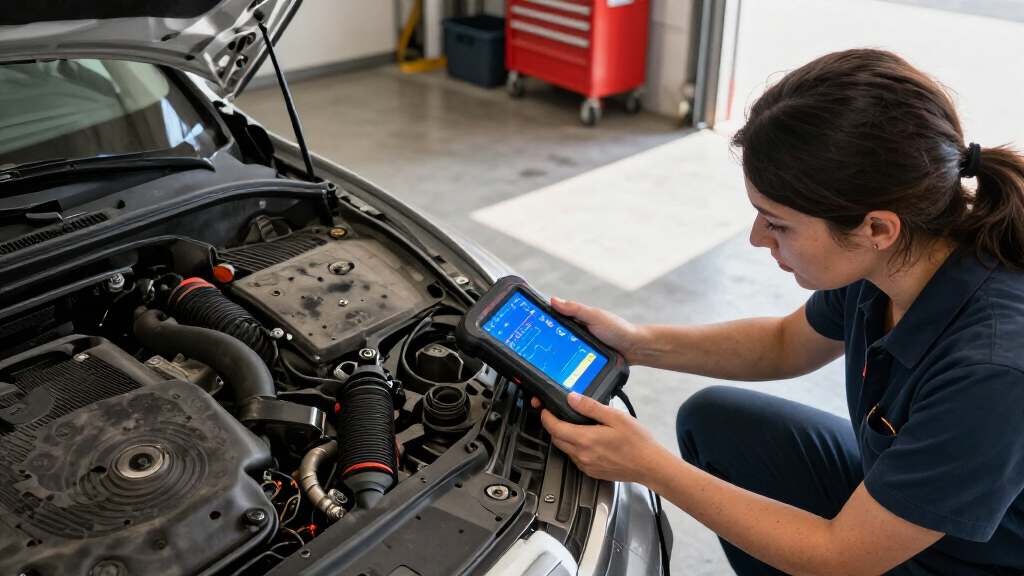
When a warning light appears, the real choice is whether you need a quick explanation or a deeper way to investigate the fault. Basic OBD-II code readers focus on standardized engine and emissions diagnostics. Advanced automotive scan tools may add live data, manufacturer-specific codes, access to systems such as ABS or airbags, and service functions, though coverage varies by tool and vehicle.

Get business pricing on garage and car supplies
- Business-only prices and quantity discounts
- Tax-exempt purchasing
- Multiple users, one account, clear invoices

FOXWELL NT604 Elite OBD2 Scanner for Engine, ABS, SRS, and Transmission Diagnostics
- ✔ Systems: Engine, transmission, ABS, and SRS on supported vehicles
- ✔ Screen: 4.3-inch color display, 480 x 272 resolution
- ✔ Controls: Physical buttons

FOXWELL NT301 OBD2 Diagnostic Scanner with Live Data
- ✔ Brand and model: FOXWELL NT301
- ✔ Screen: 2.8-inch color display
- ✔ Diagnostics: Engine trouble codes, code definitions, supported live data, and I/M readiness

ANCEL AD310 OBD2 Code Reader and Diagnostic Scanner
- ✔ Brand and model: ANCEL AD310
- ✔ Cable length: 2.5 feet
- ✔ Weight: 12 ounces
Basic readers suit owners who want to check a check-engine light before deciding what to do next. Advanced tools make more sense for hands-on owners, repair professionals, or anyone diagnosing faults that a basic reader cannot see. The tradeoff is straightforward: pay less for a narrower but useful answer, or spend more for broader capabilities that require more knowledge and careful compatibility checks.
At a Glance
| Criteria | Basic OBD-II code readers | Advanced automotive scan tools | Winner |
|---|---|---|---|
| Typical code coverage | Standardized powertrain and emissions trouble codes on supported OBD-II vehicles | May include manufacturer-specific powertrain codes and additional modules, depending on tool and vehicle | B |
| Live data and diagnostics | Often shows and clears codes; some models display limited live data and freeze-frame information | Often offers richer live data, graphing, and diagnostic tests | B |
| Vehicle system access | Usually centered on engine and emissions systems | Can cover systems such as ABS, airbag, or transmission when supported | B |
| Service functions | Generally limited; capabilities vary by model | May include functions such as service resets or relearns; availability is model-specific | B |
| Ease of use | Simple controls and focused results suit occasional checks | More menus and terminology create a steeper learning curve | A |
| Vehicle compatibility | Broad baseline compatibility for OBD-II diagnostics, with exceptions by vehicle, market, and model year | Coverage varies substantially; check make, model, year, and function lists before buying | Depends |
| Cost and value | Low purchase cost makes it practical for occasional troubleshooting | Higher upfront cost pays off when broader diagnostics or repeated use matter | Depends |
FOXWELL NT604 Elite OBD2 Scanner for Engine, ABS, SRS, and Transmission Diagnostics
The NT604 Elite is the most capable choice in this group when our diagnostic question extends beyond the check engine light. On supported vehicles it reads codes and live data for the engine, transmission, ABS, and SRS, giving it a much wider scope than the NT301 and AD310. That added access can help us identify which system has registered a fault before deciding whether further diagnosis or professional service is needed.Its 4.3-inch color screen, physical buttons, Quick Scan, and ability to graph and save supported live data make it a self-contained tool; we do not need a phone or app to view results. Wi-Fi updates also make software maintenance more direct. Compared with the NT301, this is the stronger fit when multiple systems matter, though its coverage still varies by vehicle and system.The tradeoff is that broader diagnosis should not be mistaken for advanced repair capability. The NT604 Elite does not provide bidirectional active tests or ECU coding and programming, and it omits service procedures such as ABS bleeding, oil reset, EPB, SAS, and TPMS. We should check coverage for our exact vehicle before buying. For engine-only code reading and readiness checks, the simpler NT301 or AD310 may be a more appropriate match.
Pros:
- Reads codes and supported live data across four vehicle systems.
- Large color display with physical controls works without a phone app.
- Quick Scan and graphing help organize diagnostic information.
- Includes Wi-Fi updates and a protective carrying case.
Cons:
- System coverage and functions depend on the specific vehicle and ECU.
- Does not support bidirectional active tests, coding, or programming.
- Several service functions, including ABS bleeding and oil reset, are unavailable.
Best for: Owners and home mechanics who want engine, ABS, SRS, and transmission code access on a supported vehicle.
Not ideal for: Buyers who need bidirectional tests, coding, programming, ABS bleeding, or broad maintenance resets.
Bottom line: Choose the NT604 Elite for the broadest system coverage here, provided its supported functions match your vehicle and repair needs.
“Choose the NT604 Elite for the broadest system coverage here, provided its supported functions match your vehicle and repair needs.”
FOXWELL NT301 OBD2 Diagnostic Scanner with Live Data
For engine diagnostics, the NT301 gives us more interpretation help than the AD310 while staying within standard OBD2 scope. It reads engine trouble codes, shows code definitions, and graphs supported live parameters. Those graphs can make changing readings easier to follow than a stream of numbers, which is useful when we are investigating an engine issue rather than just checking whether a code is present.Its one-click I/M readiness check uses LED indicators and audible alerts, making the status easy to understand when preparing for an emissions inspection. The 2.8-inch color screen gives readings their own display without relying on a phone. Compared with the NT604 Elite, the NT301 does not expand into ABS, SRS, or transmission systems; in return, it makes sense for buyers whose focus is the engine and emissions checks.We should keep its limits in view: functions vary by vehicle, and permanent trouble codes cannot be erased directly; they clear only after the vehicle completes required checks. It is therefore not a shortcut around a repair or drive cycle. The AD310 is a simpler alternative if code definitions and graphing are unnecessary, while owners who need multi-system access should consider the NT604 Elite after confirming coverage.
Pros:
- Displays engine code definitions to help interpret fault codes.
- Graphs supported live engine parameters.
- Readiness check includes LED indicators and audible alerts.
- Powered through the OBD2 port and includes free software updates.
Cons:
- Vehicle coverage and available functions vary.
- Permanent trouble codes clear only after required vehicle checks.
- Diagnostics are focused on standard OBD2 engine functions.
Best for: Drivers and DIY mechanics who want engine code definitions, graphing for supported live data, and an easy readiness check.
Not ideal for: Those seeking ABS, SRS, or transmission diagnostics, or a tool for service resets and advanced repair procedures.
Bottom line: The NT301 is a practical engine-focused step up from the AD310 when code definitions and live-data graphs are priorities.
“The NT301 is a practical engine-focused step up from the AD310 when code definitions and live-data graphs are priorities.”
ANCEL AD310 OBD2 Code Reader and Diagnostic Scanner
The AD310 is the straightforward pick for owners who mainly want to identify an emissions related engine warning and check basic readiness information. It reads and clears eligible engine trouble codes, and also displays live data, freeze-frame information, and I/M readiness. Because it draws power from the OBD2 connector, there is no separate battery to charge or phone app to set up.Compared with the NT301, the AD310 offers fewer interpretation aids: it does not list code definitions or provide the described live-data graphing. Its compact form and 2.5-foot cable make it easy to handle around the driver’s seat, and broad protocol support helps it work across many compatible OBD2 vehicles. For basic checks, its simpler interface may be enough; for more visual engine troubleshooting, the NT301 is the more informative option.The boundary is important: the AD310 does not diagnose ABS, SRS, transmission, or other non-emissions faults, and it requires an OBD2 interface. It is not compatible with OBD1 vehicles. Buyers who need broader system access should look at the NT604 Elite, while those who want code definitions and graphs should step up to the NT301. We should verify model-year and market compatibility before relying on it.
Pros:
- Reads and clears eligible emissions related engine codes.
- Displays live data, freeze-frame information, and readiness status.
- Compact, lightweight design with a flexible insulated cable.
- Supports major OBD2 protocols and draws power from the vehicle.
Cons:
- Does not diagnose ABS, SRS, transmission, or other non-emissions faults.
- Requires an OBD2 interface and is incompatible with OBD1 vehicles.
Best for: Owners who want a simple, self-powered OBD2 reader for engine codes, freeze-frame details, and emissions readiness.
Not ideal for: Drivers needing ABS, SRS, transmission, OBD1 support, or richer code interpretation and graphing.
Bottom line: Choose the AD310 when core engine and emissions checks are enough and a direct, app-free reader is the priority.
“Choose the AD310 when core engine and emissions checks are enough and a direct, app-free reader is the priority.”
As an Amazon Associate we earn from qualifying purchases.
Key Differences
The defining difference is diagnostic reach. A basic reader can identify many standardized engine and emissions faults, show a code, and help you decide whether further attention is needed. That can be enough to distinguish a loose-fuel-cap type issue from a persistent engine fault, although a code points to a detected condition and does not prove which component has failed. Advanced tools can add context through live sensor readings, more detailed code descriptions, and broader module access. Those extra details help narrow a diagnosis, but they do not automatically make the diagnosis correct.
Broader coverage comes with a compatibility and learning cost. An advanced scanner’s advertised functions may apply only to selected makes, model years, or modules, and some features may require updates, a subscription, or additional setup. Basic readers are easier to use and less expensive, but they may leave you without information when a warning light relates to a system beyond the engine. The better purchase depends on whether you expect to use those extra functions often enough to justify checking compatibility and learning the tool.
Detailed Comparison
Typical code coverage (Advanced automotive scan tools wins — moderate)
Advanced scan tools win by a moderate margin. Both categories can read standardized powertrain codes on supported vehicles, but advanced models may add manufacturer-specific codes and access to other modules. That broader reach is useful when the basic reader reports no engine fault but a warning remains, or when the fault belongs to another system. Coverage depends on the specific tool and vehicle, so a higher price alone does not guarantee access.
Live data and diagnostic context (Advanced automotive scan tools wins — moderate)
Advanced tools win by a moderate margin. A basic reader may provide a code and perhaps a snapshot of engine conditions, enough for an initial check. Advanced models are more likely to show multiple live sensor values, graph readings, or run supported tests. That can help a knowledgeable user see whether a sensor reading changes as expected, while a code alone offers little diagnostic context. More data still needs interpretation and may not identify the failed part by itself.
Vehicle system access (Advanced automotive scan tools wins — major)
Advanced tools win by a major margin for multi-system work. Basic readers generally concentrate on engine and emissions diagnostics. A compatible advanced tool may also query systems such as ABS, airbags, or transmission controls. This matters when diagnosing a warning outside the engine system; it matters little if your only goal is checking a check-engine light. Confirm the exact vehicle and system coverage before purchase.
Service functions (Advanced automotive scan tools wins — moderate)
Advanced tools usually win by a moderate margin. Some support maintenance-related functions, such as particular service resets or relearns, that basic readers typically lack. The practical benefit is convenience for owners or shops carrying out supported work. These functions are not universal: they may be limited to certain vehicles, require a subscription, or need a specific procedure. If you only want to read a fault code, this advantage is unlikely to justify the extra cost.
Ease of use (Basic OBD-II code readers wins — minor)
Basic readers win by a minor margin for occasional users. A focused device with a short menu can make it easier to retrieve and clear a standard code without learning a large set of functions. Advanced scanners offer more information but often present more menus, abbreviations, and settings. That complexity is worthwhile when you will use those options, but it can slow down a first-time user who just wants an initial check.
Compatibility and feature certainty (moderate difference)
The winner depends on the specific purchase. Basic readers tend to offer a predictable baseline for standardized OBD-II engine and emissions checks on supported vehicles. Advanced scanners vary more: one may offer useful access for your make while another omits the module or service function you need. Before paying more, check the manufacturer’s coverage list for your exact model year and the exact task. This research is part of the cost of buying broader capability.
Cost and value (major difference)
Neither category wins for every buyer. A basic reader is better value for an occasional check-engine light because its lower cost buys the core information many owners need. An advanced tool can be better value for frequent troubleshooting, multiple vehicles, or supported repair work, where broader access saves repeated trips or purchases. Pay more only when a listed feature addresses a real task you expect to perform; otherwise, the advanced device’s unused functions add little value.
Basic OBD-II code readers: Pros and Cons
Pros:
- Lower purchase cost for occasional code checks
- Simple operation makes it approachable for first-time users
- Useful baseline access to standardized engine and emissions codes
Cons:
- Usually cannot read faults from many non-engine systems
- Limited live data and diagnostic tests on many models
- A code may identify a symptom without pinpointing the failed component
Advanced automotive scan tools: Pros and Cons
Pros:
- Potentially broader access to vehicle modules and manufacturer-specific codes
- Richer live data and tests can support fault diagnosis
- Some models include useful maintenance and service functions
Cons:
- Higher purchase cost and a steeper learning curve
- Features vary by make, model year, and scanner
- Some functions may require subscriptions, updates, or extra setup
Who Should Choose What
Choose Basic OBD-II code readers if:
- You mainly want to read a check-engine light and decide whether to investigate further.
- You expect to use a scanner only occasionally and want a low-cost tool.
- You prefer a short, simple workflow over a large set of diagnostic menus.
Choose Advanced automotive scan tools if:
- You regularly work on vehicles and can use live data or diagnostic tests.
- You need to check systems beyond engine and emissions, and have verified support for your vehicle.
- You perform supported maintenance work that benefits from a scanner’s service functions.
Skip both if: You need a confirmed repair diagnosis or a safety-critical system assessment but lack the training to interpret scanner data. A qualified mechanic with equipment that supports your vehicle is a better fit.
Value for Money
Paying more is worthwhile when the advanced tool’s specific coverage matches work you will do repeatedly. A home mechanic investigating ABS or transmission faults, or a small shop servicing several supported vehicles, may recover the cost through better access to codes and data. Check compatibility and any subscription terms before buying; broad product descriptions can conceal limits by vehicle or function.
For a driver who wants to check an occasional engine light, a basic reader is usually the stronger value. It supplies a useful first look at much lower cost, even though it cannot replace a full diagnosis. If you are uncertain whether you need advanced features, start by identifying the exact systems and functions you expect to use, then compare models against those requirements.
Final Verdict
For most drivers who want to understand a check-engine light, choose a basic OBD-II code reader. It is affordable, straightforward, and covers the first question many owners have: what standardized engine or emissions fault has been recorded? Treat its result as a starting point, since a trouble code does not by itself confirm which part needs replacement.
Choose an advanced automotive scan tool if you regularly diagnose vehicles, need access to non-engine systems, or will use supported live-data and service functions. Verify that the scanner covers your exact vehicle and task before paying more. The deciding factor is repeated need: if broader diagnostics will change how you work, the added cost can make sense; if you only want an occasional code check, the basic reader is the better buy.
Frequently Asked Questions
Will a basic code reader diagnose why my check-engine light is on?
It can retrieve a stored standardized code and may show freeze-frame data, which helps identify the detected condition. The code is a clue, not a confirmed diagnosis; several faults can trigger similar codes, and further checks may be needed.
Can an advanced scan tool read ABS or airbag faults?
Some models can, but support depends on the scanner and the vehicle’s make, model year, and system. Confirm access to the specific module in the product’s coverage information before buying.
Is a more expensive scanner always better?
No. A higher price may buy broader coverage or useful tests, but only if those features work with your vehicle and match your needs. For occasional engine-code checks, a basic reader often provides better value.
Should I clear a trouble code after reading it?
Record the code and relevant information first. Clearing it can erase useful diagnostic context, and it does not fix the underlying fault. Follow appropriate repair guidance before clearing codes or resetting monitors.