TL;DR

Get business pricing on garage and car supplies
- Business-only prices and quantity discounts
- Tax-exempt purchasing
- Multiple users, one account, clear invoices
Mercedes-Benz’s High-Power Charging network has reached 100 locations across 28 U.S. states and British Columbia, with nearly 1,000 charging ports, according to the company. Launched in November 2023, it now reports a first-time charging success rate above 90%; uptime figures and other operating details were not fully specified in the source report.
Mercedes-Benz’s High-Power Charging network has reached 100 locations in North America, with nearly 1,000 charging ports across 28 U.S. states and British Columbia, according to a report by InsideEVs. The network launched in the United States in November 2023, and the milestone offers an update on the automaker’s charging infrastructure as more EVs use Tesla’s NACS connector alongside CCS.
InsideEVs reported that the network has served more than 245,000 customers over its first three years. Mercedes-Benz says its chargers can deliver up to 400 kilowatts of power. The report describes the network as having nearly 1,000 individual ports, but does not give an exact port count or break down how many are currently available for use.
The company says the network’s first-time success rate—the share of charging sessions that begin successfully on the first attempt—has risen from roughly 84% in 2023 to more than 90%. Mercedes-Benz has also promoted high uptime, although the source report does not provide a current uptime percentage, its measurement period or the methodology behind either performance figure.
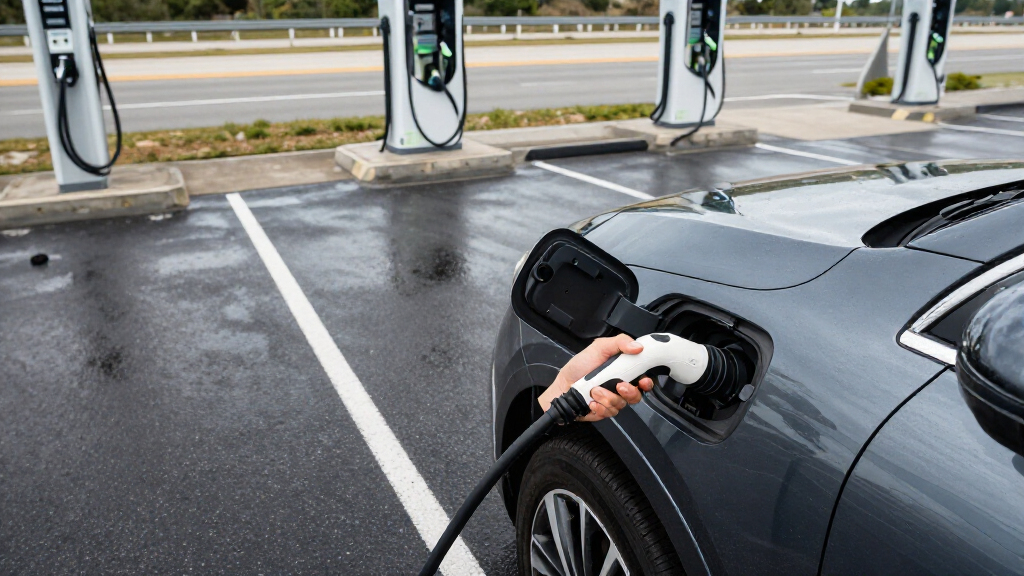
Most locations have both CCS and NACS connectors, according to the company, while 3% of sites have CCS connectors only. The stations use 400-kilowatt dispensers supplied by ChargePoint or Alpitronic and are generally placed at or near premium shopping destinations. The report says the largest site has 20 stalls and is in Orlando, Florida; two smaller sites, in Conyers, Georgia, and Red Bluff, California, have four stalls each.
More Sites, More Connector Choice
Reaching 100 locations gives EV drivers another fast-charging option, but the network’s footprint remains much smaller than a nationwide, coast-to-coast system. Its presence across 28 states and British Columbia marks a multi-state expansion; the source does not provide a map or enough detail to assess how evenly locations are distributed or whether major travel corridors are covered.
Connector availability matters as automakers and charging providers accommodate both CCS and NACS vehicles. The company’s reported mix means most sites offer both plug types directly, while drivers at CCS-only locations may need an adapter if their vehicle uses NACS. The reported improvement in sessions starting on the first try is also relevant to drivers, but it is a company-reported measure, not an independent assessment of reliability.
Products Worth Considering

DEWALT 20V MAX 7-Tool Combo Kit (DCK751P1) – Drill, Impact Driver, Reciprocating Saw, Circular Saw, Oscillating Tool, Random Orbital Sander,

Garmin Dash Cam 47, 1080p HD, 140° Field of View, Voice Control, Includes 16 GB Memory Card

NOCO Boost GB70 2000A 12V Lithium Jump Starter
As an affiliate, we earn on qualifying purchases.
From 2023 Launch to 100 Sites
The network began operating in the United States in November 2023, initially with a handful of locations in a limited number of states. Its growth to 100 locations and nearly 1,000 ports reflects a gradual build-out over three years. The report says the North American network includes British Columbia as well as U.S. sites.
Charging access has become more complex as new EVs increasingly adopt Tesla’s NACS connector, while many existing vehicles use CCS. The source notes that adapters can allow NACS-equipped vehicles to charge at CCS stations, and vice versa, subject to vehicle and equipment compatibility. It also reports that Mercedes-Benz sold its European charging network, while its North American operation continues; details of that European sale are outside the scope of the U.S. milestone.
Drivers can pay by credit card, through charging apps or with an RFID card issued by Mercedes-Benz dealers, and the network supports Plug & Charge. InsideEVs reports that prices range from 35 to 60 cents per kilowatt-hour depending on location. A temporary $25 pre-authorization is placed to verify funds; the driver is charged for energy used after the session, and the remaining amount is released.
“The first-time success rate has become the company’s “guiding star.””
— Mercedes-Benz, as reported by InsideEVs
Performance Data Still Limited
The reported milestone does not establish how many locations are open to the public at all hours, how many ports are operational at a given time or how the network’s coverage compares with competitors. The source also gives no independently verified uptime figure, definition of uptime, or details on how the first-time success rate is calculated and audited. Those limits make direct comparisons with other charging networks difficult.
Pricing varies by site, and the report does not list individual location rates or explain whether rates differ by vehicle, membership status or payment method. It also does not say how many of the network’s nearly 1,000 ports are NACS-only, CCS-only or equipped with both connectors beyond the statement that 3% of locations have CCS only. The company’s overall plans for additional U.S. locations and its investment schedule were not specified.
Expansion Plans Await Detail
Mercedes-Benz High-Power Charging North America appointed Madeline Ebert as CEO in the month before the report, according to InsideEVs. The source does not describe a new expansion target or a change in operating strategy tied to the appointment. The next useful markers for drivers will be any new site announcements, updates to the location map and clearer reporting on uptime and charger availability.
For now, the confirmed development is the network’s 100-location milestone, alongside the company’s reported service and performance figures. Drivers planning a trip should check the current station listing and pricing before traveling, since location-level availability and costs can vary.
Key Questions
How large is Mercedes-Benz’s charging network?
InsideEVs reports 100 locations and nearly 1,000 ports across 28 U.S. states and British Columbia. The source does not provide an exact port total.
How powerful are the chargers?
Mercedes-Benz says its fast chargers can deliver up to 400 kilowatts. Actual charging speed can depend on the vehicle and other conditions; the source does not report typical speeds across the network.
Can NACS and CCS vehicles use the network?
The company says most locations have both NACS and CCS connectors, while 3% have CCS connectors only. Adapters may allow vehicles to use the other connector type, subject to compatibility.
What does Mercedes-Benz report about charging reliability?
The company says its first-time success rate has risen from roughly 84% in 2023 to more than 90%. The source does not provide an independent audit, a current uptime percentage or the measurement methodology.
How much does charging cost?
InsideEVs reports rates of 35 to 60 cents per kilowatt-hour, varying by location. A temporary $25 pre-authorization is released after the session, less the amount charged for energy used.
Source: insideevs.com