TL;DR

Get business pricing on garage and car supplies
- Business-only prices and quantity discounts
- Tax-exempt purchasing
- Multiple users, one account, clear invoices
Mercedes-Benz is developing a Power Converter system that could control the charging and discharging of individual battery cells or cell groups. The company says the approach may improve battery flexibility, lifespan and efficiency, but it remains in development and its reliability, cost and production plans have not been disclosed.
Mercedes-Benz is developing a Power Converter that could control how individual battery cells or cell groups charge and discharge, a departure from the pack-level approach used by most electric vehicles today. The company says the system could support longer battery life, different cell chemistries in one pack and bidirectional charging, but it has not announced a production model or timetable.
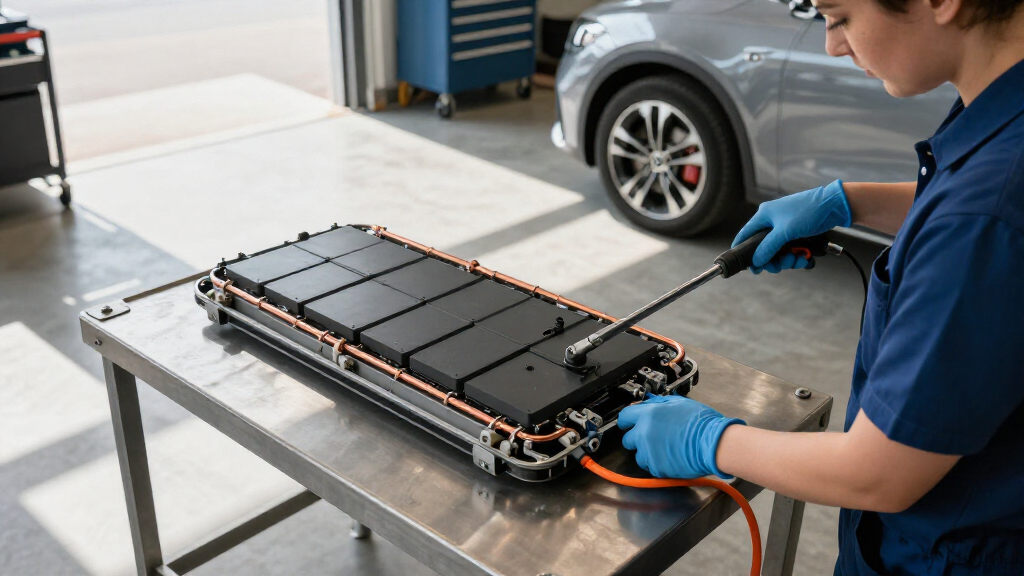
In conventional EV battery packs, management systems can monitor individual cells or modules, but the pack generally handles charging and power delivery as a coordinated unit. Mercedes’ proposed system would add programmable micro-converters that regulate energy flow for individual cells or groups. According to the report by InsideEVs, the technology is still in development.
That control could allow cells with different chemistries or ages to operate together while receiving different power levels. Mercedes’ concept could also let a vehicle put part of a battery in standby when the driver does not need its full capacity, then make that capacity available for a longer trip. The report says the converters would handle AC and DC conversion and support bidirectional charging, in which energy can flow both into and out of the vehicle.
A further proposed use is to isolate a cell that can no longer maintain the required voltage. Rather than having that cell affect the rest of the pack, its converter could disable it. This might let the vehicle continue operating with reduced capacity, but Mercedes has not provided test results showing how this would work in practice or how much capacity could be lost.
Potential Gains, With Reliability Questions
Controlling battery cells individually could give automakers more options to manage aging, usable capacity and power delivery. If a weak cell can be isolated without taking the whole pack out of service, the system might reduce the need for a full battery replacement in some circumstances. That could matter to owners facing costly repairs after a battery warranty expires, though the source material does not establish that the technology will reduce repair costs.
The design also carries a trade-off: thousands of converters inside a sealed pack would add components that could themselves fail. The technology’s practical value will depend on the converters’ durability, the consequences of faults, and whether the system can be serviced economically. These questions matter as much as the proposed flexibility, particularly because a battery pack is a complex, safety-critical vehicle system.
Mercedes says the technology could improve range and efficiency in future plug-in models. Those are potential benefits, not demonstrated outcomes: no measured range improvement, efficiency figure, cost estimate or production validation is provided in the report.
Products Worth Considering

Autel MaxiCharger AC Home Level 2 EV Charger, 50A, J1772, Hardwired, 25-Foot Cable

Autel MaxiCharger Level 2 EV Charger, 80A, Hardwired, J1772

Autel Level 2 Smart EV Charger, 50 Amp, 240V, NACS Connector, 25-Foot Cable
As an affiliate, we earn on qualifying purchases.
From Pack-Level Control to Cells
EV traction batteries contain many individual cells arranged into groups or modules. Battery-management systems monitor the pack and its components, while power electronics manage energy conversion and delivery. In the approach described by InsideEVs, Mercedes would distribute some of that control across micro-converters within the pack, rather than relying on one large converter to govern energy flow.
The proposal is not a confirmed change to a vehicle currently on sale. The report describes a development-stage technology, and gives no named production vehicle or release date. Its capabilities should be read as intended or potential functions until Mercedes provides specifications and evidence from testing.
“The new technology has the potential to boost the driving range and efficiency of future plug-in models.”
— Mercedes-Benz, as quoted in the InsideEVs report
Key Engineering Details Still Missing
Mercedes has not disclosed when the Power Converter might reach production, which vehicles could use it, or whether it is intended for battery-electric vehicles, plug-in hybrids or both. The source also provides no figures for cost, weight, durability or efficiency gains, and no test results for operating cells of different chemistries or ages together.
It is also unclear how many converters a pack would require, how failed converters would be diagnosed or replaced, and whether a faulty unit could affect nearby components. The report identifies the added component count as a reliability concern, but offers no failure-rate data. The claimed ability to disable a weak cell without replacing the full pack remains a proposed capability, not a confirmed repair outcome.
Awaiting Tests and Production Plans
The next meaningful update would be evidence that the system has moved beyond development, such as test results, technical specifications or confirmation of a vehicle application. Mercedes has not supplied a timetable in the material reported by InsideEVs. Until the company releases those details, the technology’s real-world benefits and reliability remain unverified.
Key Questions
What is Mercedes-Benz’s Power Converter?
It is a development-stage system using programmable micro-converters to control energy flow for individual battery cells or cell groups.
Could it make an EV battery last longer?
Mercedes’ approach could isolate a cell that cannot maintain the required voltage, potentially allowing the rest of the pack to keep operating. The report gives no test data proving longer battery life or showing how much capacity would remain.
Could different battery chemistries work in one pack?
The proposed converters could regulate cells or groups at different power levels, which Mercedes’ concept says may allow different chemistries or ages in one pack. Whether that is practical in a production vehicle has not been established.
When will the technology appear in a Mercedes vehicle?
No production vehicle or launch date has been announced in the source material. The Power Converter is described as still in development.
What is the main concern with the design?
A pack containing thousands of micro-converters could have many additional components that might fail. Mercedes has not released reliability, serviceability or cost data to show how that risk would be managed.
Source: insideevs.com