Car battery testers help distinguish a weak battery from a charging-system problem, but the right model depends on the vehicles and checks you need. I rank the FOXWELL BT705 as the best overall for its battery, alternator, and load-testing scope, while the TOPDON BT600 stands out for its color screen and built-in printer, and the ACCLOPE BT60 PRO for its broad voltage and CCA range. The main tradeoffs are vehicle coverage versus simplicity, and whether printouts or advanced reporting justify a more elaborate tester. Some options focus on straightforward 12V checks; others support 6V or 24V systems and add reporting features. Read on for the full breakdown and advice on matching a tester to your batteries.

Get business pricing on garage and car supplies
- Business-only prices and quantity discounts
- Tax-exempt purchasing
- Multiple users, one account, clear invoices
Complete the kit


Key Takeaways
- The FOXWELL BT705 earns the overall lead by combining battery, alternator, and load checks, making it a more rounded choice than a basic 12V tester.
- Voltage range changes who can use a tester: the ACCLOPE BT60 PRO and VDIAGTOOL BT500 cover 6V, 12V, and 24V systems, while several alternatives are aimed at 12V vehicles.
- Built-in printing is a specialist feature, not a default need: the TOPDON BT600 and OBDMATE BT770 suit buyers who want physical test records, but add complexity compared with simpler handheld options.
- CCA range and battery compatibility matter more than a long feature list: a tester must support the battery type and rating being checked to produce useful results.
- The lineup splits between simple checks and broader diagnostics: models such as the ANCEL BA101 and TOPDON BT100 suit focused 12V use, while multi-voltage testers fit mixed-vehicle needs better.
| FOXWELL BT705 12V/24V Car Battery, Alternator, and Load Tester |  | Best for 12V/24V Coverage | Supported voltage: 12V and 24V | CCA range: 100–2000 CCA | Battery types: Flooded, AGM, GEL, and EFB lead-acid | VIEW LATEST PRICE | See Our Full Breakdown |
| VDIAGTOOL BT500 6V/12V/24V Automotive Battery and Charging System Tester |  | Best for Broad Vehicle Compatibility | Supported voltage: 6V, 12V, and 24V | CCA range: 5–3000 CCA | Supported battery types: Flooded lead-acid, AGM flat plate, AGM spiral, GEL, and EFB | VIEW LATEST PRICE | See Our Full Breakdown |
| ANCEL BA101 12V Car Battery Tester |  | Best for Protected 12V Testing | Voltage: 12V | CCA range: 100–2000 CCA | Minimum battery capacity: 30Ah | VIEW LATEST PRICE | See Our Full Breakdown |
| MOTOPOWER MP0515A 12V Automotive Battery Tester, 100–2000 CCA |  | Best Compact Pick | Model: MP0515A | Operating voltage: 12V | CCA range: 100–2000 CCA | VIEW LATEST PRICE | See Our Full Breakdown |
| VEHLIVE BT900 Car Battery Tester for 6V and 12V Lead-Acid Batteries |  | Best for Guided Results and Reach | Supported voltage: 6V and 12V | CCA range: 5–3000 CCA | Battery types: Flooded, AGM flat, AGM spiral, GEL, and EFB | VIEW LATEST PRICE | See Our Full Breakdown |
| ACCLOPE BT60 PRO Battery Tester, 6V/12V/24V, 100–3000 CCA |  | Best for Broad Battery Coverage | Battery voltage: 6V, 12V, and 24V | CCA range: 100–3000 CCA | Battery capacity: 2–120Ah | VIEW LATEST PRICE | See Our Full Breakdown |
| BR502 Car Battery Tester – 6V/12V/24V, 100‑2000 CCA Internal Resistance & Voltage Analyzer |  | Best Compact Basic Analyzer | Battery voltage: 6V, 12V, and 24V | CCA range: 100–2000 CCA | Supported battery types: Flooded, AGM, and gel | VIEW LATEST PRICE | See Our Full Breakdown |
| GOOLOO ST5 12V/24V Car Battery Tester |  | Best for Cranking and Charging Checks | Battery voltage compatibility: 12V battery testing; 12V and 24V cranking and charging tests | CCA range: 100–2000 CCA | Supported battery types: Flooded, AGM, GEL, and EFB | VIEW LATEST PRICE | See Our Full Breakdown |
| TOPDON BT600 12V/24V Car Battery Tester with 3.5″ Color Screen and Built-In Printer |  | Best for Printed Shop Reports | Battery voltage: 12V and 24V | CCA range: 100–2000 A | Supported battery types: Flooded, AGM Flat, AGM Spiral, GEL, and EFB | VIEW LATEST PRICE | See Our Full Breakdown |
| MOTOPOWER MP0514A 12V Digital Car Battery and Charging System Tester |  | Best Simple Voltage Checker | Compatible systems: Vehicles with 12V batteries | Testing voltage range: 4–20V DC | Display: Four-digit digital LCD | VIEW LATEST PRICE | See Our Full Breakdown |
| UHANBUT 12V Car Battery and Alternator Tester |  | Best for Quick Voltage Checks | Operating voltage: 12 V | Measurement type: Voltmeter | Display: LED | VIEW LATEST PRICE | See Our Full Breakdown |
| TOPDON BT200 Car Battery Tester, 12V/24V, 100-2000 CCA Load Tester | 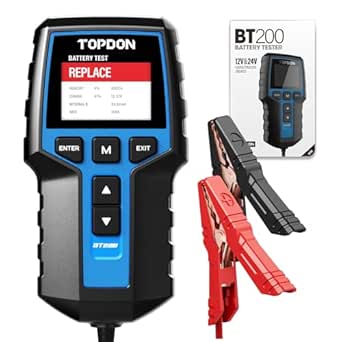 | Best for 12V and 24V Diagnostics | Supported system voltage: 12 V and 24 V | CCA range: 100–2000 CCA | Tests: Cranking, charging, and load | VIEW LATEST PRICE | See Our Full Breakdown |
| TOPDON BT100 12V Car Battery Tester |  | Best Compact Diagnostic Pick | Model: BT100 | Operating voltage: 12 V | CCA range: 100–2000 CCA | VIEW LATEST PRICE | See Our Full Breakdown |
| OBDMATE BT770 12V/24V Battery Tester with Thermal Printer |  | Best for Printed Test Reports | Model: BT770 | Battery testing voltage: 12 V | Battery CCA range: 100–2000 CCA | VIEW LATEST PRICE | See Our Full Breakdown |
| AUTOOL 0–80V Automotive Battery Tester with Built-In Printer |  | Best for Broad Voltage Coverage and Records | Voltage range: 0–80 V | CCA test range: 30–2000 CCA | Tests: Battery health, cranking, charging, load, and leakage current | VIEW LATEST PRICE | See Our Full Breakdown |
| car battery tester | CCA range | Display | Power source |
|---|---|---|---|
| FOXWELL BT705 12V/24V Car Batt | 100–2000 CCA | 2.8-inch screen | Corded electric |
| VDIAGTOOL BT500 6V/12V/24V Aut | 5–3000 CCA | — | Test battery; no charging required |
| ANCEL BA101 12V Car Battery Te | 100–2000 CCA | Black-and-white screen with adjustable contrast and white backlight | — |
| MOTOPOWER MP0515A 12V Automoti | 100–2000 CCA | — | Battery powered |
| VEHLIVE BT900 Car Battery Test | 5–3000 CCA | — | Battery powered |
| ACCLOPE BT60 PRO Battery Teste | 100–3000 CCA | 3.2-inch HD screen | — |
| BR502 Car Battery Tester | 100–2000 CCA | 1.8-inch HD screen | — |
| GOOLOO ST5 12V/24V Car Battery | 100–2000 CCA | 2.4-inch color LCD, 128 × 64 | Battery powered |
| TOPDON BT600 12V/24V Car Batte | 100–2000 A | — | Battery powered |
| MOTOPOWER MP0514A 12V Digital | — | Four-digit digital LCD | — |
| UHANBUT 12V Car Battery and Al | — | LED | Battery powered |
| TOPDON BT200 Car Battery Teste | 100–2000 CCA | Sunlight-readable color LCD | Battery powered; requires its own batteries |
| TOPDON BT100 12V Car Battery T | 100–2000 CCA | — | — |
| OBDMATE BT770 12V/24V Battery | — | 2.8-inch color LCD | — |
| AUTOOL 0–80V Automotive Batter | — | 3.2-inch color backlit display | Battery powered |
More Details on Our Top Picks
FOXWELL BT705 12V/24V Car Battery, Alternator, and Load Tester
The FOXWELL BT705 is a strong fit for owners or shops that need one tester for both 12V and 24V lead-acid systems. It checks battery condition, cranking performance, and charging output, so it can help separate a weak battery from a charging-system problem. Its 5.9-foot cable makes it easier to keep the screen in view while testing from the driver’s seat, and guided prompts make the readings more approachable than a bare-bones analyzer. Compared with the 12V-only ANCEL BA101, the BT705 covers more vehicle electrical systems; the VDIAGTOOL BT500 adds 6V support and a wider CCA range, however. This FOXWELL remains limited to lead-acid batteries, and its corded setup is less convenient to store and handle than a compact battery-powered unit.
Pros:- Tests 12V and 24V lead-acid systems
- Checks battery health, cranking performance, and charging output
- Long cable supports viewing results from the driver’s seat
- Guided prompts, protective housing, and hard carrying case
Cons:- Does not support lithium battery types
- Does not test 6V systems
- Corded electric setup may be less convenient to handle and store
Best for: Owners of 12V cars and 24V trucks who want guided battery, cranking, and charging checks in one tester.
Not ideal for: Drivers with lithium batteries or 6V vehicles, since this tester supports only 12V and 24V lead-acid systems.
- Supported voltage:12V and 24V
- CCA range:100–2000 CCA
- Battery types:Flooded, AGM, GEL, and EFB lead-acid
- Measurements:CCA, voltage, internal resistance, state of health, cranking performance, and charging output
- Display:2.8-inch screen
- Test cable:5.9 ft
- Power source:Corded electric
Our verdict“Choose the FOXWELL BT705 if you need guided testing across 12V cars and 24V vehicles, but skip it for lithium or 6V batteries.”
VDIAGTOOL BT500 6V/12V/24V Automotive Battery and Charging System Tester
For a household or service bay with cars, motorcycles, boats, and heavier vehicles, the VDIAGTOOL BT500 has the broadest voltage coverage in this group: 6V, 12V, and 24V. It also covers several lead-acid formats and tests battery, cranking, and charging systems, while its 5–3000 CCA range spans more ratings than the FOXWELL BT705 or ANCEL BA101. Protective circuitry and a shock-resistant, anti-slip body suit frequent handling, and the display supports 12 languages. That flexibility asks more of the user, though: accurate results depend on entering the right battery type, standard, and CCA value. Unlike the 12V-focused MOTOPOWER MP0515A, this is not the simplest match for someone who only wants occasional checks on a car. It also excludes lithium, deep-cycle, and golf-cart batteries.
Pros:- Supports 6V, 12V, and 24V systems
- Broad 5–3000 CCA range
- Tests battery, cranking, and charging systems
- Protective circuitry, shock-resistant body, and 12-language support
Cons:- Does not support lithium, deep-cycle, or golf-cart batteries
- Results depend on correctly entering battery type, rating standard, and CCA
- Broader setup may be more than a single-car owner needs
Best for: DIY mechanics and small workshops checking different 6V, 12V, and 24V lead-acid vehicles, including motorcycles, trucks, ATVs, and boats.
Not ideal for: Owners of lithium, deep-cycle, or golf-cart batteries, or car owners who want a simple tester without battery-standard setup.
- Supported voltage:6V, 12V, and 24V
- CCA range:5–3000 CCA
- Supported battery types:Flooded lead-acid, AGM flat plate, AGM spiral, GEL, and EFB
- Tests and measurements:Battery, cranking, and charging tests; voltage, resistance, SOH, and SOC
- Compatible vehicles:Cars, trucks, motorcycles, SUVs, ATVs, and boats
- Protection:Five-in-one protection, including reverse polarity and short circuit
- Body:Shock-resistant ABS with anti-slip design
- Power source:Test battery; no charging required
Our verdict“Pick the BT500 for varied lead-acid vehicles and voltage systems, but choose a simpler 12V tester if you only maintain one car.”
ANCEL BA101 12V Car Battery Tester
The ANCEL BA101 is a practical choice for a 12V car owner who wants battery and charging checks without paying for voltage coverage they will not use. It reads SOH, SOC, voltage, current, and CCA, and can also check cranking and charging systems. Its four electrical protections—including reverse-polarity and overvoltage protection—add a useful safeguard when connecting clips, while the adjustable-contrast backlit display helps in dim engine bays. Compared with the wider-ranging VDIAGTOOL BT500, the BA101 is limited to 12V and a 100–2000 CCA range; it also will not handle batteries below 30Ah, which rules out some smaller motorcycle batteries. The FOXWELL BT705 is the better match for 24V vehicles, but the ANCEL’s compact, lightweight format is more suited to routine checks on compatible 12V vehicles.
Pros:- Checks battery condition and cranking and charging systems
- Backlit display with adjustable contrast
- Reverse-polarity, short-circuit, overcurrent, and overvoltage protection
- Supports several 12V lead-acid battery types and testing standards
Cons:- Limited to 12V systems and does not support lithium
- Not suitable for batteries below 30Ah
- Correct results depend on entering battery type, rating, and temperature
Best for: Car owners who want a lightweight 12V tester with battery, cranking, and charging checks plus built-in connection protections.
Not ideal for: Motorcycle owners with batteries under 30Ah, lithium-battery users, or anyone needing a 6V or 24V tester.
- Voltage:12V
- CCA range:100–2000 CCA
- Minimum battery capacity:30Ah
- Battery types:Flooded, AGM, GEL, and EFB
- Supported standards:JIS, EN, DIN, SAE, BCI, GB, CA, MCA, and IEC
- Measurements:SOH, SOC, voltage, current, CCA, cranking, and charging system tests
- Display:Black-and-white screen with adjustable contrast and white backlight
- Protection:Reverse polarity, short circuit, overcurrent, and overvoltage
Our verdict“Choose the BA101 for protected, routine testing of compatible 12V lead-acid batteries, not for smaller motorcycle batteries or mixed-voltage vehicles.”
MOTOPOWER MP0515A 12V Automotive Battery Tester, 100–2000 CCA
The MOTOPOWER MP0515A keeps the job focused: it checks 12V car batteries and evaluates battery, cranking, and charging-system performance. Its compact body and 340 g weight make it an easy unit to keep with roadside tools, and the included storage bag gives the tester and leads a place to stay together. Compared with the feature-rich VDIAGTOOL BT500, it trades broad 6V/12V/24V compatibility and support for more vehicle types for a narrower car-battery role. That is a sensible exchange for drivers who only need checks on 12V vehicles, but it leaves owners of 24V trucks, 6V systems, or other battery applications needing a different model. The supplied data also gives less detail about battery chemistry support and display features than the ANCEL BA101, so buyers seeking specific compatibility guidance may prefer that alternative.
Pros:- Tests battery, cranking, and charging-system performance
- Compact dimensions and 340 g weight suit a vehicle tool kit
- Supports 100–2000 CCA batteries
- Includes a storage bag and instruction manual
Cons:- Limited to 12V car batteries
- Product data does not specify support for a range of battery chemistries
- Fewer stated display and measurement details than the ANCEL BA101
Best for: Drivers who want a small, straightforward tester to keep in a car kit for checking 12V automotive batteries and charging systems.
Not ideal for: Owners of 6V or 24V vehicles, or buyers who need clearly specified support for multiple battery chemistries and advanced readouts.
- Model:MP0515A
- Operating voltage:12V
- CCA range:100–2000 CCA
- Tests:Battery, cranking, and charging system performance
- Measurement type:Multimeter
- Power source:Battery powered
- Weight:340 g
- Included components:Battery tester, storage bag, and instruction manual
Our verdict“Pick the MP0515A for compact 12V car checks, but choose a broader tester if you maintain multiple vehicle voltages or need explicit chemistry support.”
VEHLIVE BT900 Car Battery Tester for 6V and 12V Lead-Acid Batteries
The VEHLIVE BT900 suits drivers who want the display to guide their next step rather than leave them to interpret readings alone. It tests battery health, cranking voltage, and charging output, with color-coded results and setup prompts for several lead-acid types and rating standards. Its 8.2-foot cable is the longest stated in this group, giving extra room to view the tester from the driver’s seat during charging checks. Compared with the FOXWELL BT705, it adds 6V compatibility and a wider 5–3000 CCA range, but gives up 24V support. The BT500 also handles 6V and offers 24V coverage, making it more versatile for mixed fleets; the BT900’s longer cable and next-step guidance may appeal more to home users. It still excludes lithium batteries.
Pros:- Tests battery health, cranking voltage, and charging output
- Color-coded results include next-step guidance
- 8.2-foot cable supports viewing the display from the driver’s seat
- Supports 6V and 12V lead-acid batteries across a 5–3000 CCA range
Cons:- Does not support 24V systems
- Not compatible with lithium batteries
- Battery chemistry coverage is limited to listed lead-acid types
Best for: DIY owners of 6V and 12V lead-acid vehicles who value guided, color-coded results and extra cable reach for one-person checks.
Not ideal for: Owners of 24V vehicles or lithium batteries, and fleet users who need one tester for 6V, 12V, and 24V systems.
- Supported voltage:6V and 12V
- CCA range:5–3000 CCA
- Battery types:Flooded, AGM flat, AGM spiral, GEL, and EFB
- Measurements:Voltage, CCA, internal resistance, cranking voltage, charging voltage, and ripple
- Cable length:8.2 ft (2.5 m)
- Operating voltage range:5–16V
- Power source:Battery powered
- Excluded compatibility:24V systems and lithium batteries
Our verdict“Choose the BT900 for guided 6V or 12V testing with generous cable reach, but select the BT500 if you also need 24V coverage.”
ACCLOPE BT60 PRO Battery Tester, 6V/12V/24V, 100–3000 CCA
The ACCLOPE BT60 PRO has the widest stated CCA range in this group and covers 6V, 12V, and 24V systems, making it a flexible choice for owners of cars, motorcycles, and compatible heavier vehicles. Its dedicated 6V mode and measurements of health, charge, resistance, and CCA on supported lead-acid batteries go beyond the voltage-only checks from the MOTOPOWER MP0514A. QR-code result sharing also helps keep records without installing an app. The tradeoff is that LiFePO4 checks are limited to voltage and health, and this is a conductance tester—not a carbon pile load tester or diagnostic code reader. Buyers with 48V systems should look elsewhere.
Pros:- Tests 6V, 12V, and 24V systems, with a dedicated 6V motorcycle mode.
- Measures SOH, SOC, voltage, resistance, and CCA on supported lead-acid batteries.
- QR-code result sharing supports record-keeping without an app.
- Built-in LED light, long cable, and recent-result memory aid testing and tracking.
Cons:- Does not support 48V systems.
- LiFePO4 testing is limited to voltage and health; precise CCA is not guaranteed.
- Does not perform carbon pile load tests or read and clear diagnostic trouble codes.
Best for: Drivers or small repair shops that need one conductance tester for compatible 6V, 12V, and 24V lead-acid batteries, including motorcycle batteries.
Not ideal for: Owners of 48V systems, LiFePO4 users who need dependable CCA readings, or mechanics seeking a load tester or OBD2 code reader.
- Battery voltage:6V, 12V, and 24V
- CCA range:100–3000 CCA
- Battery capacity:2–120Ah
- Supported battery types:Lead-acid, flooded, AGM, GEL, EFB, and lithium
- Lead-acid measurements:SOH, SOC, voltage, resistance, and CCA
- LiFePO4 testing:Voltage and health checks; precise CCA is not guaranteed
- Display:3.2-inch HD screen
- Result sharing:QR code cloud printing; no app required
- Power and housing:Powered by clamps; shock-resistant ABS housing
Our verdict“Choose the BT60 PRO if you need broad voltage and CCA coverage plus shareable test records, but not if you need 48V or load-testing capability.”
BR502 Car Battery Tester – 6V/12V/24V, 100‑2000 CCA Internal Resistance & Voltage Analyzer
The BR502 keeps its job straightforward: it checks 6V, 12V, and 24V batteries and reports state of health, state of charge, voltage, and internal resistance. Its compact body and plug-and-play setup suit owners who want a portable analyzer rather than the larger screen and reporting extras of the ACCLOPE BT60 PRO. It covers common flooded, AGM, and gel batteries up to 2000 CCA, so it can serve a broad mix of cars, motorcycles, boats, and trucks. The smaller 1.8-inch display means less room for results, and there is no test-history storage or wireless sharing. Clamp contact also matters: loose connections can make the screen flicker, so this is best for users willing to attach the clamps carefully.
Pros:- Supports 6V, 12V, and 24V batteries up to 2000 CCA.
- Reports battery health, charge, voltage, and internal resistance.
- Compact dimensions make it easy to store in a vehicle or toolbox.
- Polarity reversal protection helps reduce the risk of connection mistakes.
Cons:- The 1.8-inch screen is smaller than the displays on the GOOLOO ST5 and ACCLOPE BT60 PRO.
- No data storage or wireless connectivity for keeping test records.
- Loose clamp connections can cause screen flicker.
Best for: DIY owners who want a small, no-frills tester for common 6V, 12V, or 24V flooded, AGM, or gel batteries across several vehicle types.
Not ideal for: Repair shops or fleet owners who need saved test histories, wireless reporting, a larger display, or CCA coverage above 2000.
- Battery voltage:6V, 12V, and 24V
- CCA range:100–2000 CCA
- Supported battery types:Flooded, AGM, and gel
- Measurements:State of health, state of charge, voltage, and internal resistance
- Display:1.8-inch HD screen
- Compatible devices:Cars, trucks, SUVs, ATVs, boats, and motorcycles
- Dimensions:4.72 × 0.79 × 2.56 inches
- Protection:Polarity reversal protection
- Model:OBDResource BR502
Our verdict“Pick the BR502 for portable, basic battery analysis across several system voltages, and skip it if you need reporting or a larger interface.”
GOOLOO ST5 12V/24V Car Battery Tester
The GOOLOO ST5 stands out for checking more than battery condition: it runs battery tests on 12V batteries and cranking and charging tests on 12V and 24V systems. That distinction makes it a better fit than the BR502 for someone troubleshooting a vehicle’s starting or charging system, though the BR502 also tests 6V batteries and reports internal resistance. The ST5 supports flooded, AGM, GEL, and EFB batteries, with a color display and carrying bag for mobile use. Its key limitation is easy to miss: battery condition testing is 12V only, even though cranking and charging checks extend to 24V. It is not the most versatile choice for 6V batteries or a mixed-voltage battery-testing workflow.
Pros:- Checks battery condition on 12V systems and cranking and charging on 12V and 24V systems.
- Supports flooded, AGM, GEL, and EFB batteries from 100 to 2000 CCA.
- Color LCD makes results easier to read than the BR502’s smaller screen.
- Includes a carrying bag and reverse polarity protection.
Cons:- Battery condition testing is limited to 12V batteries.
- Does not support 6V systems, unlike the BR502 and ACCLOPE BT60 PRO.
- Its functions and supported voltage vary by test type, which limits its use as a single tester for mixed-voltage battery diagnostics.
Best for: DIY vehicle owners who mainly test 12V lead-acid batteries and also want to check cranking and charging behavior on 12V or 24V vehicles.
Not ideal for: Motorcycle owners with 6V batteries or users who need 24V battery-condition testing rather than cranking and charging checks.
- Battery voltage compatibility:12V battery testing; 12V and 24V cranking and charging tests
- CCA range:100–2000 CCA
- Supported battery types:Flooded, AGM, GEL, and EFB
- Battery standards:CCA, CA, BCI, MCA, DIN, IEC, EN, SAE, JIS, and GB
- Display:2.4-inch color LCD, 128 × 64
- Power source:Battery powered
- Dimensions:7.40 × 4.06 × 1.42 inches
- Included components:Tester, quick reference guide, and carrying bag
Our verdict“Choose the ST5 if your priority is 12V battery testing plus 12V/24V cranking and charging checks, not 6V or 24V battery-condition analysis.”
TOPDON BT600 12V/24V Car Battery Tester with 3.5″ Color Screen and Built-In Printer
For workshops that need a paper record at the vehicle, the TOPDON BT600 is the clear reporting pick here: its built-in thermal printer produces hard-copy results without a separate printer. The 3.5-inch color screen is also larger than the GOOLOO ST5’s, giving technicians more room to read results while checking supported 12V and 24V lead-acid batteries. It covers health, CCA, cranking, and charging diagnostics across flooded, AGM, GEL, and EFB types. Compared with the ACCLOPE BT60 PRO, however, it does not offer 6V testing or the higher stated CCA ceiling. Its USB connection is for firmware updates through Windows, not a broad data-export system, so buyers seeking digital records across other platforms may prefer a different workflow.
Pros:- Built-in thermal printer creates paper reports at the vehicle.
- Large 3.5-inch color screen makes readings easier to view.
- Checks health, CCA, cranking, and charging on supported 12V and 24V batteries.
- Supports several common lead-acid types, including AGM Spiral and EFB.
Cons:- Does not support 6V batteries, unlike the ACCLOPE BT60 PRO and BR502.
- Firmware updates require a Windows PC.
- Its listed CCA range ends at 2000, below the ACCLOPE BT60 PRO’s stated ceiling.
Best for: Independent repair shops and mobile technicians who test 12V and 24V lead-acid batteries and want immediate printed reports for job records.
Not ideal for: Owners of 6V batteries, users needing CCA coverage above 2000, or technicians who require firmware updates from a non-Windows computer.
- Battery voltage:12V and 24V
- CCA range:100–2000 A
- Supported battery types:Flooded, AGM Flat, AGM Spiral, GEL, and EFB
- Measurements and diagnostics:Battery health, CCA, cranking, and charging system diagnostics
- Screen:3.5-inch color display
- Printer:Built-in thermal printer using thermal-sensitive paper
- USB port:Mini-USB for Windows firmware updates
- Weight:1.29 kg
- Power source:Battery powered
Our verdict“Choose the BT600 if paper reports and a large screen matter more than 6V support or cross-platform digital record keeping.”
MOTOPOWER MP0514A 12V Digital Car Battery and Charging System Tester
The MOTOPOWER MP0514A is the simplest tool in this group: it reads 12V battery and alternator voltage rather than estimating CCA, internal resistance, or battery health like the BR502. That narrower role can suit drivers who want a quick check before starting the vehicle and a charging-system reading after it is running, without working through a broader analyzer’s menus. A four-digit LCD, colored LEDs, reverse-connection protection, and a 50 cm extension cable make the basic readout easier to use around the battery. The limitation is the same reason it costs less in capability: it is designed for 12V systems and does not offer the multi-voltage, battery-condition measurements available from the ACCLOPE BT60 PRO or GOOLOO ST5.
Pros:- Checks battery voltage without starting the vehicle and alternator voltage with the engine running.
- Four-digit LCD and eight colored LEDs give both numerical and visual readings.
- Reverse-connection and over-voltage protection help guard against connection errors.
- Lightweight design includes a 50 cm extension cable and 30A alligator clips.
Cons:- Designed for 12V vehicles and does not support 6V or 24V systems.
- Does not provide CCA, state-of-health, state-of-charge, or internal-resistance measurements.
- The 4–20V DC range limits its use to voltage checks within that span.
Best for: 12V car owners who want a straightforward battery-voltage and alternator-voltage check without CCA or battery-health analysis.
Not ideal for: Owners of 6V or 24V vehicles, or anyone who needs CCA, state-of-health, state-of-charge, or internal-resistance results.
- Compatible systems:Vehicles with 12V batteries
- Testing voltage range:4–20V DC
- Display:Four-digit digital LCD
- Voltage accuracy:0.01V
- Indicators:Eight colored LEDs
- Cable length:50 cm
- Weight:150 g
- Protection:Reverse connection and over-voltage protection
- Model:MOTOPOWER MP0514A
Our verdict“Pick the MP0514A for basic 12V battery and alternator voltage checks, but choose a CCA analyzer if you need battery-condition results.”
UHANBUT 12V Car Battery and Alternator Tester
The UHANBUT is the simplest choice here for a quick read on a compatible 12V system. Its LED screen reports voltage, battery health, and charging status, while the full, high, low, and empty indicators make a basic check easier to interpret than a bare voltmeter reading. Compared with the TOPDON BT100, it offers less diagnostic depth: the BT100 adds cranking tests and supports several battery types across a stated CCA range. UHANBUT’s appeal is its compact, lightweight format and protective features, including reverse-connection and over-voltage protection. The tradeoff is that it is limited to 12V batteries and still depends on correctly attaching the red and black clips. I’d choose it for simple checks, not fault-finding that calls for more detailed test results.
Pros:- Displays voltage, battery health, and charging status in one basic check
- LED condition indicators are straightforward to read
- Reverse-connection and over-voltage protection are included
- Compact 81 g design suits storage in a vehicle kit
Cons:- Limited to 12V battery systems
- Does not list cranking tests or a CCA measurement range
- Clip polarity must be connected correctly
Best for: Drivers who want a compact tester for basic voltage, battery-condition, and charging-status checks on 12V cars, motorcycles, boats, or trucks.
Not ideal for: DIY mechanics who need cranking or load-test results, a specified CCA range, or support for 24V systems.
- Operating voltage:12 V
- Measurement type:Voltmeter
- Display:LED
- Compatible devices:Cars, trucks, motorcycles, and boats
- Protection:Reverse connection and over-voltage
- Power source:Battery powered
- Weight:81 g
- Dimensions:4.53 × 2.75 × 0.79 in
Our verdict“Choose the UHANBUT for uncomplicated 12V status checks, but pick the TOPDON BT100 if you need cranking and charging-system diagnostics.”
TOPDON BT200 Car Battery Tester, 12V/24V, 100-2000 CCA Load Tester
The TOPDON BT200 earns its place as the most versatile diagnostic option in this group for buyers who work with both 12V and 24V vehicles. It combines cranking, charging, and load tests and supports flooded, AGM, GEL, and deep-cycle batteries, giving more diagnostic coverage than the 12V-only TOPDON BT100. Its color LCD and Good/Replace prompts help turn test results into a clear next step, while memory recall can be useful when tracking repeat checks. The stated 100–2000 CCA range suits a broad spread of batteries, and its operating temperature range is geared toward varied working conditions. The main tradeoff is that the tester needs its own batteries for power, so it is not as ready-to-use as a tester powered by the vehicle battery. Buyers who only need basic 12V checks may find the extra range unnecessary.
Pros:- Tests 12V and 24V systems
- Combines cranking, charging, and load diagnostics
- Supports flooded, AGM, GEL, and deep-cycle batteries across 100–2000 CCA
- Color display, memory recall, and a stated -4°F to 140°F operating range
Cons:- Requires its own batteries for power
- More diagnostic capability than needed for basic voltage checks
- Its 15.52 oz weight is higher than compact options such as the TOPDON BT100
Best for: Home mechanics, service workers, and fleet owners who diagnose both 12V and 24V lead-acid systems and want cranking, charging, and load results.
Not ideal for: Drivers seeking a simple, vehicle-powered 12V tester, or anyone who does not want to maintain separate batteries for the tester.
- Supported system voltage:12 V and 24 V
- CCA range:100–2000 CCA
- Tests:Cranking, charging, and load
- Battery types:Flooded, AGM, GEL, and deep-cycle
- Display:Sunlight-readable color LCD
- Power source:Battery powered; requires its own batteries
- Operating temperature:-4°F to 140°F
- Weight:15.52 oz
Our verdict“Pick the BT200 if you need broad 12V/24V testing and multiple diagnostic modes; choose the BT100 for a smaller, 12V-only tool.”
TOPDON BT100 12V Car Battery Tester
For a glove box or small roadside kit, the TOPDON BT100 offers more diagnostic range than its compact size suggests. It checks battery health, cranking, and charging systems, and supports several lead-acid types with a 100–2000 CCA range. That makes it a stronger choice for diagnosing a 12V starting problem than the simpler UHANBUT, which focuses on voltage, condition, and charging-status indications. The BT100’s copper clamps include reverse-polarity prevention and spark protection, adding reassurance during connection. Its limits are clear: it works only with 12V batteries, and it needs a connection to the battery to power on. The TOPDON BT200 is the better fit for 24V vehicles and load testing, but it is larger and requires separate batteries. I’d pick the BT100 when portability and core starting-system checks matter more than broader system compatibility.
Pros:- Checks battery health, cranking, and charging systems
- Supports flooded, AGM, EFB, and GEL batteries
- 100–2000 CCA range covers a broad set of 12V batteries
- Compact 9 oz body and protected copper clamps
Cons:- Works only with 12V batteries
- Must be connected to a battery to power on
- Does not list load testing among its diagnostic functions
Best for: Drivers and DIY owners who want a small 12V tester for battery health, cranking, and charging checks across common lead-acid battery types.
Not ideal for: Owners of 24V vehicles or buyers who need a tester with load testing or independent power.
- Model:BT100
- Operating voltage:12 V
- CCA range:100–2000 CCA
- Battery types:Flooded, AGM flat plate and spiral, EFB, and GEL
- Tests:Battery health, cranking, and charging system
- Compatible devices:Cars, trucks, motorcycles, boats, ATVs, SUVs, and golf carts
- Weight:9 oz
- Dimensions:5.3 × 3 × 1 in
Our verdict“Choose the BT100 for compact, multi-check 12V diagnostics; step up to the BT200 if you need 24V compatibility or load tests.”
OBDMATE BT770 12V/24V Battery Tester with Thermal Printer
The OBDMATE BT770 stands apart for turning a battery check into a paper record. Its built-in thermal printer can produce reports for battery, cranking, and charging tests, which is useful for repair shops or owners comparing results over time. The 2.8-inch color display and menu-based operation also give it a more workshop-oriented feel than the compact TOPDON BT100. Despite the product title and compatibility listing mentioning 12V/24V vehicles, the supplied battery-testing specification is for 12V lead-acid batteries rated 100–2000 CCA; I would not treat it as a 24V battery tester without confirmation from the manufacturer. It also checks load/unload and ripple voltage, with reverse-polarity, current-leakage, and overload protection. The printer adds practical reporting, but paper rolls are consumables that need replacement.
Pros:- Prints battery, cranking, and charging test reports
- Checks battery health, load/unload voltage, and ripple voltage
- Color display and menu interface support on-device reading
- Includes reverse-polarity, current-leakage, and overload protections
Cons:- Battery testing is specified for 12V systems despite the 12V/24V vehicle compatibility listing
- Thermal printer paper must be replenished
- More workshop-focused than compact options such as the TOPDON BT100
Best for: Independent mechanics and hands-on vehicle owners who test 12V lead-acid batteries and want printed results for records or customer handoffs.
Not ideal for: Buyers who need confirmed 24V battery testing, a pocket-sized tool, or a tester without consumable printer paper.
- Model:BT770
- Battery testing voltage:12 V
- Battery CCA range:100–2000 CCA
- Battery types:Flooded, AGM flat plate, AGM spiral, GEL, and EFB
- Tests:Battery health, cranking, charging, load/unload voltage, and ripple voltage
- Display:2.8-inch color LCD
- Printer:Built-in thermal printer
- Included accessories:Two paper rolls, USB-C cable, carrying case, and user manual
- Safety protections:Reverse polarity, current leakage, and overload
Our verdict“Choose the BT770 when printed 12V test records matter; pick the TOPDON BT200 if confirmed 24V battery testing is your priority.”
AUTOOL 0–80V Automotive Battery Tester with Built-In Printer
The AUTOOL 0–80V is the broadest-ranging pick here on stated voltage, pairing battery-health, cranking, charging, and load checks with leakage-current monitoring. Its built-in record storage and thermal printer suit garages that want to keep or share results, while the 3.2-inch backlit color display is geared toward reading in dim work areas. Compared with the OBDMATE BT770, AUTOOL lists a 0–80V range and a lower starting point of 30 CCA, rather than a 12V battery-testing specification and 100–2000 CCA range. Still, its listed battery chemistries are limited to lead-acid types, and its maximum operating voltage is 80V, so it is not a universal tester for every battery system. I’d favor it for varied lead-acid applications and recordkeeping, while the BT770 is a more narrowly specified choice for common 12V testing.
Pros:- Combines battery, cranking, charging, and load tests with leakage-current monitoring
- Stores test records and prints reports
- 3.2-inch backlit color display suits dim work areas
- 30–2000 CCA range and stated 0–80V voltage range
Cons:- Listed battery types are limited to flooded, AGM, EFB, and GEL lead-acid
- Maximum operating voltage is 80V
- Larger 10 × 4 × 9 in dimensions are less suited to a compact vehicle kit
Best for: Garage users and mobile mechanics who want lead-acid battery diagnostics, leakage-current checks, stored records, and printed reports across a wider stated voltage range.
Not ideal for: Buyers testing non-lead-acid chemistries or systems above 80V, or those wanting a small, simple voltage checker.
- Voltage range:0–80 V
- CCA test range:30–2000 CCA
- Tests:Battery health, cranking, charging, load, and leakage current
- Battery types:Flooded, AGM, EFB, and GEL lead-acid
- Compatible vehicles:Cars, trucks, motorcycles, RVs, ATVs, and boats
- Display:3.2-inch color backlit display
- Printer and storage:Built-in thermal printer and test record storage
- Power source:Battery powered
- Dimensions:10 × 4 × 9 in
Our verdict“Choose AUTOOL for broader stated voltage coverage and report storage, but select the OBDMATE BT770 if your needs center on specified 12V battery testing.”

How We Picked
I compared these 15 car battery testers by the jobs they can perform and the vehicles they can serve: battery condition checks, alternator or charging-system testing, load testing, supported voltage, CCA range, and stated battery compatibility. I also weighed practical usability—screen clarity, controls, clamp design, portability, and whether a built-in printer or other reporting feature adds value for the intended buyer. A broad feature set only counted as an advantage when it addressed a real use case.
The ranking favors useful diagnostic coverage and clear fit over feature count alone. The FOXWELL BT705 leads as a rounded tester; models with 6V/12V/24V coverage rank well for mixed fleets, while focused 12V testers remain sensible for ordinary passenger vehicles. Printer-equipped and wide-voltage models serve more specialized needs, but their extra functions do not make them the right choice for every driver. I also account for tradeoffs: buyers should verify battery chemistry, voltage, and rating support before relying on any tester.
| car battery tester | Power source |
|---|---|
| FOXWELL BT705 12V/24V Car Batt | Corded electric |
| VDIAGTOOL BT500 6V/12V/24V Aut | Test battery; no charging required |
| ANCEL BA101 12V Car Battery Te | — |
| MOTOPOWER MP0515A 12V Automoti | Battery powered |
| VEHLIVE BT900 Car Battery Test | Battery powered |
| ACCLOPE BT60 PRO Battery Teste | — |
| BR502 Car Battery Tester | — |
| GOOLOO ST5 12V/24V Car Battery | Battery powered |
| TOPDON BT600 12V/24V Car Batte | Battery powered |
| MOTOPOWER MP0514A 12V Digital | — |
| UHANBUT 12V Car Battery and Al | Battery powered |
| TOPDON BT200 Car Battery Teste | Battery powered; requires its own batteries |
| TOPDON BT100 12V Car Battery T | — |
| OBDMATE BT770 12V/24V Battery | — |
| AUTOOL 0–80V Automotive Batter | Battery powered |
Factors to Consider When Choosing Car Battery Testers
Before choosing among car battery testers, start with the batteries and vehicles you actually need to check. I would match the tester to the battery label and the test you want to run, then decide whether broader coverage or reporting features will get regular use.
Match the Tester’s Voltage to Your Vehicles
Most everyday passenger vehicles use 12V batteries, but a household, workshop, or fleet may include 6V or 24V systems. A multi-voltage tester can cover more vehicles, though that flexibility is wasted if you only maintain one 12V car. Check whether the stated voltage range applies to the battery test you need, rather than assuming every function works across every voltage. Avoid connecting a 12V-only model to a higher-voltage system. If your vehicle mix may change, broader voltage support can be a practical reason to spend more; otherwise, a focused tester may be simpler.
Check Battery Chemistry and CCA Support
A tester’s battery compatibility and CCA range determine whether it can evaluate your battery as intended. Read the battery label for its rating and chemistry, then check the tester’s supported standards and battery types in the manufacturer’s specifications. A high maximum CCA does not automatically mean the tester supports every chemistry or rating method. Buyers sometimes enter the wrong rating standard, which can make a test result misleading even when the clamps are connected correctly. If you maintain different battery types, prioritize clearly stated compatibility over a broad but vague range.
Decide Which Tests You Will Actually Run
A battery-condition check answers a different question from an alternator or load test. If a car struggles to start, checking only the battery may not reveal a charging fault or another source of trouble. A tester with multiple diagnostic functions can help narrow the cause, but it does not replace a mechanic’s diagnosis when results are unclear. For routine home checks, a basic battery and charging-system tool may be enough. Workshop users may benefit from load testing and broader diagnostic coverage, provided they are comfortable following the test procedure.
Choose a Reporting Style That Fits Your Work
A built-in printer can create a portable record of test results, which may help in a repair setting or when documenting checks for multiple vehicles. It also adds a feature to manage, and may be unnecessary if you only want to know whether your own car battery needs attention. A screen without printed reports can keep the device more straightforward for occasional use. Think about where results need to go: a shop record, a customer handoff, or simply your own notes. Do not pay for reporting hardware unless you expect to use it.
Balance Range Against Ease of Use
More functions can make a tester more versatile, but simple controls and readable results may matter more to a first-time owner. Look for clear instructions on entering the battery rating and selecting the correct test; confusing setup can undermine even capable hardware. A compact, direct tester is easier to keep in a vehicle or use for occasional maintenance. Buyers who maintain several cars may accept a more involved interface in return for wider coverage. Consider who will operate the tool and how often before choosing the feature-heavy option.
Treat Results as a Diagnostic Clue, Not a Guarantee
A battery tester provides a snapshot under particular conditions, not a promise that the vehicle will start in every situation. Temperature, battery charge level, surface charge, and connection quality can affect readings, so follow the maker’s instructions and repeat a questionable test after correcting setup issues. A weak result may point to a battery problem, while an abnormal charging result calls for additional diagnosis. Do not replace a battery based on one unexplained reading alone. When symptoms persist or results conflict, have the battery and vehicle checked by a qualified technician.
Frequently Asked Questions
Can one car battery tester check both a battery and an alternator?
Some models in this roundup include battery and charging-system checks, while others are more focused on battery condition. An alternator check can help identify whether a charging problem may be contributing to a weak or discharged battery. Confirm that the specific tester lists the charging-system function, rather than assuming it from the product name. Follow the instructions for running each test, since the vehicle may need to be in a particular state. If results remain abnormal, use them as a reason for further diagnosis rather than a final repair decision.
Do I need a 24V tester if I only own a regular car?
If you only need to check a standard 12V passenger vehicle, a 12V-focused tester may cover your needs without extra voltage options. A 24V-capable model makes more sense if you also maintain compatible trucks, commercial vehicles, or other 24V equipment. Multi-voltage support does not necessarily mean every battery chemistry or test type is supported, so check both details. Choosing a wider range just in case can add functions you never use. Base the decision on the vehicles you are responsible for now and expect to maintain.
Is a built-in printer useful for a home car owner?
For most occasional home checks, a clear on-screen result is enough to decide whether to investigate further. A printer is more useful when you need physical records across many vehicles or want to hand a report to someone else. It can add convenience in a workshop, but it also means managing paper and using a more feature-rich device. Consider whether you would actually keep or share printed results. If not, prioritize test coverage and ease of use instead.
Why does a tester’s CCA range matter?
CCA support needs to match the rating on your battery so the tester can evaluate it within its stated range. A model with a high upper limit may be suitable for larger batteries, but that alone does not confirm compatibility with your battery chemistry or rating standard. Check the battery label and the tester’s instructions before entering values. Using the wrong rating or test mode can lead to results that are difficult to interpret. If you maintain several batteries, confirm support for each one rather than relying on a single headline range.
Can a battery tester tell me whether I should replace the battery?
A tester can provide useful evidence about battery condition, but one reading should not be the only basis for replacement. Low charge, temperature, poor clamp contact, or an incorrect setup can affect a result. Follow the recommended procedure and repeat a doubtful test under suitable conditions. Check charging-system results too if the battery keeps losing charge, since an underlying vehicle issue may be involved. Persistent starting trouble or conflicting readings merit a professional inspection.
Conclusion
For the broadest everyday diagnostic role, I recommend the FOXWELL BT705 as best overall, thanks to its battery, alternator, and load-testing scope. The best value direction is a straightforward 12V model such as the MOTOPOWER MP0514A or ANCEL BA101 for buyers who do not need multi-voltage support or printed reports. The TOPDON BT600 is my best premium-style pick for buyers who want a color screen and built-in printer, while the TOPDON BT100 is a sensible beginner-friendly option for focused 12V checks. For mixed 6V, 12V, and 24V needs, look first at the ACCLOPE BT60 PRO or VDIAGTOOL BT500; for a wider stated voltage span and printed reporting, the AUTOOL 0–80V model has a more specialized role. Choose by battery compatibility and the tests you will run, not by the longest feature list.