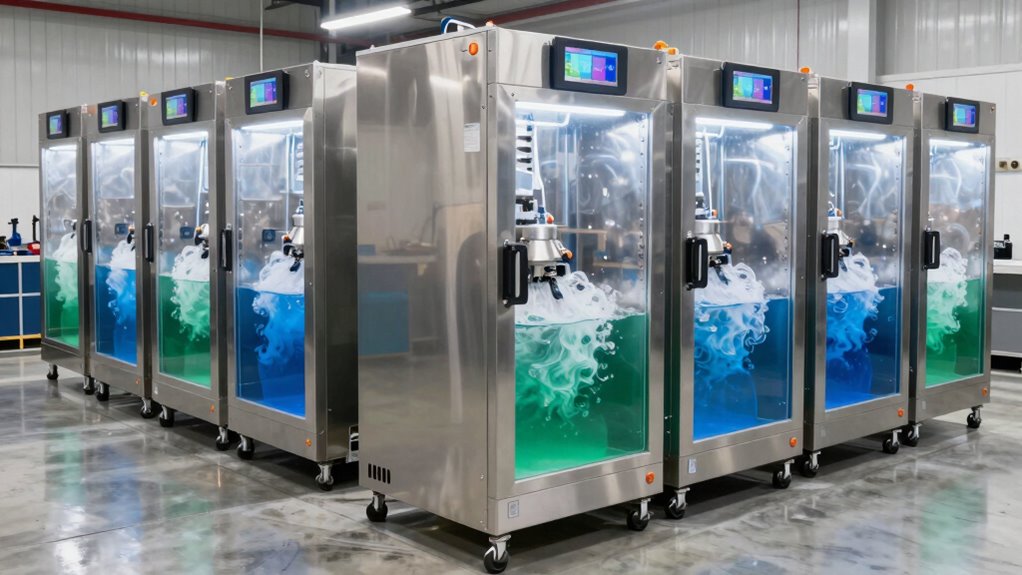

An aqueous parts washer machine replaces flammable solvent tanks with water-based detergent cleaning, making it a safer choice for degreasing engine blocks, gears, carburetors, and wheel bearings. The TEMCO Industrial T5 with 30-inch turntable earns my top spot as the only true closed-loop aqueous cabinet here, delivering heated, agitated cleaning that benchtop solvent tanks simply cannot match. For tighter budgets, the VEVOR 40-Gallon Parts Washer offers the most tank capacity per dollar, while the JEGS Portable 5-Gallon unit suits hobbyists who only clean small components occasionally. The main tradeoff in this category is between true heated aqueous systems, which cost more and need power and drainage planning, and ambient-temperature solvent-style tanks, which are cheaper but still rely on chemical degreasers. Read on for the full breakdown of all ten options.

Get business pricing on garage and car supplies
- Business-only prices and quantity discounts
- Tax-exempt purchasing
- Multiple users, one account, clear invoices
Complete the kit


Key Takeaways
- Only one product in this lineup — the TEMCO T5 — is a genuine heated aqueous cabinet washer; most others are solvent-tank designs that can run water-based detergent but lack heating and agitation.
- Tank size does not equal usable capacity: the VEVOR 40-gallon and Red Sun 40-gallon units hold far less working fluid than their frame size suggests, so check fluid capacity, not just the gallon in the name.
- The two Eastwood cabinets separate by workflow: the 20-gallon enclosed cabinet controls overspray and odors, while the 40-gallon open tub handles bulky parts like intake manifolds and axle housings.
- Two of the ten entries are accessories rather than machines — the 5-gallon solvent pail and the Little Giant PE-2YSA pump — and they matter most as replacement or upgrade parts for an existing washer.
- Sub-$150 small tanks (the 3.5-gallon and 5-gallon portables) struggle with anything larger than a carburetor; buyers who clean engine parts regularly outgrow them within months.
| Eastwood 20 Gallon Parts Washer Cabinet with Electric Pump |  | Best Overall | Tank Capacity: 20 gallons | Power: 110-120V AC, 60Hz, 10A | Construction: Welded steel | VIEW ON AMAZON | See Our Full Breakdown |
| JEGS Portable Parts Washer with 5-Gallon Tank |  | Best Value for Small Shops | Tank Capacity: 5 gallons | Solvent Capacity: 3.5 gallons | Power: 110V / 60Hz | VIEW ON AMAZON | See Our Full Breakdown |
| Red Sun 40 Gallon Parts Washer with Electric Solvent Pump, Shelf, and Cleaning Basket |  | Best for Heavy-Duty Jobs | Capacity: 40 gallons | Material: Powder-coated steel | Pump: Electric solvent pump with filter | VIEW ON AMAZON | See Our Full Breakdown |
| Parts Washer 3.5 Gallon Capacity Tank Cabinet Portable Automotive Parts Cleaner |  | Best Compact Pick | Capacity: 3.5 gallons | Material: Steel with anti-rust coating | Tube Length: 28 inches | VIEW ON AMAZON | See Our Full Breakdown |
| Parts Washer Solvent, 5-Gallon |  | Best Solvent Companion | Type: Parts washer solvent | Container Size: 5 gallons | Intended Use: Automotive and machinery parts cleaning | VIEW ON AMAZON | See Our Full Breakdown |
| Eastwood 40 Gallon Parts Washer with 10 Inch Deep Tub |  | Best Heavy-Duty Workshop Workhorse | Capacity: 40 Gallons | Tub Depth: 10 Inches | Flow Pump: 120V, 5.3 GPM | VIEW ON AMAZON | See Our Full Breakdown |
| TEMCO Industrial T5 Aqueous Cabinet Parts Washer, 30-Inch Turntable |  | Best Premium Industrial Cabinet | Model: T5 | Turntable Diameter: 30 inches | Working Height: 41 inches | VIEW ON AMAZON | See Our Full Breakdown |
| VEVOR 40-Gallon Parts Washer with Electric Pump, 17 Gallon Solvent Capacity |  | Best Value for High-Volume Shops | Tank Capacity: 40 gallons | Solvent Capacity: 17 gallons | Max Pump Output: 1 gallon per minute | VIEW ON AMAZON | See Our Full Breakdown |
| 20 Gallon Portable Automotive Parts Cleaner with 110V Pump |  | Best Compact Benchtop Pick | Capacity: 20 gallons | Motor: 110V single-phase, 0.7A | Pump Output: 50 gallons per hour | VIEW ON AMAZON | See Our Full Breakdown |
| Little Giant PE-2YSA 115V 300 GPH Submersible Parts Washer Pump |  | Best Replacement Pump for Aqueous Setups | Power: 1/40 HP, 115V | Flow Rate: 300 GPH at 1-foot lift | Maximum PSI: 5.3 PSI | VIEW ON AMAZON | See Our Full Breakdown |
| aqueous parts washer machine | Material |
|---|---|
| Eastwood 20 Gallon Parts Washe | — |
| JEGS Portable Parts Washer wit | Powder-coated steel |
| Red Sun 40 Gallon Parts Washer | Powder-coated steel |
| Parts Washer 3.5 Gallon Capaci | Steel with anti-rust coating |
| Parts Washer Solvent | — |
| Eastwood 40 Gallon Parts Washe | All Steel Components |
| TEMCO Industrial T5 Aqueous Ca | — |
| VEVOR 40-Gallon Parts Washer w | Heavy-duty steel with powder coating |
| 20 Gallon Portable Automotive | — |
| Little Giant PE-2YSA 115V 300 | Glass-filled polyester, nylon, stainless steel, Viton, polyethylene, Nitrile |
More Details on Our Top Picks
Eastwood 20 Gallon Parts Washer Cabinet with Electric Pump
This Eastwood cabinet hits the best balance of capacity, durability, and footprint in this lineup. The welded steel construction feels more rigid than the powder-coated sheet steel used on the Red Sun 40-gallon model, and the removable shelves let you stage multiple parts at once — something the JEGS 5-gallon unit simply can’t do. The flow-through brush paired with the electric aqueous pump delivers consistent solution delivery for greasy brackets and cylinder heads. Compared with smaller portable units, the 20-gallon tank means fewer solution changes between jobs. The tradeoff is weight and placement: at 62 pounds, this is a set-it-and-forget-it bench fixture, not something you’ll wheel around the shop. It’s also limited to water-based solvents, which keeps it compliant but rules out petroleum-based degreasers some mechanics prefer.
Pros:- Welded steel build is sturdier than typical bolted or folded designs
- 20-gallon tank plus removable shelves handles multiple parts per session
- Flow-through brush and electric pump deliver steady solution flow
- Drain plug simplifies solution changes
Cons:- Heavy at 62 pounds — effectively a stationary fixture
- Water-based solvents only, so petroleum degreasers are off the table
- Requires a dedicated 110-120V outlet
Best for: Home mechanics and small shops who clean engine parts regularly and want a permanent, mid-size aqueous cleaning station
Not ideal for: Anyone with a shared or cramped workspace who needs to move their washer between job sites — at 62 pounds it stays put
- Tank Capacity:20 gallons
- Power:110-120V AC, 60Hz, 10A
- Construction:Welded steel
- Weight:62 pounds
- Dimensions:30″ x 21″ x 34.5″ tall
- Included Accessories:Flow-through brush, removable shelves, drain plug
- Solvent Type:Water-based only
Our verdict“If you want one aqueous parts washer that covers most automotive cleaning without hogging the whole shop, this is the one to buy.”
JEGS Portable Parts Washer with 5-Gallon Tank
JEGS keeps things deliberately simple here, and that’s the point. With a 5-gallon tank, removable tray, and manual operation, it costs and occupies far less than the Eastwood 20-gallon cabinet while still handling carburetors, small brackets, and hardware. The powder-coated steel body resists shop grime better than bare steel units like the 3.5-gallon portable washer elsewhere in this guide. Where it gives ground is throughput: the 3.5-gallon working solvent capacity means more frequent refills on bigger jobs, and there’s no powered flow-through brush, so stubborn grease takes more elbow grease of your own. For occasional cleaning rather than daily teardown work, those tradeoffs are easy to accept — this is a bench-space-friendly starter washer that gets the basics right without asking much in return.
Pros:- Compact footprint fits on a workbench or crowded shelf
- Removable tray makes post-cleaning cleanup quick
- Powder-coated steel resists corrosion and shop wear
- Lightweight at 16.8 pounds for easy repositioning
Cons:- Manual operation with no powered flow-through brush
- 3.5-gallon solvent capacity requires frequent refills on bigger jobs
Best for: DIYers and hobby mechanics who degrease small parts occasionally and want a low-cost, low-commitment setup
Not ideal for: Anyone rebuilding engines or cleaning large assemblies — the small tank and manual operation become a bottleneck fast
- Tank Capacity:5 gallons
- Solvent Capacity:3.5 gallons
- Power:110V / 60Hz
- Dimensions:17.375″ L x 14.25″ W x 8.75″ H
- Weight:16.8 lbs
- Material:Powder-coated steel
- Access:Top load, freestanding
- Operation:Manual
Our verdict“A sensible entry point for light-duty cleaning where a full-size cabinet would be overkill.”
Red Sun 40 Gallon Parts Washer with Electric Solvent Pump, Shelf, and Cleaning Basket
When parts get big, most washers tap out — this one doesn’t. The 40-gallon tank is sized for wheel bearings, gears, carburetors, and the Red Sun claims room for a pair of tires, capacity that dwarfs both the Eastwood 20-gallon cabinet and the VEVOR 40-gallon unit in this guide. The standout feature is the recirculating pump with a built-in filter, which extends solution life instead of letting it saturate with grease — a genuine running-cost advantage over non-filtered designs. The self-locking fuse lid adds a layer of fire safety the smaller portable washers lack entirely. Tradeoffs are real: this cabinet demands serious floor space, and it refuses volatile solvents like gasoline, so buyers married to aggressive petrochemical cleaners should look elsewhere. For volume cleaning of large components, though, nothing else in this batch competes.
Pros:- 40-gallon capacity handles large assemblies and even two tires
- Filtered recirculating pump extends solvent life and reduces waste
- Self-locking fuse lid adds fire safety
- 28-inch flow-thru brush tube with 180-degree rotating metal nozzle reaches awkward areas
Cons:- Large footprint demands substantial dedicated workspace
- Not compatible with volatile solvents such as gasoline
Best for: Repair shops and serious restorers who regularly clean large components and want solvent recirculation to cut operating costs
Not ideal for: Home garages with limited floor space — this cabinet dominates a small workshop
- Capacity:40 gallons
- Material:Powder-coated steel
- Pump:Electric solvent pump with filter
- Tube Length:28 inches (71 cm)
- Nozzle:Flexible 180-degree rotating metal nozzle
- Safety Features:Self-locking fuse lid
- Included Accessories:Flow-thru brush, removable parts basket, shelf
- Solvent Compatibility:No volatile solvents such as gasoline
Our verdict“The pick when oversized parts and high cleaning volume justify the floor space it commands.”
Parts Washer 3.5 Gallon Capacity Tank Cabinet Portable Automotive Parts Cleaner
This is the roundup’s true lightweight champion for site-to-site portability. At 3.5 gallons, it’s smaller than even the JEGS 5-gallon unit, but it counters with a high-flow pump and a 28-inch flow-through brush with a 180-degree rotating nozzle — powered cleaning that the manual-only JEGS can’t match. That combination makes it surprisingly capable on small, greasy parts like brake hardware and sensors despite its size. The rust-resistant steel holds up to shop humidity, and the low weight makes tossing it in a truck bed realistic. The compromises are capacity and chemical flexibility: it’s water-based solvent only, and using anything incompatible risks damaging the pump — an expensive mistake the manual JEGS is more forgiving of. If your cleaning jobs are small but frequent, the powered brush arguably matters more than tank volume.
Pros:- Genuinely portable and lightweight for transport between locations
- High-flow pump with flow-through brush delivers powered cleaning
- 28-inch tube with 180-degree rotating nozzle reaches tight spots
- Rust-resistant steel construction
Cons:- Water-based solvents only — incompatible chemicals can damage the pump
- Very small 3.5-gallon capacity limits part sizes and session length
Best for: Mobile mechanics and DIYers who need powered parts cleaning they can carry between garage, driveway, or job sites
Not ideal for: Shops cleaning large or numerous parts — the 3.5-gallon tank empties patience along with solution
- Capacity:3.5 gallons
- Material:Steel with anti-rust coating
- Tube Length:28 inches
- Nozzle:180-degree rotating nozzle
- Pump:High-flow electric pump
- Solvent Type:Water-based solvents only
- Portability:Lightweight, job-site portable
Our verdict“The right choice when portability and powered cleaning matter more than capacity.”
Parts Washer Solvent, 5-Gallon
No washer works without solution, and this 5-gallon supply earns a slot as the consumable companion pick. A single pail fills the JEGS 5-gallon unit or tops off the Eastwood 20-gallon cabinet multiple times, and buying in bulk beats repeatedly purchasing smaller containers for anyone cleaning parts weekly. Compared with the aqueous-only requirements of most machines in this roundup, a dedicated solvent like this is formulated specifically to cut automotive grease and grime rather than relying on diluted general-purpose degreasers. The honest caveat: published specifications are thin, so verify compatibility with your specific machine before filling — several models here, including the 3.5-gallon portable washer, restrict solution chemistry, and the wrong solvent can wreck a pump. Treat this as the supply-line half of your parts-cleaning setup, not a standalone purchase.
Pros:- Formulated specifically for automotive grease and machinery grime
- 5-gallon bulk size reduces replenishment frequency
- Suitable for industrial and workshop use
- Works as refill supply for multiple washer sizes
Cons:- Minimal published specifications make compatibility checking the buyer’s job
- May not be suitable for aqueous-only machines in this lineup
Best for: Owners of solvent-compatible parts washers who want bulk solution on hand and fewer replenishment trips
Not ideal for: Owners of aqueous-only machines like the Eastwood cabinet — check compatibility first or you’ll damage your pump
- Type:Parts washer solvent
- Container Size:5 gallons
- Intended Use:Automotive and machinery parts cleaning
- Environment:Industrial and workshop use
- Compatibility:Verify against your washer’s solvent requirements
Our verdict“A practical bulk buy for compatible washers — just confirm your machine’s solvent requirements before pouring.”
Eastwood 40 Gallon Parts Washer with 10 Inch Deep Tub
Of the two 40-gallon units in this lineup, the Eastwood 40 Gallon Parts Washer is the one built like shop equipment rather than assembled like a kit. The all-steel construction and powder-coated finish mean the tub survives being loaded with cylinder heads and axles without flexing, and the 5.3 GPM flow pump delivers more circulation than the budget 40-gallon options in this roundup, which translates to faster cleaning on caked-on grime. Its 10-inch deep tub is the real differentiator — deep enough to submerge large components that sit awkwardly in shallower basins. Compared with the VEVOR 40-gallon, Eastwood’s reusable filter is a better long-term fluid management story. The tradeoff: it arrives without a cleaning brush, so budget for accessories before day one, and like any solvent-adjacent machine, it demands real ventilation and safety discipline.
Pros:- All-steel construction with corrosion-resistant powder coating stands up to daily shop abuse
- Oversize 40-gallon tank with 10-inch tub depth accommodates large parts
- 5.3 GPM pump circulates fluid faster than competing budget 40-gallon models
- Reusable filter extends fluid life and reduces operating cost
Cons:- Cleaning brush not included, so there is an added accessory cost at setup
- Requires proper ventilation and safety precautions that casual users may underestimate
Best for: Serious DIY mechanics and small professional shops that regularly clean large, greasy components like cylinder heads and transmissions
Not ideal for: Hobbyists cleaning small parts like carburetors — a 20-gallon benchtop unit handles that job for far less space and fluid
- Capacity:40 Gallons
- Tub Depth:10 Inches
- Flow Pump:120V, 5.3 GPM
- Finish:Powder Coated Steel
- Material:All Steel Components
Our verdict“This is the pick for buyers who need a 40-gallon washer that behaves like professional shop equipment rather than a garage toy.”
TEMCO Industrial T5 Aqueous Cabinet Parts Washer, 30-Inch Turntable
Everything else in this roundup is a sink-style washer; the TEMCO T5 is a different category entirely — a closed aqueous cabinet with a motorized 30-inch turntable and a 41-inch working height designed around the operator’s posture rather than the price tag. For transmission and automotive rebuilding shops, that closed-cabinet approach matters: it contains overspray, recirculates aqueous solution, and keeps degreasing chemicals off the shop floor in a way open-basin models like the Eastwood 40-gallon simply cannot. The USA-built, stainless-finished construction is proven in rebuild shops across the country, and it swallows industrial parts that would overflow any sink washer here. The tradeoffs are equally industrial: at 1,000 pounds, it needs dedicated floor space, a pallet jack at minimum for placement, and pricing that is quote-based rather than listed. This is equipment, not a purchase you make casually.
Pros:- Fully enclosed aqueous cabinet contains chemicals and overspray unlike open-basin washers
- 30-inch motorized turntable handles large industrial parts with minimal manual handling
- 41-inch working height is ergonomically designed for all-day operator use
- USA-built stainless construction with a long track record in transmission rebuilding
Cons:- 1,000-lb weight demands significant floor space and material-handling equipment to place
- Pricing is not readily listed, requiring a quote process that slows comparison shopping
Best for: Transmission rebuilders and automotive repair shops running high parts volume that need enclosed, hands-off aqueous cleaning
Not ideal for: Home garages and small workshops — the 1,000-lb footprint, installation requirements, and industrial cost structure are pure overkill
- Model:T5
- Turntable Diameter:30 inches
- Working Height:41 inches
- Weight:1,000 pounds
- Exterior Finish:Stainless Steel, Glossy
- Application:Automotive / Industrial
- Country of Origin:USA
Our verdict“Buy this if you run a professional rebuilding operation; everyone else should stay with a sink-style washer and a fraction of the commitment.”
VEVOR 40-Gallon Parts Washer with Electric Pump, 17 Gallon Solvent Capacity
Where the Eastwood 40-gallon competes on build pedigree, the VEVOR 40-Gallon Parts Washer competes on capability per dollar — and it wins that fight for most buyers. A 220-lb weight rating means multiple heavy components can sit in the basin at once, something smaller units like the 20-gallon benchtop washer in this lineup can’t attempt, while the electric circulation pump with mesh filtration keeps solvent cleaner between changes. The adjustable gooseneck tube is the feature you notice daily: directing flow precisely where you aim it makes rinsing a greasy differential far less of a wrestling match. Add a bottom storage shelf for supplies and powder coating against rust, and it covers the shop-basics checklist. Just know the footprint is genuinely large for home garages, and like every washer here, solvent arrives separately — factor that recurring cost in from the start.
Pros:- 220-lb weight capacity allows multiple large parts to be cleaned simultaneously
- Circulating pump with mesh filter extends solvent and detergent life
- Adjustable gooseneck tube makes targeted rinsing of heavy parts much easier
- Powder-coated steel construction plus bottom storage shelf add durability and convenience
Cons:- Large footprint can overwhelm small home garages
- Solvent must be purchased separately, adding upfront and recurring cost
Best for: Auto repair shops and serious home mechanics who want 40-gallon capacity and a 220-lb load rating without paying premium-brand prices
Not ideal for: Tight home garages or occasional tinkerers — the footprint is large and the fluid volume wasteful for small jobs
- Tank Capacity:40 gallons
- Solvent Capacity:17 gallons
- Max Pump Output:1 gallon per minute
- Weight Capacity:220 lbs
- Material:Heavy-duty steel with powder coating
- Pump Type:Electric filtration pump
Our verdict“The smart middle ground for buyers who need big-tank capability at a working-shop price point.”
20 Gallon Portable Automotive Parts Cleaner with 110V Pump
Not everyone needs 40 gallons, and the 20-Gallon Portable Parts Cleaner is built precisely for that buyer — the one degreasing wheel bearings, gears, and carburetors rather than engine blocks. At roughly 30 by 21 inches with a modest 58-lb shipping weight, it fits where the VEVOR and Eastwood 40-gallon units cannot, and its removable shelf with work basket plus flexible gooseneck spigot cover the essentials for small-part precision work. The standout safety detail is the hinged lid with a fusible link that slams shut automatically during a flash fire — a genuine protective feature rarely found at this size class. The compromises follow from the scale: the pump moves about 50 gallons per hour, which is modest circulation, and the 10-inch tub depth limits what you can submerge. For carburetor-and-bearings workloads, those limits rarely matter.
Pros:- Compact footprint with 58-lb shipping weight fits benches and tight garage corners
- Fusible-link lid automatically closes during a flash fire for real safety protection
- Removable work shelf and basket keep small parts organized during cleaning
- Sealed 0.7A pump motor with flexible gooseneck spigot enables targeted rinsing
Cons:- Approximately 50 GPH pump output provides limited circulation for heavily soiled parts
- 10-inch tub depth restricts the size of parts that can be fully submerged
Best for: Home mechanics and small garages focused on small-component cleaning like carburetors, gears, and wheel bearings
Not ideal for: Anyone cleaning cylinder heads or transmission cases — the shallow tub and low flow rate will frustrate large-part work
- Capacity:20 gallons
- Motor:110V single-phase, 0.7A
- Pump Output:50 gallons per hour
- Tub Depth:10 inches
- Dimensions:30 in D x 21 in W x 35 in H
- Shipping Weight:58 lbs
- Finish:Powder coated steel
Our verdict“The right-sized choice for small-part degreasing where a 40-gallon machine would be wasted space and wasted solvent.”
Little Giant PE-2YSA 115V 300 GPH Submersible Parts Washer Pump
When the pump on an existing washer dies — and on budget units it often does — the Little Giant PE-2YSA is the upgrade path that makes more sense than replacing the whole machine. At 300 GPH, it outflows the stock pumps found on washers like the 20-gallon benchtop model by several times, which matters because flow rate is what actually loosens baked-on grease. The glass-filled polyester casing and stainless steel shaft are specifically rated for aqueous solutions and UL-listed solvents, so it holds up where cheap pumps corrode through a season. Add continuous-duty rating with thermal overload protection and it becomes the heart of a DIY aqueous cleaning station built around a stock tank. The catch is installation: it ships without a plug, using a conduit fitting for hardwired mounting, so this is a component for capable hands, not an appliance.
Pros:- 300 GPH flow substantially outperforms typical stock washer pumps
- Glass-filled polyester and stainless construction is rated for aqueous solutions and UL-listed solvents
- Continuous duty rated with thermal overload protection for long sessions
- 6-foot cord with conduit fitting allows secure, permanent mounting
Cons:- No plug included — requires conduit-fitting hardwired installation
- Limited to solvents with a flash point above 100°F, ruling out more volatile cleaners
Best for: Mechanics repairing or upgrading an existing aqueous parts washer, or building a DIY cleaning tank from scratch
Not ideal for: Buyers wanting a complete out-of-the-box washer — this is a pump only, and the plugless hardwired installation requires electrical competence
- Power:1/40 HP, 115V
- Flow Rate:300 GPH at 1-foot lift
- Maximum PSI:5.3 PSI
- Shutoff Height:12.2 ft
- Discharge Size:1/4-inch MNPT
- Cord Length:6 ft (plugless, conduit fitting)
- Material:Glass-filled polyester, nylon, stainless steel, Viton, polyethylene, Nitrile
- Certification:CSA listed
Our verdict“The smart buy when your existing washer’s pump fails or you’re building a custom aqueous station, provided you can handle a hardwired install.”

How We Picked
I evaluated each option through the lens a buyer actually uses: cleaning performance, capacity and part clearance, pump quality, build durability, and total cost of ownership. Cleaning performance weighed heaviest — a true aqueous machine needs heat and flow to break grease without aggressive solvents, so heated cabinet systems scored differently than ambient drip tanks. Capacity comparisons used working fluid volume and tub or turntable dimensions rather than marketing gallon figures, since those numbers vary wildly in meaning across brands.
Pump quality separated several similarly priced units, because a weak or short-lived pump turns any tank into a bucket. I also factored in footprint, lid and splash control, drain provisions, and how easy each machine is to maintain season after season. Finally, I ranked against buyer type: a hobbyist cleaning carburetors monthly has different needs than a small shop washing brake components daily, and the ordering reflects which machine serves the most buyers best at each price tier.
| aqueous parts washer machine | Material |
|---|---|
| Eastwood 20 Gallon Parts Washe | — |
| JEGS Portable Parts Washer wit | Powder-coated steel |
| Red Sun 40 Gallon Parts Washer | Powder-coated steel |
| Parts Washer 3.5 Gallon Capaci | Steel with anti-rust coating |
| Parts Washer Solvent | — |
| Eastwood 40 Gallon Parts Washe | All Steel Components |
| TEMCO Industrial T5 Aqueous Ca | — |
| VEVOR 40-Gallon Parts Washer w | Heavy-duty steel with powder coating |
| 20 Gallon Portable Automotive | — |
| Little Giant PE-2YSA 115V 300 | Glass-filled polyester, nylon, stainless steel, Viton, polyethylene, Nitrile |
Factors to Consider When Choosing Aqueous Parts Washer Machine
Before choosing a parts washer, it helps to understand what actually drives cleaning results and long-term satisfaction. These are the factors that separated the winners from the disappointments in this comparison.True Aqueous vs. Solvent Tank: Know What You Are Buying
The biggest mistake buyers make is assuming every “parts washer” is an aqueous system. A genuine aqueous parts washer machine uses heated water-based detergent, usually with a pump-driven spray or agitation cycle, and typically works inside a closed cabinet so the solution stays contained. Traditional solvent tanks — which describe most of the open-tub units here — can run water-based degreasers at room temperature, but cold detergent cuts grease far more slowly and evaporates faster in a shallow tray. If your goal is specifically to move away from solvent, budget for a heated cabinet or accept noticeably longer soak times. Matching the machine type to your cleaning chemistry up front prevents the most common regret in this category.
Working Fluid Capacity and Part Clearance
Manufacturers love quoting frame size, but what matters is how much solution the tank holds and the largest part that fits under the faucet or inside the cabinet. A unit labeled “40 gallon” may hold under 20 gallons of fluid, and a deep tub with a low flexible spout limits tall parts like cylinder heads. Measure the longest, heaviest component you clean regularly — a differential cover or intake manifold — and compare it against interior tub dimensions before buying. For cabinet washers, turntable diameter and door opening height are the hard limits; a 30-inch turntable handles most automotive castings, while smaller cabinets force awkward repositioning mid-cycle. When in doubt, buy more clearance than you think you need, because outgrowing a washer is far more expensive than oversizing once.
Pump Power, Flow Rate, and Durability
The pump is the heart of any washer, and it is usually the first component to fail. Flow rates on consumer-grade units typically range from around 300 to 500 gallons per hour, which is fine for recirculating fluid over small parts but modest for blasting caked-on grime. Look for sealed motors, metal housings, and easy access for replacement — the Little Giant PE-2YSA submersible pump exists precisely because original equipment pumps on budget tanks die young. Heated machines add another layer, since the pump must tolerate elevated detergent temperatures. If a washer’s pump is riveted or glued in place with no service path, treat that as a red flag for long-term ownership.
Enclosure, Splash Control, and Shop Environment
Where the washer lives shapes which design works. Open tubs are faster for quick jobs — drop a part in, scrub, pull it out — but they sling fluid, release odor, and collect shop debris in the solution. Cabinets contain spray, reduce evaporation, and keep detergent warm longer, at the cost of slower loading and less visibility while cleaning. Garages attached to living spaces, or shops sharing space with paint work, strongly favor enclosed designs. Also check lid or door hardware: steel lids with solvent-resistant gaskets outlast flexible vinyl covers that warp and crack within a couple of seasons. Drain valve placement matters too, since emptying a 30-gallon tank with a bad valve is a miserable, messy job.
Solution Disposal and Regulatory Reality
Water-based detergent sounds environmentally friendly, but once it is loaded with grease, oil, and heavy metals, most municipalities classify it as hazardous waste — and used solvent always is. Closed-loop cabinet systems extend solution life through filtration, sometimes months longer than open tanks, which reduces disposal frequency and cost. Before buying any washer, check local rules on discharging or storing spent cleaning fluid, because a cheap tank with weekly solution changes can cost more in disposal fees than a heated machine with filtration. Budget for a sediment tray and filter stock from day one. Buyers who skip this step often end up with a washer they are afraid to use.
Footprint, Power, and Total Cost of Ownership
Bigger tanks demand more than floor space — they demand filled weight. A 40-gallon washer loaded with fluid can weigh over 350 pounds, so casters, reinforced legs, and placement planning matter before the first fill. Heated machines need a dedicated 120V or 240V circuit depending on the heater element, and ambient tanks still need a grounded outlet for the pump. Price the first two years honestly: machine cost plus detergent, filters, eventual pump replacement, and disposal. That math is why mid-range units with serviceable pumps frequently beat the cheapest tanks on value, and why the smallest portables only make sense for genuinely occasional use.
Frequently Asked Questions
Can I use water-based detergent in a parts washer designed for solvent?
Most open-tub washers with electric pumps can run water-based degreasers, but with caveats. Cold detergent cleans far slower than solvent or heated aqueous solution, so expect longer soak and scrub times for heavy carbon and grease. You should also confirm the pump seals and any vinyl components are rated for your specific detergent chemistry, since some alkaline cleaners swell rubber parts over time. The bigger issue is that ambient tanks lack filtration, so the detergent loads with grease quickly and needs more frequent replacement. If water-based cleaning is your primary goal, a heated cabinet washer does the job properly rather than as an afterthought.
What size parts washer do I actually need for automotive work?
Size your washer to the largest part you clean regularly, not the average part. Carburetors, wheel bearings, and small brackets fit comfortably in 5-to-20-gallon tanks, but engine covers, cylinder heads, and axle components need a 30-to-40-gallon tub or a cabinet with at least a 20-inch turntable. Check the usable depth under the spout or inside the cabinet door, because tall castings often defeat nominally large tanks. Also weigh your floor space and filling logistics — a 40-gallon machine filled with fluid is a permanent fixture, not something you shuffle around the garage. Most home mechanics land best in the 20-gallon range unless engine rebuilding is a regular activity.
Are the small portable parts washers worth buying, or should I just save for a bigger unit?
Small portables make sense for a narrow use case: occasional cleaning of genuinely small parts where a full-size tank would be wasted space and money. If you rebuild carburetors or clean bearings once a month, a 3.5-to-5-gallon unit does that job adequately. The break-even comes quickly for anyone touching greasy engine parts weekly, because small tanks foul fast, hold limited fluid, and cannot fit the parts that actually generate the mess. A common pattern is buying a small unit, outgrowing it within a season, and paying twice. If your budget only stretches to a small portable now, at least pick one with a replaceable pump so it survives as a second bench station later.
Why would I buy a standalone parts washer pump like the Little Giant PE-2YSA?
A submersible pump like the PE-2YSA serves two practical purposes. First, it is the standard replacement pump for a huge number of consumer parts washers, and swapping a failed pump costs a fraction of replacing the whole tank — original pumps on budget machines routinely fail within a year or two of regular use. Second, resourceful buyers pair one with a suitable tub, heater, and plumbing to build a custom aqueous cleaning station sized exactly to their needs. At roughly 300 gallons per hour, its flow rate matches what most consumer washers ship with, so it restores original performance rather than upgrading it. Anyone buying a budget washer should price a spare pump into the purchase from the start.
How do heated aqueous cabinet washers compare to solvent tanks on cleaning power?
Heated aqueous cabinets generally win on stubborn, baked-on contamination because heat and detergent chemistry break down grease at the molecular level while spray impingement flushes it away — all without flammable solvent vapor in your shop. Solvent tanks are faster for light oil and grease films and require no warm-up time, which is why quick-bench work still favors them. The tradeoffs are cost and cycle time: heated cabinets carry a substantially higher purchase price, use real electricity during warm-up and cycles, and lock you into buying aqueous detergent concentrate. Where solvent becomes hard to obtain or dispose of locally, the cabinet pays for itself in compliance and safety alone. For daily shop use on grimy castings, heated aqueous is the direction the industry has moved.
Conclusion
Mapping these ten options to buyer type closes the decision cleanly. For the best overall aqueous cleaning, the TEMCO Industrial T5 cabinet is the only true heated, closed-loop machine in the group and the right call for anyone whose primary goal is water-based degreasing. The best value goes to the VEVOR 40-Gallon washer, which pairs a large tub and workable pump with a price that leaves budget for detergent and accessories. Best premium belongs to the Eastwood 40-Gallon with its 10-inch deep tub, built for serious engine work where part clearance and durability justify the spend. For beginners and occasional hobbyists, the JEGS 5-gallon portable covers carburetors and small assemblies without overwhelming a modest shop, while the Eastwood 20-gallon cabinet is the better beginner step-up when odor and splash control matter. Finally, for specific needs: the Little Giant PE-2YSA pump for anyone reviving or building a custom tank, and the 5-gallon solvent pail as a consumable for the solvent-tank owners in the group. Match the machine to your actual cleaning volume, and the right pick becomes obvious.
Fall Picks
fall essentials
As an affiliate, we earn on qualifying purchases.