
TL;DR

Get business pricing on garage and car supplies
- Business-only prices and quantity discounts
- Tax-exempt purchasing
- Multiple users, one account, clear invoices
The China Zorrilla, built by Incat Tasmania for Buquebus, has entered commercial service between Argentina and Uruguay with a Corvus Energy battery system rated at more than 41 MWh. The ferry can carry more than 2,100 passengers and over 225 vehicles, and can sail for 1.5 hours on battery power alone. Corvus describes the installation as the largest deployed on a ship; comparative details have not been independently supplied in the source report.
The China Zorrilla, a battery-electric ferry built by Incat Tasmania for operator Buquebus, has entered commercial service between Argentina and Uruguay with a Corvus Energy storage system rated at more than 41 MWh. The commissioning puts a large battery-powered passenger and vehicle vessel into service on the Río de la Plata, though the source report does not give its entry date or operating schedule.
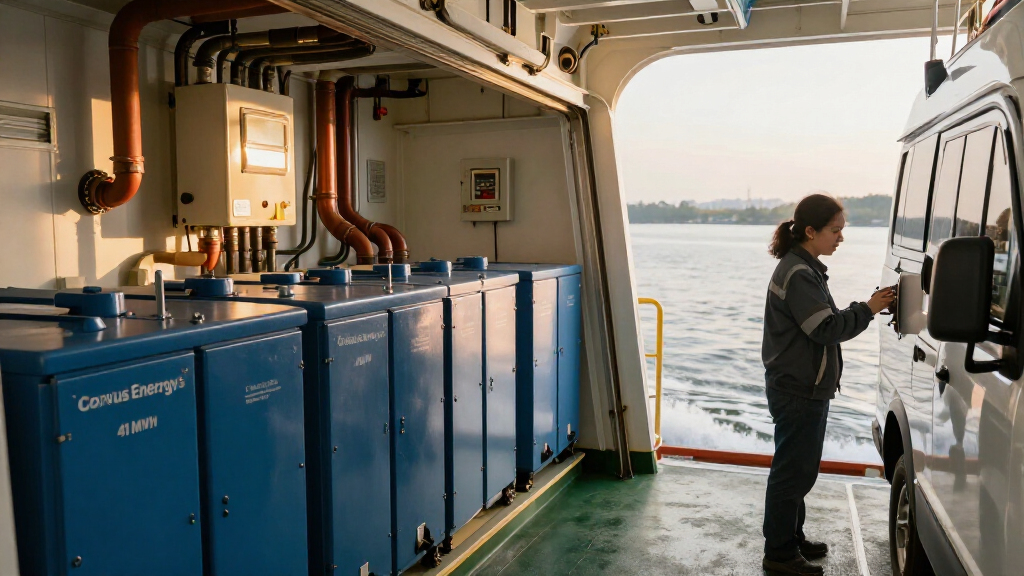
Corvus Energy says it supplied and commissioned the vessel’s battery system, made up of 5,016 Dolphin Energy NxtGen modules installed across four battery rooms. The ferry can carry more than 2,100 passengers and over 225 vehicles. According to the source report, it can sail for 1.5 hours on battery power alone.
Corvus calls the installation the largest battery system ever deployed on a ship, and says it is about four times larger than any battery system previously used in commercial maritime service. Those are the supplier’s comparisons; the source material does not provide a separate dataset or independent assessment to verify them. Corvus also describes the China Zorrilla as the first fully electric ship of its kind in South America.
The ferry was built by Incat Tasmania for Buquebus, which operates crossings between Argentina and Uruguay. The reported figures establish its passenger and vehicle capacity and battery-only sailing duration, but do not specify the route’s distance, the vessel’s charging arrangements or how much of a typical crossing is expected to use battery power alone.
A Larger Battery Ferry Enters Service
The China Zorrilla’s entry into service shows that a high-capacity passenger and vehicle ferry can be deployed with a battery system measured in tens of megawatt-hours. Its stated capacity—more than 2,100 passengers and over 225 vehicles—makes the project relevant beyond small passenger ferries, while the 1.5-hour battery-only sailing capability indicates the operating duration reported for electric-only travel.
For passengers and freight moving across the Río de la Plata, the immediate development is the start of commercial service, not a published assessment of its environmental or operating performance. The source does not give energy use per crossing, charging time, service frequency or emissions comparisons. Those figures would help establish how the vessel’s battery system performs in routine operation and what its deployment could mean for other ferry routes.
The project also places a large marine battery installation into use, rather than leaving it as a build or commissioning milestone. Corvus argues that the system reflects the maturity and reliability of marine batteries, but those characterizations are the company’s claims. Public operating data over time would be needed to assess reliability and performance independently.
Products Worth Considering

DEWALT 20V MAX 1/4-Inch Impact Driver Kit with Battery and Charger (DCF787D1)
NOCO Boost GB50 1500A UltraSafe Jump Starter, 12V Lithium Battery Booster

NOCO Boost GB150 3000A UltraSafe Jump Starter, 12V Lithium Battery Booster
As an affiliate, we earn on qualifying purchases.
From Commissioning to Passenger Service
The reported sequence is that Incat Tasmania built the China Zorrilla for Buquebus, Corvus Energy supplied and commissioned its energy storage system, and the ferry then entered commercial service between Argentina and Uruguay. The source report does not provide dates for construction, commissioning or the start of service, so a more detailed project timeline cannot be confirmed from the available material.
Corvus identifies the system as its Dolphin Energy NxtGen product, comprising 5,016 modules in four battery rooms. A vessel’s total installed energy capacity is not, by itself, a measure of how much energy it uses on a specific trip. The report gives a battery-only sailing duration of 1.5 hours, but does not state the trip’s length or whether the crossing is completed entirely on battery power.
The company’s descriptions of the installation as the largest of its kind and the vessel as a South American first provide a sense of the project’s intended significance. The available source attributes those comparisons to Corvus and does not present independent records against which to assess them.
“This project proves that battery-electric propulsion is no longer limited to smaller ferries or short routes.”
— Ole Jacob Irgens, Corvus Energy’s executive vice president and head of sales
Operating Data Still Unreported
The source report does not state the exact date the China Zorrilla began commercial service, its route distance, timetable or the number of crossings it will make. It also does not explain how the 1.5-hour battery-only capability relates to the duration of a typical trip or whether other propulsion or energy arrangements are used during service.
No charging location, charging duration, battery operating data, maintenance plan or measured emissions comparison is provided. The source also does not independently verify Corvus’s statements that the system is about four times larger than previous commercial maritime installations or that the vessel is the first of its kind in South America. These details remain unconfirmed by the material available here.
Service Data Will Test the Claims
The next evidence will come from the ferry’s operation on the Argentina-Uruguay route. Buquebus’s published service details and any later reporting from the operator or Corvus could clarify the crossing schedule, charging arrangements and how often the vessel sails on battery power alone.
Operational figures—such as energy use per trip, charging time, service reliability and maintenance—would help readers assess how the 41 MWh-plus system performs in routine use. No specific follow-up data release or evaluation date is identified in the source report.
Key Questions
What happened to the China Zorrilla?
The ferry has entered commercial service between Argentina and Uruguay after Corvus Energy commissioned its battery system.
How large is its battery system?
The system is rated at more than 41 MWh and comprises 5,016 Corvus Dolphin Energy NxtGen modules in four battery rooms, according to the source report.
How many passengers and vehicles can it carry?
The China Zorrilla can carry more than 2,100 passengers and over 225 vehicles, according to the report.
How long can it sail on battery power alone?
The source says it can sail for 1.5 hours on batteries alone. It does not state the route distance or how that duration compares with a typical crossing.
Is this the largest ship battery system?
Corvus Energy says it is the largest battery installation ever deployed on a ship and about four times larger than earlier commercial maritime systems. The source report does not provide independent verification of those comparisons.
Source: chargedevs.com