
To match oil thickness to temperature, you need to conduct viscosity tests at different operating conditions using tools like viscometers. These tests show how the oil flows at various temperatures, helping you select the right grade or add viscosity modifiers if needed. By understanding these results, you can guarantee your equipment runs smoothly in hot or cold weather. Keep exploring to discover detailed methods for achieving ideal lubrication under any temperature.
Key Takeaways
- Conduct viscosity tests at various temperatures using a viscometer to observe how oil flow changes.
- Compare measured viscosity values to manufacturer specifications for different temperature conditions.
- Use standardized testing methods, such as ASTM or ISO, to ensure consistent and accurate results.
- Adjust oil formulation or select different grades based on test data to maintain proper viscosity across temperature ranges.
- Regularly monitor and retest oil to confirm it maintains the right thickness for optimal equipment performance.
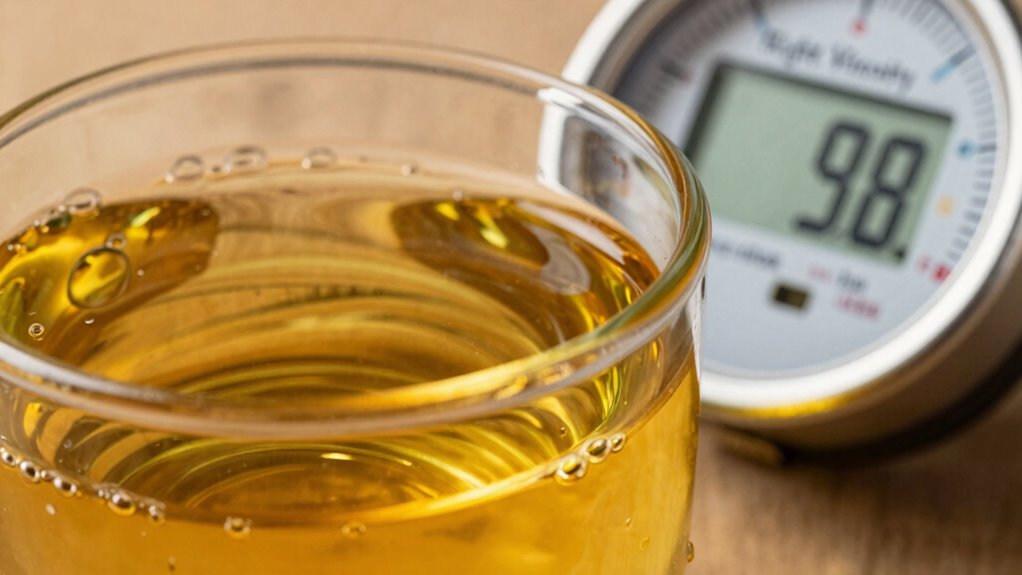
Have you ever wondered how professionals determine the ideal thickness of a liquid for a specific application? It all comes down to understanding oil consistency and how it changes with temperature. Oil consistency, or viscosity, is a measure of a fluid’s resistance to flow. To guarantee maximum performance, you need to match the oil’s viscosity to the operating conditions, especially temperature. This process involves viscosity adjustment, which means selecting or modifying the oil so it performs reliably across a range of temperatures.
Understanding oil viscosity helps optimize performance across temperature variations.
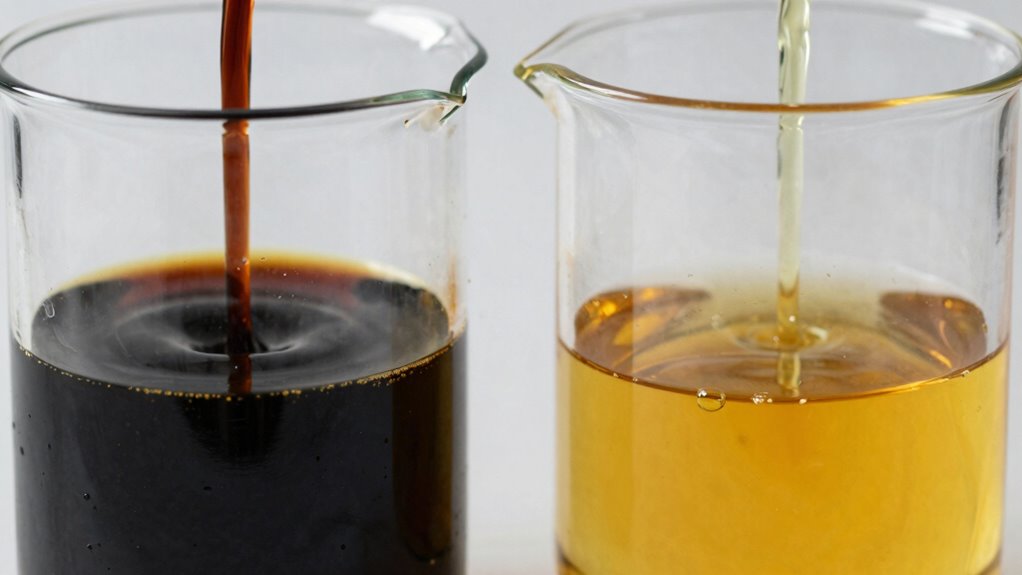
When you’re working with oils—whether for engines, machinery, or industrial processes—you have to consider how temperature impacts viscosity. As temperature rises, oil becomes thinner, decreasing its viscosity. Conversely, at lower temperatures, oil thickens, increasing its resistance to flow. If you don’t account for these changes, the oil might be too thick to circulate properly in cold weather or too thin to provide adequate lubrication when hot. That’s why understanding and adjusting oil consistency is vital for maintaining efficiency and protecting equipment.
To determine the right viscosity, professionals often perform tests that simulate operating conditions at various temperatures. These tests help identify how much an oil’s viscosity shifts with temperature, guiding you to select the proper oil grade or formulate a custom blend. Viscosity adjustment might involve choosing oils with specific additive packages or blending different oils to achieve the desired flow characteristics. This guarantees the lubricant maintains its protective qualities whether it’s cold outside or the machinery runs at high temperature.
You can also use viscosity measurement tools, like viscometers, to assess an oil’s flow properties at different temperatures. These measurements help you understand the oil’s behavior in real-world conditions and make informed decisions about which oil to use or how to modify it. For example, if you find that an oil is too viscous at startup in winter, you might select a lighter grade or add viscosity modifiers to improve cold flow. Conversely, if an oil is too thin at high temperatures, you might opt for a higher-viscosity formulation or incorporate thicker base oils.
Ultimately, matching oil consistency to temperature involves both testing and adjusting. By understanding the principles of viscosity adjustment, you can choose or engineer oils that perform reliably across temperature ranges. This not only prolongs equipment life but also enhances efficiency and safety. Whether you’re dealing with engine oils, lubricants, or hydraulic fluids, paying attention to how viscosity changes with temperature ensures your systems operate smoothly and effectively, no matter the conditions. Recognizing the impact of temperature on viscosity is essential for optimal lubrication and equipment performance.

DEWALT Grease Gun 20V MAX, Cordless Electric Grease Gun 42” Hose, 10,000 PSI, Variable Speed Triggers, Tool Only (DCGG571B)
DEWALT cordless grease gun can power through clogged grease fittings with a motor that delivers up to 10,000...
As an affiliate, we earn on qualifying purchases.
Frequently Asked Questions
How Often Should I Perform the Viscosity Test?
You should perform the viscosity test during routine scheduling, ideally every 3,000 to 5,000 miles or as recommended by your vehicle’s manufacturer. Testing frequency depends on your driving habits and operating conditions, such as extreme temperatures or heavy loads. Regular testing helps guarantee your oil maintains the right viscosity, preventing engine wear. Make it a habit to check viscosity periodically to keep your engine running smoothly.
Can Viscosity Testing Be Done at Home?
Many believe DIY testing is impossible, but with proper calibration techniques, you can check oil viscosity at home. While professional labs offer precise measurements, you can perform simple tests using a viscometer or a flow cup, ensuring your device is correctly calibrated. Regular calibration and careful observation help you monitor oil thickness, making home viscosity testing a practical way to maintain engine health without frequent trips to the shop.
What Tools Are Needed for Accurate Viscosity Measurement?
You need testing equipment like a viscometer or a cup viscometer to measure viscosity accurately. Make sure to use viscosity standards for calibration, ensuring your measurements are precise. These tools help you determine oil thickness at different temperatures, so you can match the viscosity to the operating conditions. Proper testing equipment and viscosity standards are essential for reliable results, especially when evaluating oil performance in various environments.
How Does Altitude Affect Oil Viscosity?
Altitude effects cause oil to become thinner because lower air pressure reduces its viscosity. You’ll notice that at higher elevations, thin oil flows more easily, which can lead to inadequate lubrication if not addressed. To counter this, you might need to use oil with a higher viscosity rating or adjust your oil change schedule. Always monitor your engine’s performance and check your oil regularly to guarantee proper lubrication in varying altitudes.
Is Viscosity Testing Necessary for Synthetic Oils?
Viscosity testing is essential for synthetic oils because it guarantees your oil maintains proper oil consistency and temperature stability under various conditions. You can’t rely solely on manufacturer labels since synthetic oils are formulated for specific temperature ranges. Testing helps you verify that the oil performs well in your engine’s environment, preventing wear and ensuring ideal lubrication. Regular viscosity checks keep your engine running smoothly and protect your investment.

GEVEELIFE Electric Grease Gun -2025 Upgraded 2-in-1 Design with 2×4000mAh Batteries, Fast Charger & 90° Swivel Coupler, 12,000 PSI - Works with Bulk & Cartridge Grease for Farm, Truck, Construction
🚀 Cordless Freedom & Dual-Mode Operation:Experience hassle-free greasing with our cordless electric design that eliminates manual pumping. Switch...
As an affiliate, we earn on qualifying purchases.
Conclusion
Now that you know how to match oil viscosity to temperature, you’ll keep your engine running smoothly, even through a rain of arrows or a sun blazing like Vulcan’s forge. Remember, just like a knight chooses the right armor, selecting the proper oil thickness guarantees your engine’s longevity and performance. So, don’t forget this simple test—your trusty steed deserves the best care, whether in a chariot or a modern day carriage.

Yokoma 220V Filtering Machine Portable Hydraulic Oil Filter Cart Single Cylinder Mobile Oil Filtration Purification System 3um Fine Size with 78.74in/2m PVC Hose
【Efficiency】- Effectively maintain the performance of the oil, with high purification accuracy. Old oil can be regularly filtered...
As an affiliate, we earn on qualifying purchases.

JARYANNIX 220V Portable Filtering Machine, Hydraulic Oil Filter Cart with Single Barrel, Oil Filtration Purification System with 78.74in/2m PVC Hose, 63 L/min
Excellent Purification Performance: Filter elements ranging from 3μm to 40μm are available on demand. Equipped with a dual...
As an affiliate, we earn on qualifying purchases.