
The NLGI #2 grease mainly tells you its consistency or firmness, but it doesn’t cover all performance factors. Things like temperature stability, water resistance, shear strength, and additives matter just as much for your equipment’s reliability. Simply choosing #2 isn’t enough—you need to take into account the specific conditions and requirements of your machinery. To guarantee optimal performance, you’ll want to understand these extra details, which get explained as you explore further.
Key Takeaways
- NLGI #2 indicates grease consistency but doesn’t specify properties like temperature stability or water resistance.
- It omits critical performance factors such as shear stability, load capacity, and additive packages.
- Different applications require specific NLGI grades combined with other specifications for optimal performance.
- Solely relying on NLGI #2 can lead to inadequate lubrication under varying environmental and operational conditions.
- Comprehensive specifications, including viscosity and additive content, are essential for selecting the right grease.

GEVEELIFE Electric Grease Gun -2025 Upgraded 2-in-1 Design with 2×4000mAh Batteries, Fast Charger & 90° Swivel Coupler, 12,000 PSI - Works with Bulk & Cartridge Grease for Farm, Truck, Construction
🚀 Cordless Freedom & Dual-Mode Operation:Experience hassle-free greasing with our cordless electric design that eliminates manual pumping. Switch...
As an affiliate, we earn on qualifying purchases.
What Is the NLGI Scale and Why Should You Care?

The NLGI scale is a standardized system that classifies greases based on their consistency or hardness. It helps you comprehend how firm or soft a grease is, ranging from 000 (very fluid) to 6 (very hard). This scale, created by the National Lubricating Grease Institute, guides you in choosing the right grease for specific applications. Knowing the NLGI grade ensures you select a lubricant that matches your equipment’s operational needs, such as low temperatures, heavy loads, or high temperatures. It also simplifies communication across maintenance teams by providing a common reference. By understanding the NLGI scale, you can better match grease properties with application requirements, improving performance and extending the lifespan of your machinery. Additionally, Free Floating greases are often associated with specific NLGI grades to optimize performance in various environments.

Alloyman 2-in-1 Electric Grease Gun Kit, Upgraded 12,000 PSI,2×4000mAh Batteries,Built for Farmers, Mechanics & Truckers,5.3 oz/min, 39.4” Long Hose& LED Light for Tractors, Trailers,Heavy Equipment
【Cordless Freedom & Dual-Mode Operation】One-button switch between pistol and straight modes — cordless convenience that cuts maintenance time...
As an affiliate, we earn on qualifying purchases.
How Is Grease Consistency Measured With Penetration Tests?
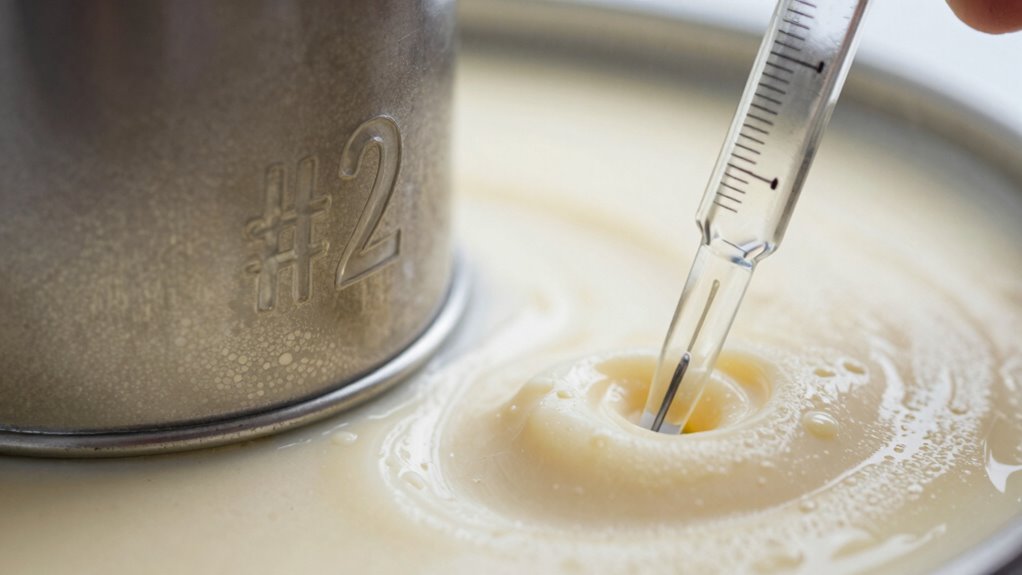
Grease consistency is measured using a standardized penetration test that quantifies how soft or firm a grease is. In this test, a cone-shaped needle is pressed into the grease at a controlled temperature of 25°C for 5 seconds. After the test, you record how far the cone has penetrated in tenths of a millimeter (0.1 mm units). The grease is worked through 60 strokes before testing to ensure uniform consistency. The resulting penetration value indicates the grease’s firmness, with higher numbers meaning softer grease and lower numbers indicating firmer grease. This measurement is part of the NLGI grading system, helping you determine if a grease’s consistency is suitable for your application, from fluid-like to very stiff lubricants. penetration test is a critical method for assessing grease quality and performance.

LUMAX LX-1152 Black Heavy Duty Deluxe Pistol Grease Gun with 18" Flex Hose, Handy 3-Way Loading - Fill with Standard Cartridge, Suction or Bulk Fill. Convenient One-Hand Operation for Easy Greasing.
HARD-TO-REACH: Comes with 18" flex hose extension for hard-to-reach fittings. Convenience of one-hand operation for easy greasing. Fit...
As an affiliate, we earn on qualifying purchases.
Why NLGI #2 Grease Isn’t the Whole Story: What You Need to Know

While NLGI #2 grease is popular, it doesn’t tell the whole story about performance. Relying solely on its consistency overlooks important factors like additives, viscosity, and water resistance. To choose the right grease, you need to take into account other specifications and how it fits your specific application. Additionally, understanding the Gold IRA Rollovers process can be crucial for diversifying your retirement investments and safeguarding assets.
Limitations of NLGI #2
Although NLGI #2 grease is widely used because of its versatility, relying solely on its consistency rating can be misleading. The #2 designation only tells you about the grease’s hardness, not its performance under specific conditions. It doesn’t account for important factors like viscosity, water resistance, or shear stability, which are critical for many applications. Additives such as extreme pressure (EP) agents or rust inhibitors aren’t reflected in the NLGI grade, yet they influence how well the grease performs under load or in harsh environments. Additionally, the base oil type and thickener used can fundamentally impact its behavior. To select the right grease, you need to take into account these other specifications alongside the NLGI number, not rely on it alone. Understanding performance factors is essential for choosing the most suitable grease for your specific needs.
Additional Specification Needs
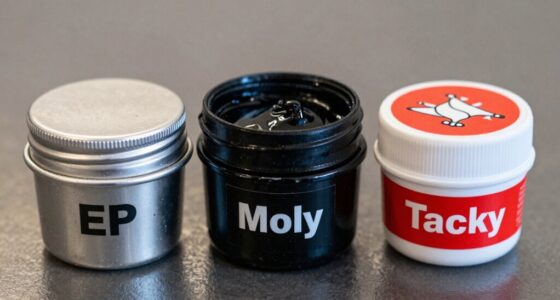
Relying solely on the NLGI #2 classification can lead to choosing a grease that doesn’t meet all operational needs. While it indicates consistency, it doesn’t specify critical performance factors like viscosity, water resistance, or load capacity. These properties determine how well the grease performs under specific conditions, such as high temperatures or heavy loads. You also need to contemplate additives like extreme pressure (EP) agents, anti-wear components, and corrosion inhibitors, which improve durability and protection. The base oil type and thickener influence stability and compatibility with equipment. Without detailed specifications—such as dropping point, shear stability, and compatibility—you risk selecting a grease that underperforms or fails prematurely. Thorough specs ensure the grease aligns with your equipment’s demands and operating environment.
Application Suitability Factors
Choosing the right grease for your application requires more than just selecting an NLGI #2 grade. You need to consider factors that impact performance and longevity. Think about:
- Temperature ranges your equipment operates within
- Load and pressure demands on the bearing or gear
- Exposure to water or moisture
- Speed or rotational velocity of moving parts
- Specific industry requirements, like food-grade or heavy-duty use
Simply choosing #2 grease doesn’t guarantee compatibility or durability. You must match the grease’s properties to your application’s conditions. For example, high-temperature environments may require a grease with a higher dropping point, while water exposure calls for water-resistant formulations. Always evaluate your equipment’s needs beyond consistency to ensure effective lubrication.

LockNLube Grease Gun Coupler locks onto Zerk fittings. Grease goes in, not on the machine. World's best-selling original locking grease coupler. Rated 10,000 PSI. Long-lasting rebuildable tool.
LOCKS ON, STAYS ON, WON'T LEAK—LIKE HAVING AN EXTRA HAND! No need to hold the coupler in place...
As an affiliate, we earn on qualifying purchases.
Key Specs to Consider Beyond NLGI Grade for Better Lubrication

To select the appropriate grease, you need to look beyond the NLGI grade and consider factors like viscosity and viscosity index, which affect flow and staying power under different conditions. Additives also play an essential role by providing features like extreme pressure or corrosion resistance, tailoring the grease to your application. Additionally, paying attention to the operating temperature range guarantees the lubricant performs reliably across the temperature spectrum your equipment faces. Understanding lubrication requirements ensures you choose the best product for your specific needs.
Viscosity and Viscosity Index
Have you considered how viscosity and viscosity index influence the effectiveness of a grease beyond its NLGI grade? Viscosity measures the grease’s resistance to flow, affecting pumpability and lubrication at different temperatures. The viscosity index (VI) indicates how much viscosity changes with temperature; a higher VI means less change, maintaining consistent performance. Additionally, temperature stability plays a crucial role in ensuring reliable operation across diverse conditions. Key factors to keep in mind include:
- Optimal viscosity for smooth flow and film formation.
- Viscosity index to ensure stability across temperature ranges.
- Temperature-dependent behavior affecting start-up and operation.
- Shear stability related to viscosity retention under load.
- Viscosity modifiers that improve performance in varying conditions.
Additives and Their Roles
While viscosity and additives both influence grease performance, additives play a vital role in enhancing specific properties that NLGI grades alone can’t provide. Additives improve things like wear protection, water resistance, and temperature stability. For example, extreme pressure (EP) additives help the grease withstand heavy loads without metal-to-metal contact. Anti-wear agents protect surfaces during startup or low-speed operation. Thickeners and antioxidants prevent breakdown over time, extending service life. Water resistance additives help the grease maintain lubrication even in wet environments. Dispersants keep contaminants suspended, preventing sludge buildup. Without these additives, a grease may meet the right consistency but still fall short under real-world conditions. Selecting the right additives ensures your grease performs reliably across various applications and operating environments.
Operating Temperature Range
Ever wondered how grease performs across different temperatures? Your operating temperature range determines if the grease stays effective or breaks down. If it’s too cold, the grease might harden, causing poor lubrication or equipment failure. At high temperatures, grease can soften, lose film strength, or oxidize faster. To guarantee ideal performance, consider:
- The minimum temperature where the grease remains pumpable and doesn’t harden.
- The maximum temperature before it softens or deteriorates.
- The grease’s dropping point, indicating the temperature it melts.
- Shear stability, ensuring it maintains consistency under stress.
- Water resistance at various temperatures, preventing washout or degradation.
- Lubrication effectiveness across different operating conditions, ensuring the grease maintains proper film strength and reduces wear.
Matching the grease to your equipment’s operating temperature range makes a huge difference in lifespan and reliability.
Which NLGI Grade Is Best for Your Machinery and Conditions?

Choosing the right NLGI grade for your machinery depends on the operating conditions and specific performance requirements. If your equipment operates at high loads or high temperatures, a firmer grease like NLGI 3 to 6 offers better stability and load-carrying capacity. For low-temperature applications or machinery requiring easy pumpability, softer grades like NLGI 00 or 0 are ideal. Machinery with frequent starts, stops, or low-speed operation benefits from medium grades like NLGI 2, which balances ease of movement with adequate protection. Consider environmental factors such as water exposure, which may necessitate water-resistant grades. Regular maintenance and understanding appliance testing can ensure the grease remains effective and your machinery operates smoothly. Always match the grease’s consistency with your equipment’s design and operational demands to guarantee optimal lubrication, longevity, and performance.
Common Mistakes When Choosing Grease and How to Avoid Them
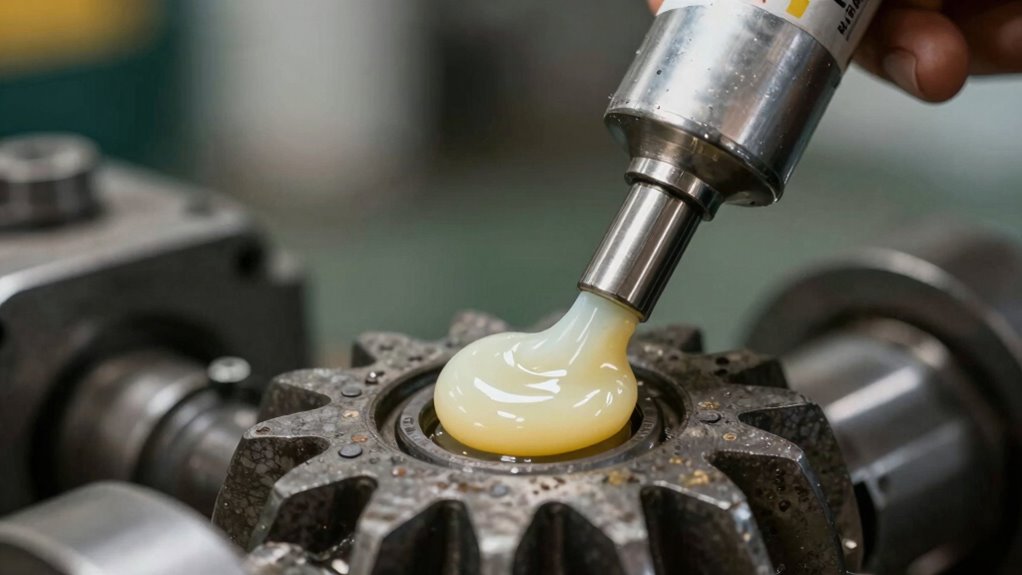
Selecting the wrong grease can lead to equipment failure, inefficiency, and unnecessary maintenance costs. One common mistake is choosing a grease based solely on NLGI grade without considering other critical factors. To avoid this, watch out for these pitfalls:
- Relying only on NLGI number instead of considering load, temperature, and speed requirements.
- Ignoring additive packages like EP, corrosion inhibitors, or water resistance needed for your application.
- Overlooking compatibility with existing lubricants or materials.
- Picking a grease based on appearance or cost rather than performance specs.
- Forgetting to verify if the grease’s base oil and thickener suit your environment.
- Not considering the body jewelry measurements and materials that might be affected by the lubricants or cleaning agents used, which can lead to irritation or damage.
Always evaluate your equipment’s demands and read manufacturer recommendations to ensure you select a grease that performs reliably under your specific conditions.
How to Ensure You’re Using the Right Grease for Your Equipment’s Needs

To guarantee you’re using the right grease for your equipment’s needs, start by thoroughly understanding its operating conditions, including temperature ranges, load requirements, and speed. Check the equipment manual or manufacturer guidelines for recommended grease types and specifications. Consider the environment—extreme temperatures, moisture, or heavy loads influence your choice. Match the grease’s NLGI grade to the application; softer grades for low temperatures and high-speed bearings, firmer grades for heavy loads or high temperatures. Look beyond consistency—evaluate additives like EP for extreme pressure, viscosity, and water resistance. If in doubt, consult with lubricant suppliers or specialists to ensure compatibility and performance. Proper selection minimizes wear, prevents failure, and extends equipment life.
Frequently Asked Questions
What Additional Grease Properties Are Crucial Besides NLGI Grade?
Besides the NLGI grade, you should consider properties like viscosity, dropping point, shear stability, water resistance, and load capacity. These factors determine how well the grease performs under specific conditions. You need to match these properties to your equipment’s temperature, pressure, and load demands. Always check for additives like EP for extreme pressure or rust inhibitors, and review the manufacturer’s specifications to guarantee maximum performance.
How Do Additives Like EP Influence Grease Performance?
Additives like EP (Extreme Pressure) notably boost grease performance by improving load-carrying capacity and reducing metal-to-metal contact under heavy loads. They help prevent wear, scoring, and failure during high-pressure conditions. When selecting grease, make certain it contains the right additives for your application’s demands, such as EP for heavy machinery or water resistance for wet environments. These additives work with the base grease to enhance durability and reliability.
Can Two Greases With the Same NLGI Grade Perform Differently?
Yes, two greases with the same NLGI grade can perform differently because the grade only measures consistency, not other critical properties. Factors like additives, base oil type, viscosity, water resistance, and shear stability influence performance. So, even if both are NLGI 2, one might handle high temperatures better or resist water more effectively. Always verify the full specifications to confirm the grease meets your specific application needs.
How Does Temperature Affect the Suitability of a Grease Grade?
Temperature greatly influences grease suitability because it affects flow, lubrication, and stability. When temperatures rise, a grease with a lower dropping point may soften or melt, causing lubrication failure. Conversely, cold temperatures can thicken grease, making it harder to pump and apply. You should select a grade designed for your operating temperature range, ensuring the grease maintains proper consistency, shear stability, and protective qualities under those specific conditions.
What Are the Risks of Choosing Grease Based Solely on NLGI Number?
If you pick grease solely based on its NLGI number, you risk inadequate lubrication. For example, choosing #2 grease for a high-temperature bearing might cause failure because the grease lacks necessary additives for heat resistance. Relying only on the NLGI grade ignores important factors like load capacity, water resistance, and shear stability, which are essential for ideal performance. Always consider complete specs for safe, effective lubrication.
Conclusion
Choosing the right grease isn’t just about nailing an NLGI grade—there’s more to the story. If you think “#2 grease” covers it all, think again. The wrong choice could lead to unexpected equipment failure or costly downtime. Are you truly confident you’re selecting the best lubricant for your machinery? Keep digging, ask the right questions, and stay ahead. The secret to peak performance might be closer than you think—ready to uncover it?