
TL;DR

Get business pricing on garage and car supplies
- Business-only prices and quantity discounts
- Tax-exempt purchasing
- Multiple users, one account, clear invoices
Thorsten Meyer AI has presented VigilSAR as a SAR-based ISR platform that detects objects in radar imagery and compares them with AIS, ADS-B and public information. The confirmed base is Sentinel-1/Copernicus public radar data; commercial constellation support, air-gapped use and performance claims remain unverified from the supplied material.
Thorsten Meyer AI has described VigilSAR as a SAR-based intelligence, surveillance and reconnaissance platform that detects objects in radar imagery and checks them against AIS, ADS-B and open-source signals, a model aimed at finding ships or aircraft that appear on radar without a matching transponder report. The development matters for maritime and security monitoring because synthetic-aperture radar can operate through cloud, smoke and darkness when optical satellite imagery may fail.
The source material says VigilSAR’s demonstrable foundation is Sentinel-1/Copernicus, the European Space Agency’s free public SAR data. That makes the base data source real and independently checkable, even though the supplied material does not verify the full product’s operational performance.
The platform is described as a pipeline that detects and classifies radar objects, fuses those detections with AIS vessel broadcasts, ADS-B aircraft broadcasts and public information, then flags objects that remain unexplained. The write-up identifies possible use cases including illegal fishing, sanctions evasion and vessels in distress, but those examples are presented as potential applications rather than confirmed VigilSAR results.
The supplied material separates the public data foundation from broader claims. Commercial constellation coverage and air-gapped deployment are described as public positioning or roadmap items, not independently demonstrated or contracted capabilities. Pricing is also not public; the product is presented through a “Request Briefing” sales path, which is common in defense markets but leaves cost and availability undisclosed.
VigilSAR — the object that isn’t transmitting
Radar sees through cloud and darkness, when cameras can’t. Fuse it with transponder data and the signal is the one detection no transponder explains.
Independent commentary on public positioning, produced with AI assistance under human editorial oversight. The views are the author’s own and may change. This does not verify or endorse VigilSAR’s capabilities, contracts, or performance. Capabilities on Sentinel-1 / Copernicus reflect a free, public data foundation; commercial-constellation and air-gapped-deployment references reflect stated positioning, not independently demonstrated fact. ISR and related technologies may be subject to export controls and dual-use regulations — lawful, ethical use is solely the operator’s responsibility. Nothing here is an offer, pricing, or operational/safety/legal advice. AI detection and classification can err and require human verification. Product and company names are trademarks of their respective owners; mention does not imply endorsement.
Silent Objects Draw Attention
The central value claim is not simply that VigilSAR can find objects in radar imagery. It is that the system can remove what cooperative transponders already explain and direct analyst attention to what remains. A radar return from a large object with no AIS or ADS-B match can be more operationally relevant than another standard detection in a crowded sea lane or border area.
For coast guards, navies, sanctions investigators and disaster-response teams, that filtering could reduce the number of images or detections humans must review. SAR’s all-weather, day-and-night capability also gives it a role when smoke, storms or darkness limit camera-based satellites. The source material frames this as a defense and intelligence product, so lawful use, human review and export-control compliance remain part of the risk picture.
As an affiliate, we earn on qualifying purchases.
Sentinel-1 Anchors The Claim
VigilSAR was presented as Day 16 of 19 in Thorsten Meyer AI’s Built in Public operator portfolio, within its Defense / Intel layer. The entry describes the product as part of a wider set of tools built around local-first deployment, provider-agnostic data use and non-developer construction.
The technical idea rests on known differences between optical and radar satellites. Optical satellites capture camera-like imagery but depend on light and visibility. SAR sends its own microwave signal and records the return, allowing it to collect data at night and through cloud cover. The tradeoff is interpretation: SAR data is not a conventional photograph, and classification depends on models, rules and analyst review.
AIS and ADS-B are cooperative broadcast systems, so their absence does not prove wrongdoing. A missing match can reflect disabled equipment, poor coverage, timing gaps, legal non-broadcasting cases, deliberate silence or a false detection. That is why the supplied material’s human-verification warning is central to how the product should be read.
As an affiliate, we earn on qualifying purchases.
Claims Still Lack Verification
The supplied material does not provide customer names, contracts, field trial results, benchmark scores, sample outputs, pricing or delivery dates. It also does not show how well VigilSAR distinguishes vessels, aircraft, infrastructure, sea clutter or other radar returns across different weather, geography and sensor conditions.
Commercial data access and air-gapped deployment are described as stated positioning, not verified capability. It is also unclear what export-control limits, audit features, retention rules or human-approval workflows would apply in real deployments. Details are still emerging from the public material.
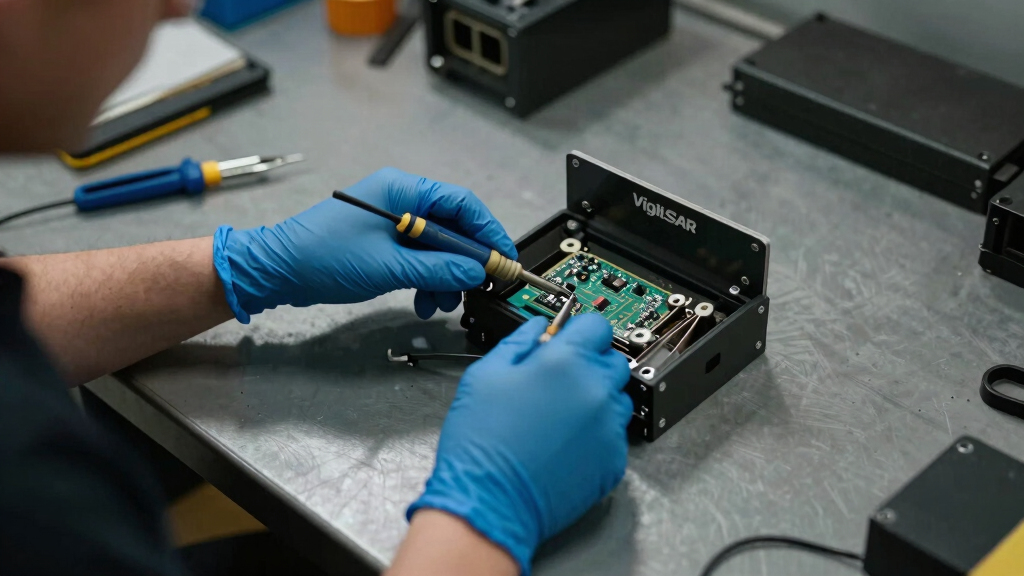
synthetic aperture radar (SAR) equipment
As an affiliate, we earn on qualifying purchases.
As an affiliate, we earn on qualifying purchases.
Briefings And Proof Points
The next public milestone would be evidence beyond the current write-up: demonstrations, benchmark data, sample Sentinel-1 workflows, commercial sensor relationships, deployment documentation or named users. Buyers would likely ask how detections are validated, how false positives are handled, what data sources are supported and how the system is governed in sensitive security settings.
For now, VigilSAR should be read as a public product positioning built on a real open SAR data foundation, not as an independently verified operational system. Its credibility will depend on whether Thorsten Meyer AI can show repeatable detection, classification and fusion performance under real monitoring conditions.
As an affiliate, we earn on qualifying purchases.
Key Questions
What is VigilSAR?
VigilSAR is described by Thorsten Meyer AI as a SAR-based intelligence, surveillance and reconnaissance platform that detects and classifies objects in radar imagery, then compares them with AIS, ADS-B and public information.
What makes SAR useful for this product?
Synthetic-aperture radar can collect imagery through cloud cover and in darkness because it uses its own microwave signal. That makes it useful when optical satellite imagery is limited by weather, smoke or night conditions.
Is VigilSAR proven?
The public foundation is checkable because Sentinel-1/Copernicus SAR data is free and public. The supplied material does not independently verify VigilSAR’s full commercial coverage, air-gapped deployment, customer use or performance.
Does VigilSAR have public pricing?
No public pricing is provided in the source material. The product is presented through a “Request Briefing” process rather than a self-serve plan.
Does a missing transponder mean wrongdoing?
No. A radar object without an AIS or ADS-B match may be suspicious or operationally relevant, but it can also reflect coverage gaps, equipment issues, timing differences, legal non-broadcasting cases or classification errors. Human verification is still required.
Source: Thorsten Meyer AI
Fall Picks
fall essentials
As an affiliate, we earn on qualifying purchases.