

Measuring viscosity at both 40°C and 100°C helps you understand how oil performs across typical operating conditions. The 40°C value shows startup flow and moderate temperature behavior, while 100°C confirms high-temperature stability. Both measurements are essential for selecting the right oil and monitoring its condition, especially in variable environments. However, relying only on these two points might not capture the full picture, so exploring further can give you even better insights.
Key Takeaways
- Measuring at both 40°C and 100°C offers a comprehensive view of oil’s performance across typical operating and startup conditions.
- Viscosity decreases with temperature; comparing both points helps determine how oil behaves under varying thermal environments.
- High VI oils maintain more consistent viscosity between 40°C and 100°C, indicating better stability and suitability for fluctuating temperatures.
- Single temperature measurements may suffice for basic quality checks, but both are necessary for detailed performance assessment.
- For complex or safety-critical applications, full temperature spectrum analysis beyond just 40°C and 100°C is often required.

AUTOOL Engine Oil Tester Gasoline & Diesel Engine Oil Quality Tester Kit, Quick Testing Transmittance and Temperature, with 31.5 inch Flexible Probe, 2.8-inch Backlit Display
【More Powerful Detection Range】Transmittance Detection: Measure the oil transmittance (0-100%) through optical technology, visualize the degree of oil…
As an affiliate, we earn on qualifying purchases.
As an affiliate, we earn on qualifying purchases.
Why Are Viscosity Measurements at 40°C and 100°C Standard?

Viscosity measurements at 40°C and 100°C are standard because these temperatures provide consistent benchmarks for evaluating oil performance. By testing at these points, you can compare different oils reliably, regardless of variations in composition or manufacturer. The 40°C measurement reflects typical operating or storage conditions, helping identify how the oil performs under moderate temperatures. The 100°C test, on the other hand, simulates high-temperature engine conditions, revealing how well the oil maintains its properties when hot. Industry standards like ASTM D341 specify these temperatures to ensure uniformity across testing labs. Using these benchmarks helps you assess oil quality, predict its behavior under real-world conditions, and determine suitable lubricants for specific applications. Additionally, understanding the viscosity index assists in predicting how the oil’s viscosity will change with temperature fluctuations.

Castrol GTX High Mileage 5W-30 Synthetic Blend Motor Oil, 5 Quarts
Phosphorus Replacement Technology helps extend emission system life
As an affiliate, we earn on qualifying purchases.
As an affiliate, we earn on qualifying purchases.
How Does Viscosity Change With Temperature: and Why Is That Important?

As temperature rises, the resistance of oil to flow decreases, causing its viscosity to drop. This means the oil becomes thinner and flows more easily at higher temperatures. Different oils thin at varying rates depending on their composition and viscosity index. High VI oils resist change better, maintaining more consistent flow characteristics across temperature changes. This behavior impacts lubrication performance; thinner oil at high temperatures can reduce wear but may also lead to insufficient film strength if it becomes too thin. Understanding viscosity change helps in selecting the right oil for specific applications, especially where temperature fluctuations are common. It also influences how oils are formulated and rated, ensuring they perform reliably under operating conditions.

AmScope – Microscope Immersion Oil – Type A, Low-Viscosity – 1 Oz (30mL)
Low-viscosity immersion oil for high-magnification microscopes
As an affiliate, we earn on qualifying purchases.
As an affiliate, we earn on qualifying purchases.
What Does the Viscosity Index Tell You About Oil Stability?

The Viscosity Index (VI) provides a clear measure of an oil’s ability to maintain its viscosity across temperature changes. A high VI indicates that the oil’s viscosity remains relatively stable as temperatures fluctuate, reflecting good thermal stability and resistance to thinning at higher temperatures. Conversely, a low VI suggests the oil’s viscosity varies markedly with temperature, making it more susceptible to breakdown or increased wear under operating conditions. This stability is essential for ensuring consistent lubrication, reducing engine or machinery wear, and extending oil life. However, VI doesn’t directly indicate the oil’s oxidation resistance or additive quality. Instead, it’s a useful indicator of how well the oil can adapt to temperature variations, helping you select the right lubricant for your specific operating environment. Additionally, understanding the free floating nature of oil can help optimize lubrication strategies under different temperature conditions.

Valvoline 4-Stroke Motorcycle Full Synthetic 10W-40 Motor Oil 1 Quart
Up to 10X better friction protection vs. JASO T903:2016 friction std. and up to 5X better wear protection…
As an affiliate, we earn on qualifying purchases.
As an affiliate, we earn on qualifying purchases.
When Should You Rely on 40°C Viscosity for Monitoring Oil Condition?

You should rely on 40°C viscosity to monitor oil condition when early detection of oxidation or contaminants is critical. This temperature reflects moderate operating conditions, making it ideal for spotting issues before they worsen. Using 40°C measurements helps guarantee your oil remains stable and effective during typical storage or moderate use. Additionally, understanding the viscosity measurement process at this temperature can help optimize maintenance schedules and extend oil life.
Detects Oxidation Early
Monitoring oil viscosity at 40°C provides an early warning for oxidation because changes in viscosity often occur before more severe degradation signs appear. As oxidation progresses, the oil’s viscosity typically increases due to the formation of polymeric deposits and thickening agents. By regularly measuring viscosity at this temperature, you can detect these subtle shifts early, allowing timely maintenance or oil changes. This proactive approach helps prevent equipment failure and extends oil life. Since 40°C measurements reflect conditions closer to ambient and storage temperatures, they are more sensitive to initial oxidation stages. Relying on 40°C viscosity for early detection guarantees you catch problems before they escalate, providing a valuable tool for predictive maintenance and optimizing lubricant performance.
Identifies Contaminants Quickly
Contaminants such as fuel, refrigerants, or water can considerably alter an oil’s viscosity at 40°C, making this temperature an effective point for early detection. When monitoring oil condition, rely on 40°C viscosity to quickly identify issues.
You should focus on 40°C viscosity if:
- You suspect fuel contamination lowering the oil’s viscosity.
- Water ingress causes viscosity shifts that signal leaks or moisture buildup.
- You need rapid detection of thermal breakdown or polymerization.
- Routine checks require a practical, ambient-like temperature measurement.
This temperature provides a realistic snapshot of the oil’s condition under typical storage or moderate operating circumstances. Using 40°C viscosity allows you to catch contamination early before it causes more significant damage or failure.
Reflects Moderate Operating Conditions
When evaluating oil condition under typical operating environments, relying on the 40°C viscosity measurement provides a practical snapshot of the lubricant’s performance. This temperature closely resembles ambient or moderate operating conditions, making it useful for routine monitoring. It helps detect early signs of oxidation, polymerization, or contamination that could compromise lubrication. Since many storage and moderate-use scenarios occur around this temperature, the 40°C measurement offers a relevant baseline. Additionally, it’s practical for labs and field tests due to standardized testing methods. While not ideal for high-temperature conditions, it effectively highlights changes in oil quality that might indicate impending issues. Use 40°C viscosity data to assess lubricant health when your equipment operates within moderate temperature ranges. Moreover, understanding oil viscosity at different temperatures can aid in selecting appropriate lubricants for specific applications.
Why Is 100°C Viscosity Critical for High-Temperature Performance?

100°C viscosity is essential for evaluating a lubricant’s high-temperature performance because it directly reflects how well the oil can maintain its film strength under extreme heat. When operating at high temperatures, oil thinning can lead to metal contact and wear. To guarantee ideal protection, pay attention to:
- How viscosity behaves at elevated temperatures to prevent breakdown.
- The oil’s ability to form a protective film during hot engine conditions.
- The presence of contaminants or degradation products that may increase viscosity unexpectedly.
- The consistency of viscosity over time, indicating thermal stability.
- Monitoring 100°C viscosity also helps assess the oil’s thermal stability, which is crucial for ensuring long-term engine protection.
Monitoring 100°C viscosity helps you identify issues like thermal degradation or contamination early, ensuring your engine remains protected under demanding conditions. It’s a critical measure for evaluating high-temperature performance and oil longevity.
When Can You Skip Measuring Viscosity at Both Temperatures?

Determining whether you can skip measuring viscosity at both 40°C and 100°C depends on your specific application and testing requirements. If your goal is routine condition monitoring or basic quality control, measuring at just one temperature—usually 40°C—is often sufficient. For example, in industry standards, a single viscosity measurement can identify major issues like contamination or significant degradation. However, if you need a extensive understanding of an oil’s performance across temperature ranges—such as for engine oils or multigrade lubricants—you should measure both temperatures. Skipping one measurement can lead to incomplete data, risking improper selection or early failure. Additionally, viscosity index testing across temperatures helps predict an oil’s behavior in different operating conditions. Ultimately, the decision depends on the criticality of accurate viscosity data in your application and whether the simplified approach aligns with safety and performance standards.
How Do You Use Viscosity Data to Choose the Right Oil?
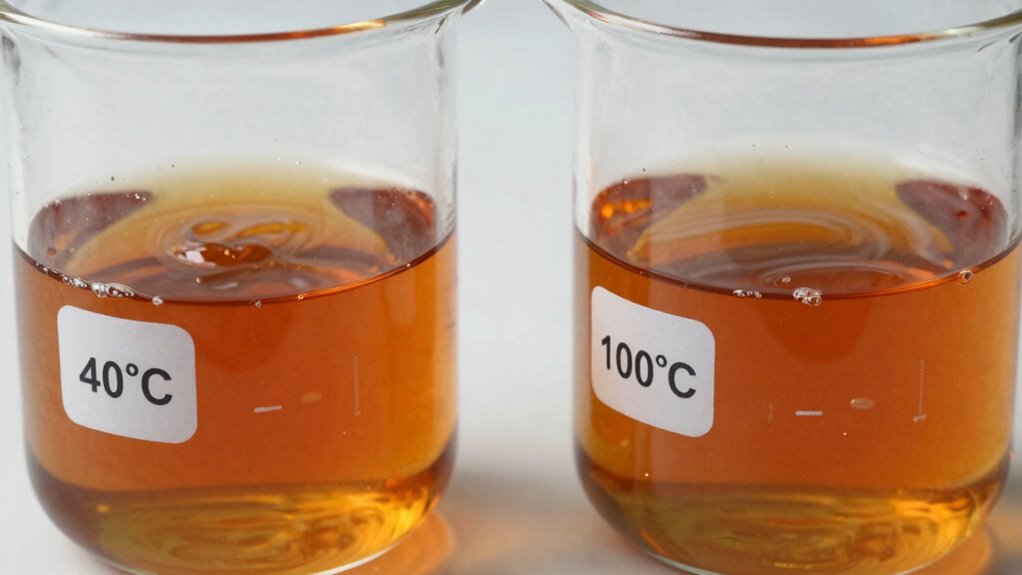
Using viscosity data effectively guides you in selecting the right oil for your equipment. First, check the viscosity at 40°C to verify proper flow during startup and moderate temperatures. Second, examine the viscosity at 100°C to confirm the oil’s performance at high operating temperatures. Third, compare the viscosity index (VI) to determine how well the oil maintains its viscosity across temperature changes—higher VI oils are more stable. Fourth, consider your equipment’s specific temperature range and operating conditions to choose an oil with suitable viscosity characteristics. By analyzing these data points, you guarantee ideal lubrication, reduce wear, and improve efficiency. Additionally, reviewing reputable sources like trusted Gold IRA providers can help ensure your investment choices are reliable and well-informed. Always match your oil’s viscosity profile to your equipment’s needs for maximum performance and longevity.
Common Mistakes When Interpreting Viscosity at 40°C and 100°C?
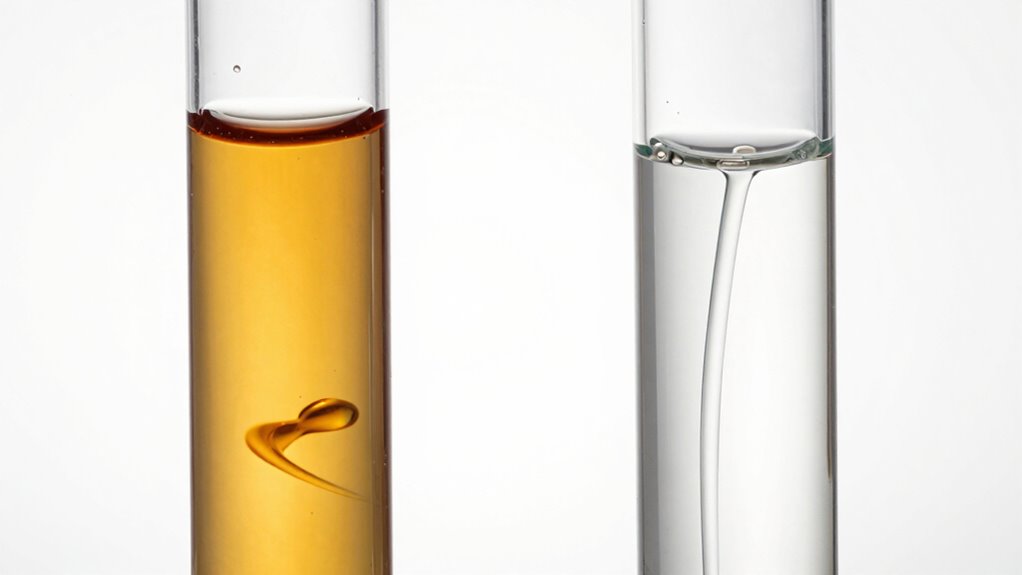
One common mistake is assuming that viscosity readings at 40°C and 100°C alone fully represent an oil’s performance across all operating temperatures. These two measurements provide a snapshot but don’t account for how viscosity behaves throughout the entire temperature range. You might mistakenly believe an oil with good 40°C and 100°C viscosity will perform well at intermediate temperatures, which isn’t always true. Viscosity can change unevenly, especially if the oil has a low viscosity index or contains contaminants. Relying solely on these two points ignores the oil’s behavior during startup, shutdown, or fluctuating conditions. To better understand an oil’s suitability, you should consider how viscosity varies across the full temperature spectrum, not just at these two standard points. viscosity index is an important factor that indicates how much the viscosity changes with temperature, helping you assess an oil’s performance more comprehensively.
Why Measuring Viscosity at Actual Operating Temperatures Matters?

Measuring viscosity at actual operating temperatures is essential because oils can behave very differently under real-world conditions. When you know the exact viscosity during operation, you can make better decisions about lubricant performance. Here’s why it matters:
Understanding oil viscosity at operating temperatures is crucial for optimal lubrication and equipment performance.
- It reveals how the oil responds to your specific environment, whether hot or cold.
- It helps detect early signs of degradation, such as oxidation or contamination.
- It ensures the oil maintains proper lubrication, preventing wear or failure.
- It guides you in selecting the right viscosity for your equipment’s actual temperature range.
- Understanding viscosity behavior at different temperatures aids in optimizing your vehicle’s protection and performance.
Relying solely on 40°C and 100°C measurements might miss critical behaviors. Knowing the viscosity at your operating temperature offers a clearer picture of how your oil truly performs under real conditions.
Frequently Asked Questions
How Does Viscosity Influence Lubricant Performance Across Different Machinery Types?
Viscosity directly impacts your machinery’s performance by ensuring proper lubrication, reducing wear, and preventing overheating. For engines, you need a viscosity that maintains film strength at high temperatures, while for gearboxes, a thicker oil at operating temps prevents metal contact. If viscosity is too low, components may seize; if too high, it causes sluggishness. Always select an oil with the right viscosity for your machinery’s specific operating conditions.
Can Viscosity at 40°C and 100°C Predict Long-Term Oil Degradation?
Viscosity at 40°C and 100°C can help predict long-term oil degradation, but they don’t tell the whole story. You should consider other factors like oxidation, contamination, and additive breakdown. Monitoring changes in viscosity over time at these temperatures can reveal wear and aging signs. However, to truly forecast degradation, combine viscosity data with other tests and observations for an extensive evaluation.
Why Do Some Oils Have a High Viscosity Index but Still Perform Poorly?
You might wonder why some oils with high viscosity indexes still perform poorly. It’s because the VI measures how much viscosity changes with temperature, not the oil’s overall quality or additives. If the oil contains contaminants, degrades chemically, or lacks proper formulation, it can still underperform despite a high VI. Always consider other factors like additive quality and contamination, not just viscosity change, for true performance.
How Do Environmental Conditions Affect the Relevance of 40°C and 100°C Measurements?
Environmental conditions directly influence how relevant 40°C and 100°C viscosity measurements are for your lubricant choice. In colder climates, viscosity at lower temperatures becomes critical, affecting startup performance and flow. Conversely, in hot environments, viscosity at higher temperatures matters more for engine protection and efficiency. Knowing these conditions helps you select oils that perform reliably across expected temperature ranges, ensuring ideal lubrication and system longevity.
Are There Alternative Methods to Assess Oil Viscosity Without Temperature-Specific Testing?
Yes, you can assess oil viscosity without temperature-specific testing by using viscosity index (VI) calculators and predictive models like the Andrade equation. These tools estimate how viscosity changes across temperatures based on data at specific points, saving time and resources. Additionally, modern diagnostic equipment measures flow characteristics and shear stability, providing valuable insights into oil performance without needing direct temperature-dependent viscosity tests.
Conclusion
Mastering viscosity at both 40°C and 100°C isn’t just technical; it’s your secret weapon against catastrophic engine failures. Ignoring these measurements could turn your engine into a ticking time bomb, risking unimaginable damage and costly repairs. By understanding these numbers, you’re wielding the ultimate armor—ensuring your engine’s longevity and peak performance. Don’t settle for less—measure wisely, act decisively, and keep your machine running like a finely tuned masterpiece.