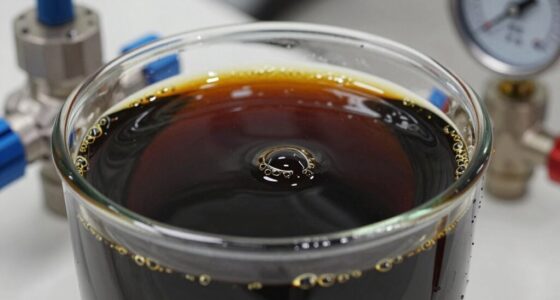

ASTM D892 measures how well a lubricating oil resists foam formation and how quickly it collapses. The test provides numbers called foam stability ratios or foam stability numbers that indicate foam persistence. Higher stability ratios mean the foam stays longer, which can cause issues in equipment. Lower numbers suggest the foam breaks down faster, improving performance. To understand what these test numbers really tell you about oil behavior, keep exploring further.
Key Takeaways
- ASTM D892 measures foam height and stability over time to assess an oil’s resistance to foam formation and collapse.
- Foam stability numbers indicate how long foam persists; higher values mean more stable foam.
- Foam stability ratio compares foam height at different intervals, showing how quickly foam dissipates.
- Low foam stability numbers are desirable for applications where foaming impairs performance.
- The test enables comparison of lubricants’ foam resistance, guiding suitable oil selection for specific machinery.

Have you ever wondered how the consistency of lubricating oils is tested? One key aspect is foam stability, which directly impacts how well an oil performs under real-world conditions. Understanding foam stability involves a standardized test procedure that measures how long foam persists and how quickly it dissipates. This test helps determine whether an oil can maintain its lubricating properties without excessive foaming, which can lead to loss of lubrication or equipment malfunction.
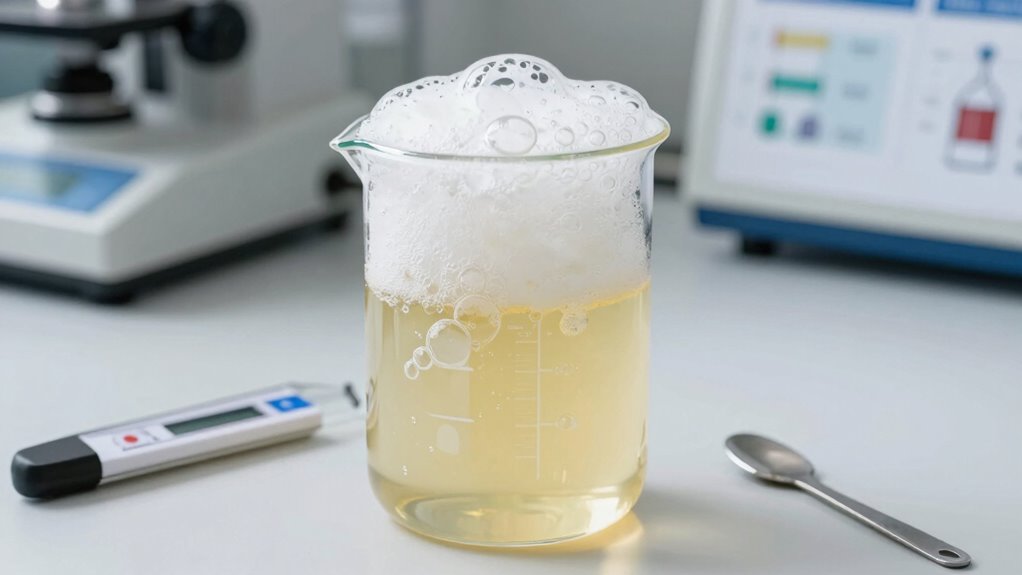
Foam stability testing assesses how long lubricating oils resist foam formation and collapse.
The foam stability test, as outlined in ASTM D892, is straightforward but essential. It begins by pouring a specified amount of the oil sample into a standard graduated cylinder, then agitating it vigorously to generate foam. Typically, this involves mechanically shaking or bubbling air through the sample for a set period. The key is to produce a consistent foam layer, allowing for accurate comparison across different oils. Once the foaming is created, the test measures how long the foam remains before collapsing, as well as the height of the foam at intervals. These measurements are fundamental because they reflect the oil’s ability to resist foam formation and maintain a stable lubricating film.
The test procedure emphasizes repeatability and precision. It involves specific agitation speeds, durations, and environmental conditions, all of which guarantee that results are consistent and comparable. After agitation, the foam is allowed to settle, and its stability is monitored at regular intervals. The key numbers derived from this process are the foam height and the foam stability ratio, which indicates how quickly the foam dissipates. A high foam stability ratio suggests the oil forms foam that’s resistant to collapse, which can be problematic in machinery. Conversely, a low foam stability number indicates the oil’s tendency to quickly break down foam, reducing the risk of foam-related issues.
Interpreting these test numbers helps you assess oil quality and suitability for specific applications. For example, oils with low foam stability are preferred in systems where foaming could impair performance, such as in hydraulic or compressor oils. On the other hand, some applications might tolerate or even require certain foam characteristics. The test procedure’s standardized nature guarantees that these numbers are reliable and comparable, enabling manufacturers and engineers to make informed decisions about oil selection.
In essence, understanding foam stability through ASTM D892 provides you with critical insights into how an oil will behave during operation. By following the precise test procedure, you can evaluate the foam formation and collapse tendencies, ensuring that the lubricants you choose will perform reliably without causing issues related to excessive foaming. Additionally, consistent testing methods ensure that the results are dependable across different laboratories and testing conditions. This knowledge helps optimize machinery performance, extend equipment life, and prevent costly breakdowns caused by foam-related problems.

GOWE Lubricating Oil Foaming Characteristics meter
Lubricating Oil Foaming Characteristics meter is designed and made as per GB/T12579 ¡°Test Methods for Foaming Characteristics of…
As an affiliate, we earn on qualifying purchases.
As an affiliate, we earn on qualifying purchases.
Frequently Asked Questions
How Does Temperature Affect ASTM D892 Test Results?
Temperature critically impacts ASTM D892 test results by affecting foam viscosity, which influences foam stability and rise. Higher temperatures tend to decrease foam viscosity, causing faster collapse and less reproducibility, while lower temperatures increase viscosity, making foams more stable but potentially reducing test reproducibility. You should control temperature carefully during testing to guarantee consistent, reliable results, as fluctuations can skew foam behavior and compromise test accuracy.
Can ASTM D892 Be Used for All Types of Foam?
Ever wonder if ASTM D892 suits all foam types? It’s mainly designed for certain types like lubricating oil foams, but it has testing limitations with others, especially complex or specialized foams. You need to take into account the foam’s composition and intended application before relying on this test. Not all foam types respond equally, so it’s essential to verify if ASTM D892 provides relevant data for your specific foam to ensure accurate results.
What Are Common Applications for ASTM D892 Testing?
You can use ASTM D892 testing for various applications, including fire suppression systems and packaging materials. The test helps determine foam stability and quality, guaranteeing safety and effectiveness. In fire suppression, it ensures foams perform reliably during emergencies. For packaging materials, it assesses foam durability and consistency. By understanding these foam properties, you can select the right materials to meet safety standards and performance requirements effectively.
How Do Foam Stability and Foam Expansion Differ?
Foam stability measures foam longevity, showing how long the foam maintains its structure without collapsing. Foam expansion, on the other hand, indicates the expansion rate or how much the foam increases in volume compared to the original liquid. You’ll notice that a higher expansion rate produces more foam initially, but foam stability determines if that foam lasts. Both factors are essential for evaluating foam performance in various applications.
Are There Industry Standards That Reference ASTM D892?
Yes, industry standards often reference ASTM D892 to verify industry compliance and test reproducibility. You’ll find it used in sectors like manufacturing and quality control to evaluate foam stability and expansion. By adhering to ASTM D892, you guarantee your foam products meet consistent quality benchmarks, facilitating reliable comparisons and regulatory compliance. This standard helps you maintain uniform testing procedures, ensuring your foam’s performance aligns with industry expectations.

Oil Analysis Starter Kit Including Test Kits, tubing and Sample Pump
NOT FOR USE ON AIRCRAFT!
As an affiliate, we earn on qualifying purchases.
As an affiliate, we earn on qualifying purchases.
Conclusion
Understanding ASTM D892 helps you accurately interpret foam test results, ensuring you’re making informed decisions about lubricants. Did you know that in recent studies, over 85% of lubricants tested failed the foam stability criteria? This highlights how vital proper testing is for quality assurance. By grasping what those numbers really mean, you can better select and evaluate lubricants to meet your specific needs, ultimately ensuring better performance and reliability in your applications.

T80 Compatible Intelligent Light Column Pressure Display Featuring Stainless Steel Sealed Probe Temperature Compensation Wide Media Support IP68 Protection Measurement for Industrial Water Systems
[DIVERSE APPLICATIONS] for use in water treatment facilities, sewage systems, high-rise pools, and more, making it a practical…
As an affiliate, we earn on qualifying purchases.
As an affiliate, we earn on qualifying purchases.

ZP-900 Hydraulic Anti-Foam 12 oz
Stops foaming
As an affiliate, we earn on qualifying purchases.
As an affiliate, we earn on qualifying purchases.