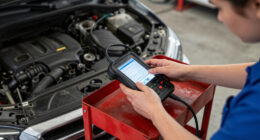
This checklist is for DIY vehicle owners setting up a home garage, refreshing their tool kit, or deciding which jobs they are ready to handle themselves. It covers core hand tools, lifting equipment, wheel work, diagnostics, and battery support, with a mix of named picks and advice-only sections.

Get business pricing on garage and car supplies
- Business-only prices and quantity discounts
- Tax-exempt purchasing
- Multiple users, one account, clear invoices
The sections follow a garage setup order: start with general-purpose tools, then consider lifting and wheel-service equipment, followed by impact work, diagnostics, and battery care. Each slot explains what to assess and where compatibility or fit deserves attention.
Use the list as a job-by-job checklist, not a reason to buy every item at once. Match tools to the vehicles you work on, check vehicle and equipment instructions before use, and make safe support and correct fit your first priorities.
Mechanic’s Tool Set
A mechanic’s tool set is the everyday foundation for garage tasks that call for turning fasteners. The listed pick is the DeWalt 264-Piece Mechanic Tool Set, 1/4", 3/8", 1/2" Drive, SAE/Metric. Its name identifies three drive sizes and SAE/metric coverage, which gives you useful details to compare against the work you expect to do. Before choosing any set, consider the fasteners and access points on your vehicles, along with whether you already own tools that would duplicate its contents.
A common buying mistake is focusing on a large piece count without checking what the pieces are or whether they suit your jobs. Look over the included tools and storage arrangement, and think about which pieces you can identify and reach quickly. Drive size is a fit question: confirm that your sockets and accessories match the ratchets or other tools you plan to use. SAE/metric labeling can help you assess whether the set aligns with the fasteners you encounter, but check your vehicle’s service information rather than guessing.
Keep the set organized and return pieces to their designated places so gaps are easy to spot. If you work in tight spaces, consider access and tool length alongside coverage. A well-matched set is more useful than a collection chosen on piece count alone.
What to look for:
- Confirm which sockets, ratchets, and accessories are included.
- Match the 1/4", 3/8", and 1/2" drives to your intended jobs.
- Check SAE/metric coverage against vehicle service information.
- Review storage layout and whether tools are easy to identify.
- Compare contents with tools you already own.
DeWalt 264-Piece Mechanic Tool Set, 1/4", 3/8", 1/2" Drive, SAE/Metric

This 264-piece mechanic tool set includes ratchets, sockets, wrenches, and bits designed for various repair tasks. Features like direct torque technology and corrosion-resistant chrome finish enhance durability and efficiency, with a sturdy case for organization and portability.
Pros:
- Comprehensive set with 264 pieces for versatile repairs
- Durable chrome finish provides corrosion resistance
- Includes organized case for easy storage and transport
- High customer rating of 4.8/5
Cons:
- Heavy and bulky, may be inconvenient for small jobs
- High price point may not suit casual users
- Some users may find the number of pieces overwhelming
Best for: DIY owners building a general-purpose hand-tool base.
Not ideal for: Shoppers who need a specific missing tool rather than a set.
Bottom line: Choose the DeWalt set if its included tools and drive sizes fit the work you plan to do.
Hydraulic Floor Jack
A floor jack helps position a vehicle for work that requires lifting, so vehicle compatibility and safe use come before convenience features. The listed pick is the Big RED 4 Ton Low Profile Hydraulic Service Floor Jack with Dual Pisto. Its name calls out a 4-ton rating, a low-profile design, and dual-piston wording; verify the complete product details and instructions before deciding whether those features suit your vehicle and workspace.
A frequent mistake is assuming that a jack’s stated capacity alone makes it appropriate for every vehicle or lift point. Check the vehicle’s manual for the correct lifting points and the jack documentation for its permitted use. Consider clearance at the intended lift point, the jack’s reach and range, and whether its shape can approach the vehicle without interference. Work on a firm, level surface and use appropriately rated stands to support a lifted vehicle; a jack is for lifting, not a substitute for secure support.
Think through the full lifting setup before buying: the jack must work with your vehicle, the stands must support it safely, and you need enough room to position and operate the equipment. Read the instructions for both vehicle and jack, and do not proceed when you cannot confirm the correct lift points or a stable setup.
What to look for:
- Verify the rating against vehicle and equipment documentation.
- Check clearance at the vehicle’s specified lift points.
- Compare lift range and reach with the vehicle’s requirements.
- Review operating instructions and the complete product specification.
- Plan to support the vehicle with suitable jack stands.
Big RED 4 Ton Low Profile Hydraulic Service Floor Jack with Dual Piston Fast Lif

This heavy-duty floor jack features a 4-ton (8,800 lbs) capacity and a 4-20 inch lifting range, suitable for most vehicles. It is designed for professional and DIY use, offering safe, efficient lifting with a quick dual-pump system and durable steel construction.
Pros:
- High load capacity suitable for most vehicles
- Fast lifting with dual-piston system
- Durable heavy-gauge steel construction
- Easy to maneuver and store
Cons:
- Limited to vehicles within the 4-20 inch lifting range
- Requires assembly and space for storage
- Heavy weight may be difficult to lift manually
Best for: Owners whose vehicles and lift points suit this low-profile jack.
Not ideal for: Anyone unable to confirm vehicle compatibility or a stable lifting setup.
Bottom line: Consider the Big RED jack only after checking its full specifications against your vehicle.
Jack Stands
Jack stands provide the stable support plan for work beneath or around a raised vehicle. There is no named product pick for this slot, so make the choice from the vehicle, the lifting method, and the stand’s documentation. Confirm the required capacity and support points using reliable vehicle and equipment instructions, and make sure the stands can be positioned where the vehicle is designed to be supported.
A common mistake is treating stands as an accessory to choose after the jack. Plan the pair together: the jack must reach the lifting point, and the stands must fit the support points and provide a stable setup on the surface where you work. Check the stand’s stated capacity and operating range, inspect its locking or support mechanism as described by its maker, and read its instructions before use. Do not rely on a jack alone to hold a vehicle while you work.
Compatibility includes height and placement, not just capacity. Consider whether the stands can reach the required support height while remaining properly positioned, and whether their bases sit securely on your work surface. If you cannot confirm fit, capacity, or correct support points, stop and consult the vehicle and equipment documentation before lifting.
What to look for:
- Confirm capacity using vehicle and stand documentation.
- Match the stand’s height range to the planned support points.
- Check that the stands can be positioned securely on your work surface.
- Review the maker’s instructions for locking and support procedures.
- Plan stand placement before raising the vehicle.
Cordless Impact Wrench
An impact wrench can support fastener work where a powered tool is appropriate, while a hand tool may still be needed for careful control. The named pick is the Milwaukee M18 FUEL 18V Brushless Cordless 1/2-Inch Impact Wrench Kit. Its name specifies an 18V cordless kit and a 1/2-inch drive. Check the kit contents and tool instructions to see whether it fits your existing equipment and the jobs you intend to handle.
A common mistake is assuming that a matching drive size guarantees compatibility with every socket or fastener. Confirm that accessories are intended for impact use and fit the tool, then check the vehicle’s service information for the correct procedure and tightening requirements. For installation, use the appropriate method to achieve the specified result; do not treat an impact wrench as a substitute for controlled final tightening when the procedure calls for it.
Consider reach, access, handling, and the included kit components before choosing. Cordless convenience matters only if the tool and its power arrangement suit your workflow. Read the product documentation for battery and charger details rather than assuming which components are included. Keep the correct socket and procedure in mind for each task, and avoid using powered tools where the vehicle instructions call for a different approach.
What to look for:
- Confirm the kit’s included components and power arrangement.
- Check that sockets and accessories fit the 1/2-inch drive and are impact-rated.
- Compare tool access and handling with your intended jobs.
- Follow vehicle instructions for loosening and tightening fasteners.
- Review battery and charger details in the product documentation.
Milwaukee M18 FUEL 18V Brushless Cordless 1/2-Inch Impact Wrench Kit

This Milwaukee M18 FUEL impact wrench has a brushless motor and a 1/2-inch friction ring. The kit includes one 5.0 Ah battery and a carrying bag.
Pros:
- Brushless motor
- Cordless 18V design
- Includes a 5.0 Ah battery and bag
Cons:
- Listed item weight is 11.2 pounds
Best for: Owners seeking a cordless impact wrench for compatible fastener work.
Not ideal for: Those who need a different drive size or a specific kit component not included.
Bottom line: Choose the Milwaukee kit if its contents, drive size, and instructions match your workflow.
OBD2 Scanner
An OBD2 scanner can help you read vehicle diagnostic information, but this checklist has no named product pick for the slot. Start by checking the vehicle’s manual and the scanner maker’s compatibility information. Confirm the vehicle’s model year and system requirements against the device documentation before buying, and be clear about whether you need basic code access or functions beyond that.
A common mistake is choosing a scanner based on a broad compatibility claim without confirming the exact vehicle and features. Product descriptions can use terms differently, so check the functions that matter to you and how results are displayed or saved. Consider whether you need a handheld device or a tool that works with another device, and confirm what is included. Do not assume a code by itself identifies the complete cause of a problem; use the vehicle’s service information or qualified assistance to interpret findings.
Think about ease of use before purchase: readable instructions, a clear display or interface, and a practical way to access results all matter. Verify that the connector and supported systems suit your vehicle using documentation. If the scanner will be used across multiple vehicles, check each one individually rather than assuming they share the same support.
What to look for:
- Check compatibility using the vehicle and scanner documentation.
- List the diagnostic functions you actually need.
- Confirm how the scanner displays, stores, or shares results.
- Review included components and operating instructions.
- Check compatibility separately for each vehicle you plan to scan.
Battery Charger
A battery charger belongs in a garage checklist when you want equipment for battery care or charging tasks. The listed pick is the Schumacher Electric SC1445 6/12V Wheeled Battery Charger and 250A Engi. The product name identifies 6/12V operation, a wheeled design, and 250A wording; use the complete product documentation to confirm its functions and intended applications before buying.
A common mistake is treating voltage labeling as the only compatibility check. Verify the vehicle or battery requirements and follow both battery and charger instructions. Confirm the battery type and charging procedure are supported, and check whether the charger’s controls and connections suit the tasks you plan to perform. The name includes “250A Engi,” but do not infer a particular function from that abbreviated wording; consult the full product listing and manual for its meaning and limitations.
Consider where the charger will be stored and used. A wheeled design may be relevant to moving it around your workspace, but check the complete specifications and how the equipment will fit your setup. Review connection steps, ventilation and handling guidance, and any safety directions in the documentation. Prioritize correct battery matching and clear instructions over features you have not confirmed you need.
What to look for:
- Verify battery and vehicle compatibility in the charger documentation.
- Confirm the supported battery types and charging procedures.
- Check the meaning and limitations of the complete product specifications.
- Review connections, controls, and operating instructions.
- Consider storage and movement needs for a wheeled unit.
Schumacher Electric SC1445 6/12V Wheeled Battery Charger and 250A Engine Starter
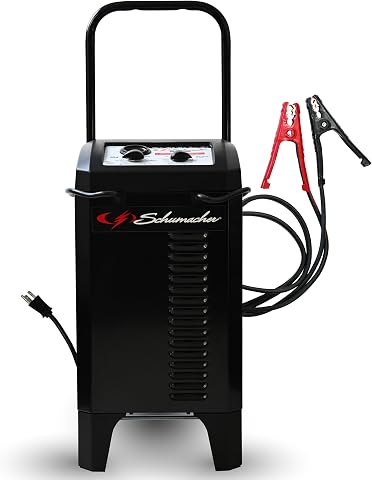
The Schumacher SC1445 is a wheeled manual battery charger and engine starter with 250A engine start, 25A and 50A boost modes, and a 10A charging mode. It supports 6V and 12V standard, AGM, gel, and deep-cycle batteries, with a 135-minute timer, analog ammeter, steel case, retractable handle, and solid wheels.
Pros:
- Combines battery charging and engine starting
- Supports multiple battery types and both 6V and 12V systems
- Wheeled design with retractable handle for mobility
- Manual timer and analog ammeter provide charging control and monitoring
Cons:
- Manual charging requires the user to control the process
- The product description gives conflicting boost-mode voltage details
Best for: Owners whose battery requirements match the charger documentation.
Not ideal for: Anyone unable to verify battery type, supported use, or charging procedure.
Bottom line: Review the complete Schumacher specifications and battery instructions before choosing this charger.
Build your garage in a job-first order: begin with the hand tools you will use across routine tasks, then plan safe lifting equipment as a compatible system. Add an impact wrench when its drive size and kit fit your work, followed by a scanner or charger once you have confirmed the functions and battery requirements you need.
You can put together a useful setup one task at a time. Check vehicle instructions, compare each tool’s documentation with your needs, and pause when compatibility or safe support is uncertain. A considered checklist helps you focus on equipment that fits the work ahead.
Halloween Picks
halloween
As an affiliate, we earn on qualifying purchases.