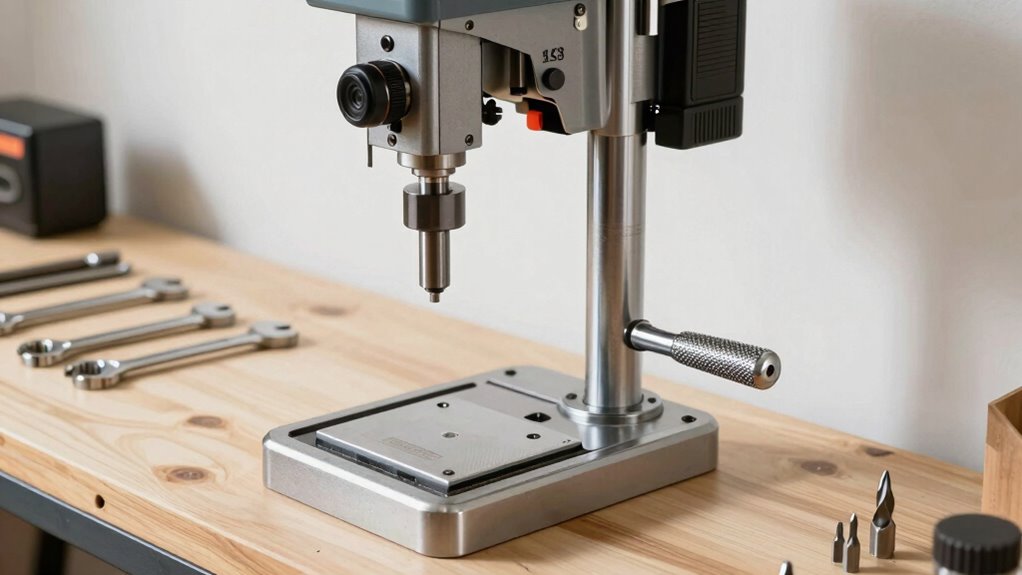
For a heavy-duty benchtop drill press, my best overall pick is the JET JWDP-12: its variable speed and digital RPM readout make it easier to match drilling speed to the material. The JET J-2530 stands out for buyers who want a larger 15-inch swing and a broad range of fixed speeds, while the BUCKTOOL 12-inch pairs a 3/4 HP motor with a slower speed range suited to demanding work. The main tradeoffs are capacity and control versus footprint, simplicity, and budget. Continue reading for the full breakdown of all 11 options and the features that separate shop-ready machines from lighter-duty models.

Get business pricing on garage and car supplies
- Business-only prices and quantity discounts
- Tax-exempt purchasing
- Multiple users, one account, clear invoices
Complete the kit

Key Takeaways
- The JET JWDP-12 leads for control: variable speed and a digital RPM readout make speed selection more direct than on fixed-speed models.
- The JET J-2530 prioritizes capacity: its 15-inch swing and 16 speeds suit larger work, but its size and 115/230V setup call for more planning than compact presses.
- Motor power alone does not define heavy-duty performance: swing, spindle speed range, table support, and machine mass all affect how confidently a press handles large or tough work.
- The 12-inch group offers the broadest middle ground: VEVOR, BUCKTOOL, and WEN options bring more reach than 8- or 10-inch presses without the JET J-2530’s 15-inch footprint.
- Compact picks trade capacity for shop flexibility: the WEN 4206T and VEVOR 10-inch model suit tighter spaces, but they are less compelling for frequent large-hole or oversized-stock work.


| drill press bench top heavy duty | Swing | Motor | Voltage | Chuck capacity |
|---|---|---|---|---|
| VEVOR Benchtop Drill Press | 10 inches | 3.2 A | 120 V | — |
| WEN 6.2-Amp 33-Inch Radial Arm | — | 6.2 A induction motor | — | 5/8 inch |
| JET JWDP-12 12" Benchtop Drill | 12 inches | 1/2 HP, 5 A | 115 V, 1-phase | 5/8 inch |
| VEVOR 12 in Benchtop Drill Pre | 12 inches | 5 A | 120 V | — |
| SKIL 6.2 Amp 10-Inch Benchtop | 10 inches | 6.2 A induction motor | 120 V | — |
| JET 15-Inch Benchtop Drill Pre | 15 inches | — | 115/230V, single phase | — |
| WEN 10-Inch Benchtop Drill Pre | 10 inches | 6.2-amp induction motor | — | 1/2 inch |
| WEN 2.3-Amp 8-Inch 5-Speed Cas | 8 inches | 2.3 amps | 120V | 1/2 inch |
| BUCKTOOL 12-Inch Benchtop Dril | 12 inches | — | — | — |
| VEVOR 12-Inch Benchtop Drill P | 12 inches | — | 110V | 0.6 inch |
| WEN 12-Inch Benchtop Drill Pre | 12 inches | — | — | 5/8 inch |
More Details on Our Top Picks
VEVOR Benchtop Drill Press, 3.2 Amp, 5-Speed, 10-inch Swing, Cast Iron Frame, Tilting Worktable
For a buyer who wants a cast-iron frame and tilting table without moving up to a larger machine, this VEVOR is a straightforward fit. Its five fixed speeds cover routine drilling in wood and lighter metal, while the 45-degree table tilt helps with angled holes. Compared with the SKIL 6.2 Amp 10-Inch, it gives up motor amperage and has less supplied detail around accuracy aids, so it suits simpler jobs better than frequent precision work. The tradeoff is a 0.5-inch stated drilling capacity in both wood and metal; buyers tackling larger bits or demanding metalwork should look at the stronger JET or WEN options instead. Its cast-iron construction adds useful mass, but also makes it less convenient to shift around a crowded bench.
Pros:- Cast-iron frame offers a stable base for ordinary bench drilling.
- Tilting worktable supports angled holes up to 45 degrees.
- Five speed settings provide options for different materials and bit sizes.
- Includes accessories for setup and operation.
Cons:- Stated drilling capacity is limited to 0.5 inches for wood and metal.
- Five fixed speeds lack the adjustment flexibility of variable-speed models such as the JET JWDP-12.
- Cast-iron construction can be awkward to relocate in a small workspace.
Best for: Home woodworkers and occasional metal hobbyists who want a compact, cast-iron press for routine holes and occasional angled drilling.
Not ideal for: Buyers drilling larger holes, working metal heavily, or needing fast, precise speed adjustment; the stated capacity is limited and speeds are fixed.
- Swing:10 inches
- Motor:3.2 A
- Voltage:120 V
- Speed settings:5
- Maximum speed:2,800 rpm
- Maximum chuck size:0.5 inches
- Stated drilling capacity:0.5 inches in wood and metal
- Worktable:Tilts up to 45 degrees
Our verdict“Choose this VEVOR for straightforward bench drilling and a tilting cast-iron table, but step up to the SKIL or JET for more demanding work.”
WEN 6.2-Amp 33-Inch Radial Arm Drill Press, 5-Speed Benchtop Model (4233)
The WEN 4233 earns its place through reach rather than compactness: its radial arm adjusts the swing from 11 to 33 inches, letting the head move over broad or awkward workpieces that are difficult to position under a conventional benchtop press. A 6.2-amp induction motor, 5/8-inch chuck, and cast-iron base give it a more substantial working profile than the 10-inch VEVOR and SKIL models. Its table tilts both left and right, adding flexibility for angled setups. That reach has a clear cost in shop space and handling: at 105 pounds, it is a poor choice if the press must be moved often. Speed changes also mean manual belt repositioning, unlike the JET JWDP-12’s mechanical variable-speed control. This is a specialized heavy bench machine, not the easiest general-purpose pick.
Pros:- Adjustable 11-to-33-inch swing reaches across large workpieces.
- 6.2-amp induction motor and 5/8-inch chuck support a substantial range of drilling tasks.
- Cast-iron table tilts 45 degrees left or right and has slots for clamping.
- Locking depth stop supports repeatable hole depth.
Cons:- At 105 pounds, setup and relocation can be difficult.
- Changing among the five speeds requires manual belt repositioning.
- Its radial-arm footprint demands more bench space than the 10-inch VEVOR or SKIL.
Best for: Woodworkers and fabricators who regularly drill large panels or reposition holes across wide workpieces and can dedicate a sturdy bench to the machine.
Not ideal for: Small-shop users who need to move their press frequently or want quick speed changes; its 105-pound weight and belt adjustment add effort.
- Adjustable swing:11 to 33 inches
- Motor:6.2 A induction motor
- Speeds:5: 600, 1,100, 1,700, 2,300, or 3,100 rpm
- Spindle travel:3-1/8 inches
- Chuck capacity:5/8 inch
- Worktable:10-inch cast iron; tilts 45 degrees left and right
- Base:15 x 21-inch cast iron
- Weight:105 pounds
- Warranty:2 years
Our verdict“Pick the WEN 4233 when reach across large workpieces matters more than portability or convenient speed changes.”
JET JWDP-12 12″ Benchtop Drill Press with Variable Speed and Digital RPM Readout
The JET JWDP-12 is the lineup’s precision-minded woodworking choice: its mechanical variable-speed drive adjusts from 530 to 3,100 rpm without belt changes, and the digital readout makes the selected speed visible while you work. That combination is more convenient for changing bit sizes and materials than the fixed-speed VEVOR and SKIL presses. The XACTA laser crosshairs and LED work light also help with alignment and visibility, while the cast-iron table tilts up to 45 degrees in either direction. Its 12-inch swing and 5/8-inch chuck are substantial for a benchtop machine, but the listed guidance limits its suitability to woodworking rather than heavy metal drilling. At 85 pounds, it also needs a secure mounting surface and can be awkward to assemble. Buyers focused on maximum workpiece reach should compare it with the WEN 4233’s radial arm.
Pros:- Variable speed from 530 to 3,100 rpm avoids belt changes.
- Digital rpm readout helps users set and monitor speed.
- Laser crosshairs and LED work light aid alignment and visibility.
- Cast-iron table tilts 45 degrees left or right.
Cons:- Not presented as a choice for heavy-duty metal drilling.
- At 85 pounds, it is difficult to move and should be securely mounted.
- Assembly of the heavy machine may require help, and mounting fasteners are not included.
Best for: Woodworkers who change speeds often and want a digital rpm readout, built-in alignment aids, and a stable cast-iron table.
Not ideal for: Buyers seeking a press for heavy-duty metal drilling, frequent relocation, or wide-panel reach; its stated strengths center on woodworking and it weighs 85 pounds.
- Swing:12 inches
- Spindle speed:530 to 3,100 rpm
- Motor:1/2 HP, 5 A
- Voltage:115 V, 1-phase
- Chuck capacity:5/8 inch
- Spindle travel:3-1/8 inches
- Table:9-1/2 x 9-1/2-inch cast iron; tilts 45 degrees left or right
- Weight:85 pounds
- Warranty:5 years; 2 years for commercial use
Our verdict“Choose the JET JWDP-12 for woodworking that benefits from easy, visible speed adjustment, not for heavy metalwork or frequent moves.”
VEVOR 12 in Benchtop Drill Press, 5 Amp 120V, Variable Speed Cast Iron Bench Drill Press with Laser Work Light
This 12-inch VEVOR offers a useful middle ground for buyers who want variable speed and a cast-iron build without stepping into the JET’s more specialized woodworking setup. Its 580-to-3,200-rpm range is broad on paper, and the laser work light gives a visible reference when positioning a hole. The listed 0.6-inch drilling capacity in wood and metal is also higher than the 0.5-inch limits stated for the smaller VEVOR and SKIL presses. However, the supplied data does not specify a chuck capacity or spindle travel, so buyers comparing fit and reach should verify those details before purchase. The laser may need calibration, and the heavy, bulky cast-iron construction calls for a stable bench. Compared with the JET JWDP-12, it lacks a stated digital rpm readout, making speed monitoring less explicit.
Pros:- 12-inch swing gives more workpiece clearance than the 10-inch VEVOR and SKIL models.
- Variable speed spans 580 to 3,200 rpm.
- Stated drilling capacity reaches 0.6 inches in wood and metal.
- Cast-iron construction and laser work light suit a fixed, well-supported bench setup.
Cons:- Laser alignment may need calibration before it can be relied on.
- Heavy, bulky construction is less suitable for a small or frequently rearranged workspace.
- Chuck capacity and spindle travel are not specified in the supplied product data.
Best for: DIYers and small-shop users who want a 12-inch swing, variable speed, and stated wood-and-metal capacity in a cast-iron benchtop press.
Not ideal for: Buyers who need a clearly specified chuck and spindle reach, frequent portability, or a digital speed readout; those details are not supplied here.
- Swing:12 inches
- Motor:5 A
- Voltage:120 V
- Speed range:580 to 3,200 rpm
- Stated drilling capacity:0.6 inches in wood and metal
- Construction:Cast iron
- Additional feature:Variable speed
- Work light:Laser work light
Our verdict“Choose this VEVOR if variable speed and a 12-inch swing are priorities, but confirm chuck and spindle details before committing.”
SKIL 6.2 Amp 10-Inch Benchtop Drill Press with Laser Alignment and Work Light
The SKIL DP9505-00 brings a 6.2-amp induction motor and practical alignment aids to a 10-inch benchtop format. Its five speeds run from 610 to 2,800 rpm, while the laser, LED work light, adjustable depth stop, and tilting work surface support repeatable everyday drilling. Against the smaller 3.2-amp VEVOR, the stronger stated motor makes the SKIL the more capable compact choice; against the JET JWDP-12, it gives up variable speed and a 5/8-inch chuck in favor of a simpler five-speed arrangement. Its listed drilling capacity remains 0.5 inches in wood and metal, so it is not the pick for larger bits or demanding metal jobs. The laser may need calibration, and its supplied warranty information is limited to Amazon’s return policy rather than a manufacturer warranty.
Pros:- 6.2-amp induction motor is stronger on paper than the 3.2-amp VEVOR’s motor.
- Laser alignment and LED work light support positioning and visibility.
- Adjustable depth stop helps repeat hole depth.
- Tilting work surface adds flexibility for angled drilling.
Cons:- Stated drilling capacity is limited to 0.5 inches in wood and metal.
- Five fixed speeds are less flexible than the variable-speed JET JWDP-12 or 12-inch VEVOR.
- Laser alignment may need calibration, and the supplied warranty data lists only Amazon’s return policy.
Best for: Home-shop users who want a 10-inch press with a stronger stated motor, alignment aids, and a depth stop for repeat work.
Not ideal for: Buyers drilling holes larger than 0.5 inches, seeking variable-speed control, or needing a clearly stated manufacturer warranty.
- Swing:10 inches
- Motor:6.2 A induction motor
- Voltage:120 V
- Speed settings:5
- Speed range:610 to 2,800 rpm
- Maximum chuck size:0.5 inches
- Stated drilling capacity:0.5 inches in wood and metal
- Additional features:Laser alignment, LED work light, adjustable depth stop, tilting work surface
Our verdict“Pick the SKIL for a compact 10-inch press with helpful alignment and depth features, but choose a variable-speed or larger-capacity model for tougher jobs.”
JET 15-Inch Benchtop Drill Press, 16 Speed, 3/4 HP, 115/230V 1Ph (Model J-2530)
The JET J-2530 is the strongest fit here for buyers who value a substantial, steady machine and a broad choice of fixed speeds over convenience features. Its 3/4 HP motor, 16 speed settings, large ground-steel column, and cast-iron head are aimed at controlled drilling across varied materials; the 3-1/8-inch quill travel also gives more depth per plunge than the WEN DP1062V’s 2-inch travel. Four permanently lubricated spindle bearings support the machine’s precision focus. Compared with the BUCKTOOL 12-inch model, JET offers a wider stated speed range and a more established heavy-duty feature set, while BUCKTOOL adds a laser and work light. The tradeoff is that JET does not list those positioning aids, and changing among 16 speeds may be less convenient than variable-speed control. Its 15-inch swing and substantial build also call for a sturdy bench and room to work.
Pros:- 3/4 HP motor paired with 16 speeds from 200 to 3,630 RPM
- 3-1/8-inch quill travel supports deeper drilling per plunge
- Ground-steel column and cast-iron head support rigidity
- Four permanently lubricated spindle bearings are designed to support precision
Cons:- No laser guide or digital speed display is listed
- Selecting among 16 speeds is less direct than mechanical variable-speed adjustment
- Its substantial frame needs a sturdy mounting surface and generous bench space
Best for: Woodworkers and metalworking hobbyists who need a stable benchtop press, deeper quill travel, and multiple speed choices for varied drilling jobs.
Not ideal for: Buyers who prioritize quick variable-speed changes, built-in laser guidance, or a compact machine for a small bench.
- Motor power:3/4 HP
- Speed settings:16
- Spindle speed range:200–3,630 RPM
- Quill travel:3-1/8 inches
- Swing:15 inches
- Voltage:115/230V, single phase
- Spindle bearings:Four permanently lubricated ball bearings
- Certification:CSA/CUS
Our verdict“Choose the JET J-2530 if rigidity, deep quill travel, and broad speed selection matter more than built-in guidance or fast speed changes.”
WEN 10-Inch Benchtop Drill Press, 6.2-Amp Variable Speed Motor with Cast Iron Construction, and Laser (DP1062V)
The WEN DP1062V makes speed adjustment easy to understand: turn the mechanical control and check the digital RPM display rather than choosing from preset steps. That is useful when moving between materials or tuning a setup, while the 6.2-amp induction motor, cast-iron table, and base give it a sturdier working platform than the smaller WEN 4206T. Its 10-inch swing and 2-inch spindle travel, though, put it below the larger JET J-2530 for reach and depth. The laser helps locate a hole center, and the table bevels up to 45 degrees each way for angled work. This is a capable home-shop choice, not the most substantial press in this group: the JET brings a larger swing and longer quill travel, while the DP1062V counters with easier speed changes and a more compact footprint. Buyers should also note the listed 57-pound weight and mount it securely.
Pros:- Mechanical variable speed from 530 to 3,100 RPM
- Digital display shows current spindle speed
- Laser guide and adjustable depth stop aid repeatable setup
- Cast-iron table bevels 45 degrees left and right
Cons:- 10-inch swing and 2-inch spindle travel offer less reach than the JET J-2530
- The 1/2-inch chuck limits the maximum listed bit capacity
- At 57 pounds, it still needs careful mounting and is not effortless to relocate
Best for: Home-shop users who frequently switch materials and want variable speed, a readable RPM display, and laser alignment in a mid-size press.
Not ideal for: Buyers drilling large workpieces or deep holes who would benefit more from the JET J-2530’s 15-inch swing and 3-1/8-inch quill travel.
- Motor:6.2-amp induction motor
- Swing:10 inches
- Spindle travel:2 inches
- Speed control:Mechanical variable speed
- Speed range:530–3,100 RPM
- Chuck capacity:1/2 inch
- Table:8 × 7.5 inches; bevels 45 degrees left and right
- Dimensions and weight:13.2 × 19.3 × 33.9 inches; 57 pounds
- Warranty:Two years
Our verdict“Pick the DP1062V for accessible variable-speed control and alignment aids, but choose a larger press when reach and drilling depth lead your needs.”
WEN 2.3-Amp 8-Inch 5-Speed Cast Iron Benchtop Drill Press (4206T)
The WEN 4206T is the compact, straightforward choice in this group: its 8-inch swing and five preset speeds keep the setup simpler than the variable-speed WEN DP1062V or the larger BUCKTOOL 12-inch press. A cast-iron construction and adjustable table provide a more grounded platform than a lightweight hand drill, and the table can bevel up to 45 degrees for angled holes. Its 2.3-amp motor and five-speed range are better matched to occasional shop work than sustained heavy-duty drilling. The listed 1/2-inch metal capacity also sets a clear limit; buyers needing more headroom should move up to the DP1062V, while the JET J-2530 offers much greater motor power and quill travel. This WEN earns its place by prioritizing a smaller footprint and uncomplicated controls, not by matching the larger machines’ reach or power.
Pros:- Compact 8-inch swing suits smaller workpieces and limited bench space
- Cast-iron construction supports a steady setup
- Five selectable speeds provide basic material flexibility
- Adjustable table bevels up to 45 degrees
Cons:- 2.3-amp motor is less suited to demanding or sustained drilling than the larger presses
- Five preset speeds offer less adjustment than the DP1062V’s variable-speed control
- Listed metal drilling capacity is limited to 1/2 inch
Best for: Beginners and space-conscious hobbyists doing occasional drilling in wood, plastic, and modest metal stock who want a compact, bench-mounted machine.
Not ideal for: Frequent metalworkers, users drilling larger stock, or anyone who needs the power and depth capacity of the JET J-2530.
- Motor:2.3 amps
- Swing:8 inches
- Speed settings:5
- Maximum speed:3,200 RPM
- Chuck capacity:1/2 inch
- Voltage:120V
- Table:Adjustable; bevels up to 45 degrees
- Construction:Cast iron
Our verdict“Choose the WEN 4206T for compact, occasional shop work, not for large stock or repeated heavy-duty drilling.”
BUCKTOOL 12-Inch Benchtop Drill Press with 6-Pole Motor, 3/4 HP, 360-2000 RPM
For buyers who spend more time drilling metal or larger-diameter holes than chasing high spindle speeds, the BUCKTOOL 12-inch press stands out with its 6-pole, 3/4 HP motor and 360–2,000 RPM range. Its lower speed ceiling favors controlled work compared with the WEN DP1062V, which reaches 3,100 RPM and is more adaptable for jobs needing faster rotation. BUCKTOOL also lists a laser, LED work light, digital speed readout, and tilting table, giving it useful setup support that the JET J-2530 does not list. The JET, however, reaches 3,630 RPM and has 3-1/8 inches of quill travel, so it better serves buyers who need broader speed coverage and deeper plunges. BUCKTOOL’s larger footprint and unspecified amperage, chuck capacity, and quill travel make it harder to judge for demanding work; its feature set should not be mistaken for a stated industrial-duty rating.
Pros:- 6-pole, 3/4 HP motor is positioned for lower-speed drilling
- 360–2,000 RPM range includes a low-speed setting
- Laser guide, LED work light, and digital speed readout assist setup
- 12-inch swing and tilting table accommodate larger and angled work
Cons:- Maximum speed is lower than the WEN DP1062V and JET J-2530
- Product data does not specify chuck capacity or quill travel
- Large dimensions may demand more bench space and a robust mounting surface
Best for: Metalworking and woodworking hobbyists who favor lower-speed operation, a 12-inch swing, and built-in lighting and alignment aids.
Not ideal for: Buyers needing high spindle speeds, published quill-travel or chuck-capacity figures, or a compact press for a crowded bench.
- Motor power:3/4 HP
- Motor type:6-pole
- Swing:12 inches
- Speed range:360–2,000 RPM
- Maximum speed:2,000 RPM
- Worktable:Tilting
- Guidance and lighting:Laser guide and LED work light
- Dimensions:33.07 × 21.06 × 13 inches
- Warranty:Two years
Our verdict“Choose BUCKTOOL when low-speed work and built-in setup aids matter most, but favor JET or WEN if you need clearer capacity data or a broader speed range.”
VEVOR 12-Inch Benchtop Drill Press, 6.2 Amp, 1 HP Bench Drill Press, 530 to 3140 RPM Variable Speed, 0-45° Tilting Worktable, with Laser and LED Work Light, Tabletop Drilling Machine, for Wood Metal
The VEVOR 12-inch press pairs the highest stated motor rating in this batch with variable speed, a digital readout, laser, and LED work light. That combination makes it a feature-rich choice for mixed home-shop work: the 530–3,140 RPM range gives more flexibility than BUCKTOOL’s 360–2,000 RPM range at the high end, while its 12-inch swing is larger than the WEN DP1062V’s 10 inches. The table adjusts in height and tilts up to 45 degrees in either direction, adding options for angled setups. Its listed 84.3-pound weight and 37.4-inch height point to a substantial machine that will need a solid bench and room overhead. The tradeoff is that the product data gives a 0.6-inch chuck capacity but no quill travel or detailed construction material, so buyers seeking fully specified capacity or the JET J-2530’s documented bearing arrangement may prefer a better-documented alternative.
Pros:- Listed 1 HP motor and 6.2-amp rating
- Variable speed from 530 to 3,140 RPM with digital readout
- 12-inch swing and height-adjustable table that tilts 45 degrees each way
- Laser guide and LED work light support positioning and visibility
Cons:- At 84.3 pounds and 37.4 inches tall, it needs a sturdy bench and ample clearance
- Product data does not state quill travel or construction material
- Listed 0.6-inch chuck capacity may limit bit selection compared with presses specified for a 1/2-inch chuck
Best for: Home-shop users who want a 12-inch swing, variable speed, and integrated alignment and lighting features for mixed wood and light-metal projects.
Not ideal for: Buyers with limited bench space or those who require published quill-travel details and a clearly stated heavy-duty construction specification.
- Motor power:1 HP
- Motor current:6.2 amps
- Swing:12 inches
- Speed range:530–3,140 RPM
- Chuck capacity:0.6 inch
- Table tilt:0–45 degrees
- Voltage:110V
- Dimensions:14.37 × 22.44 × 37.4 inches
- Weight:84.3 pounds
Our verdict“Pick the VEVOR for a powerful, feature-packed 12-inch press if you have the bench space, but compare its missing travel and build details against the better-documented JET.”
WEN 12-Inch Benchtop Drill Press with Variable Speed and Cast Iron Construction
The 12-inch swing, cast iron body, and variable-speed range make this WEN a capable fit for a fixed workshop bench where material changes are common. Its 580–3100 RPM control lets you choose slower settings for metal and faster ones for wood or plastic, while the 5/8-inch chuck accepts larger bits than many compact presses. Compared with the WEN 10-Inch DP1062V, this model offers more swing and a larger worktable, giving you more room for wider stock. The tradeoff is its 85-pound weight: it is stable once installed, but awkward to move or store. The laser and LED improve visibility, though setup may take more effort than a simpler press. I’d choose it for versatility, not frequent portability.
Pros:- Variable speed from 580 to 3100 RPM suits a range of drilling materials.
- 12-inch swing and 5/8-inch chuck provide useful capacity for larger workpieces and bits.
- Cast iron construction and 85-pound weight support a stable bench setup.
- Laser guide, LED work light, and beveling table aid alignment and visibility.
Cons:- At 85 pounds, it is difficult to relocate or store between jobs.
- Corded power limits use to locations near an outlet.
- Setup may be more involved than on a basic fixed-speed benchtop press.
Best for: Home-shop users who drill different materials and need a sturdy benchtop press with variable speed and extra swing capacity.
Not ideal for: Users who need to move or store their drill press often, or buyers who want a simple, lightweight machine with minimal setup.
- Power source:Corded electric
- Swing:12 inches
- Motor power:6.2 amps
- Spindle travel:3-1/8 inches
- Speed range:580–3100 RPM
- Worktable:9-1/2 x 9-1/2 inches; bevels 45° left and right
- Chuck capacity:5/8 inch
- Weight:85 pounds
- Base dimensions:10 x 16 inches
Our verdict“Choose this WEN for varied bench drilling where speed control and 12-inch capacity matter more than easy portability.”
How We Picked
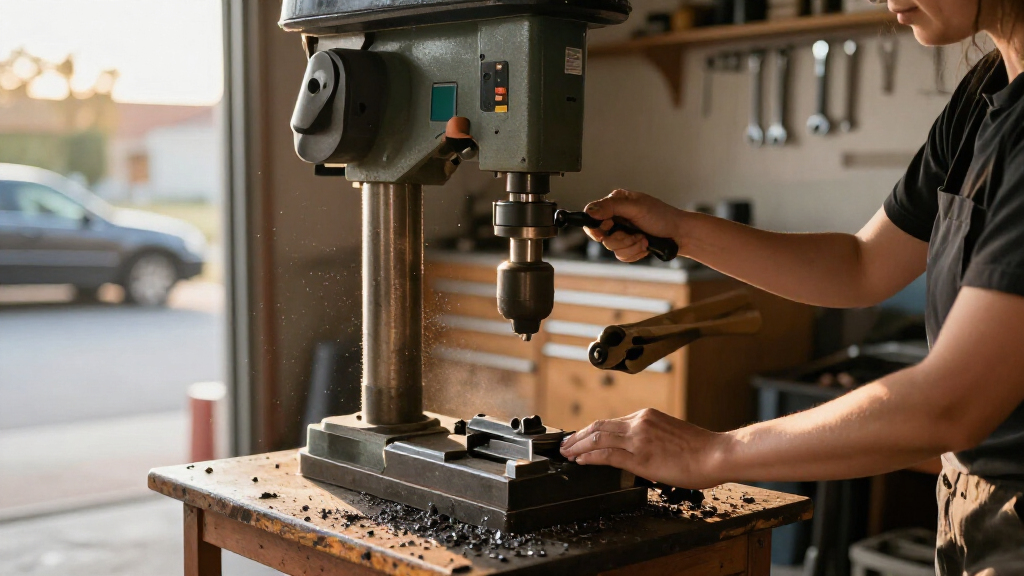
I compared the 11 presses by the demands implied by heavy-duty benchtop work: swing and usable capacity, motor and speed range, construction, worktable flexibility, and how clearly each model supports accurate drilling. Variable speed and a readable RPM display can make repeated material changes easier; fixed-speed designs can be simpler, but the available steps need to match the work. I also weighed practical shop fit, including machine size, power requirements, and whether features such as a laser or work light add useful setup help.
The ranking favors a balanced mix of capacity, control, and build over a single impressive specification. That puts the JET JWDP-12 first as a versatile choice, with the larger JET J-2530 higher for capacity-focused buyers and the BUCKTOOL 12-inch as a strong motor-and-speed-range alternative. Smaller and less powerful models rank lower for heavy workloads, though they can be better choices when space, simpler operation, or lighter tasks matter more. Since listed specifications do not establish real-world rigidity or drilling performance, I treat them as selection signals rather than proof that one press will outperform another in every shop.
Factors to Consider When Choosing Drill Press Bench Top Heavy Duty
Choosing a heavy-duty benchtop drill press involves more than finding the largest motor or swing measurement. The right match depends on the stock you drill, how often you change materials, the room available around the machine, and the accuracy your work requires. These factors help distinguish genuine capacity from features that may matter less in your shop.
Match Swing and Throat Reach to Your Work
Swing describes the largest workpiece diameter that can be positioned under the spindle, but it does not tell the whole story about usable reach. A wide panel may fit a press on paper and still be awkward if the table, column, or head limits how you can position it. Measure your usual stock and leave room to rotate or reposition it, rather than choosing only by the biggest project you might make once. Buyers who regularly drill near the center of larger pieces may benefit more from a 12- or 15-inch model than from a compact 8- or 10-inch press. For small parts and routine holes, the larger machine can take up valuable bench space without improving daily work. Check the press dimensions and your bench layout before treating a bigger swing as an automatic upgrade.
Choose Speed Control for Your Materials
Drilling speed should suit both the bit diameter and the material, so a press that makes speed changes easy can save setup time across mixed projects. Variable-speed models offer finer adjustment, while fixed-speed presses rely on a limited set of steps that may leave you between preferred settings. Do not assume a high maximum RPM means a press is better for heavy work: larger bits and tougher materials often call for slower speeds. Compare the low end of the range as carefully as the high end, especially if you expect to bore with larger bits. Frequent changes between wood, metal, and different bit sizes strengthen the case for variable control. If your work repeats at a narrow range of speeds, a well-chosen fixed-speed model may be simpler to operate.
Read Motor Specs Alongside the Rest of the Machine
Amperage and horsepower are useful clues, but neither measures rigidity, spindle stability, or how well the machine maintains alignment under load. Compare motor details with the press’s frame, table, speed range, and intended workload instead of ranking models by the biggest number alone. A heavier frame can help the press feel more planted, but it also makes installation and repositioning harder. For sustained use or larger bits, check the manufacturer’s stated capacity and operating guidance rather than inferring it from motor power. Home shops that drill intermittently may not benefit from a larger motor if the work is mostly small and light. Match the whole machine to the job, including the support beneath it.
Plan for Bench Space, Mounting, and Power
A benchtop press still needs a sturdy mounting surface, enough overhead clearance, and room to raise the table or handle longer stock. Before buying, measure the footprint and the space above the bench; a press that fits at rest may be awkward when adjusting its head, table, or workpiece. Larger models such as the 15-inch JET can demand more planning than compact presses, and a 115/230V model may require an electrical check before installation. Secure mounting matters because vibration and movement can undermine accurate drilling and create an unpleasant work setup. Leave space around the machine for clamping and material support rather than fitting it tightly between other tools. These planning steps often matter more than a small difference in listed motor power.
Treat Lasers and Lights as Aids, Not Accuracy Guarantees
Lasers and work lights can make layout marks easier to see, particularly when the bench area is dim or the workpiece is awkward to position. They do not replace a center punch, careful measurement, or a securely clamped part. A laser helps with initial alignment, but its position can require checking and adjustment, and it cannot correct spindle runout or a poorly supported workpiece. If accuracy is central to your work, prioritize a stable setup and repeatable depth control alongside alignment aids. For occasional workshop tasks, an integrated light may be more useful day to day than an advanced speed display. Pay for convenience features when they solve a problem you encounter often, not because they sound like substitutes for sound setup.
Decide How Much Capacity You Will Actually Use
Extra swing, more speed settings, and a stronger motor can expand what a press handles, but they also bring a larger machine and potentially more setup demands. Think about the biggest bit, thickest stock, and widest workpiece you use regularly, not just what the press could theoretically accommodate. Buyers doing frequent metalwork or large-hole drilling should put low-speed control and robust support high on the list. For furniture repairs, small shop projects, and occasional holes, a modest press may leave more room and be easier to live with. A premium model makes more sense when its added reach or control removes a recurring limitation. If your workload rarely approaches the machine’s capacity, spend attention on fit, stability, and ease of adjustment instead.
Frequently Asked Questions
Is a 12-inch benchtop drill press enough for most home-shop work?
For many home shops, a 12-inch swing is a practical balance between workpiece reach and bench space. It can suit a wider range of projects than an 8- or 10-inch press, though the workpiece still needs to fit around the column and table. If you regularly drill large panels or position holes far from an edge, compare the 12-inch models with the 15-inch JET J-2530. If most of your work involves small parts, the extra reach may not justify a larger footprint. Base the choice on the largest work you repeat, not an occasional outlier.
Should I choose variable speed or a fixed-speed drill press?
Variable speed is most helpful when you often switch materials, bit sizes, or drilling tasks and want to adjust the spindle without relying on a few preset steps. Fixed-speed models can be a sensible fit when your work uses a familiar set of materials and you are comfortable selecting among the available speeds. Check the actual speed range and adjustment method rather than relying on the label alone. Low-speed capability matters for large bits and many metalworking jobs, while higher speeds can suit smaller bits and wood. Your routine matters more than the control type in isolation.
Does a 3/4 HP or 1 HP motor automatically make a press heavy duty?
No. Motor power is only one part of a drill press’s ability to handle demanding work. Swing, available low speeds, table support, frame rigidity, and secure mounting also affect how the machine fits a task. The listed motor figures can help narrow choices, but they do not by themselves prove drilling capacity or long-term performance. Compare the manufacturer’s capacity guidance with your bits and materials. A well-matched smaller machine can be a better shop choice than a larger motor attached to a press that does not fit your work.
Can I use a benchtop drill press for metal, or do I need a floor model?
Several benchtop presses in this roundup are described for wood and metal, but suitability depends on the material, bit size, and frequency of use. Metal drilling calls for appropriate speeds, secure clamping, and a stable workpiece; the press label alone does not make a setup safe or effective. A benchtop model can make sense for occasional or moderate metalwork if its capacity and speed range match the job. A floor model may be a better fit when you routinely handle large, heavy stock or need more working room. Check the manufacturer’s guidance and your bench’s ability to support the machine and work.
What should I verify before installing a larger benchtop drill press?
Check the machine’s footprint, total height, clearance for the workpiece, and space needed to move the table or adjust the press. Confirm that the bench can support the machine and that you can bolt it down securely. Review the electrical requirements too; the JET J-2530, for example, lists 115/230V operation, so buyers should confirm their setup before installation. Plan for room to clamp stock and support long pieces, not just room for the press itself. If any measurement or electrical detail is unclear, consult the manufacturer’s specifications before committing to a location.
Conclusion
For a balanced shop setup, I recommend the JET JWDP-12 as the best overall thanks to its variable speed and digital RPM readout. The VEVOR 10-inch or WEN 4206T are the best value-oriented choices when a smaller footprint and simpler workload matter more than maximum reach; the WEN 4206T is especially suited to beginners handling lighter tasks. For a best premium, capacity-focused pick, the JET J-2530 offers a 15-inch swing and 16 speeds, provided its size and power setup suit your shop. The BUCKTOOL 12-inch is a strong fit for buyers focused on its 3/4 HP motor and slower stated speed range, while the VEVOR 12-inch with 1 HP suits shoppers drawn to a broad variable-speed range and integrated alignment aids. Choose by your recurring work: reach for large stock, speed control for changing materials, and a compact model if bench space is the binding limit.