TL;DR
A car diagnostic scan tool reads trouble codes and, depending on the model and vehicle, live data and information from other control modules. A code points to a system or condition, not automatically to a failed part, so record the data, confirm the cause, and check that the tool supports your exact vehicle before buying or repairing anything.
A check-engine light can turn a quiet drive into a guessing game. A car diagnostic scan tool gives you a way to read what your car’s computers have noticed, often before you spend money replacing parts. Yet the number on the screen is a clue, not a verdict.

Get business pricing on garage and car supplies
- Business-only prices and quantity discounts
- Tax-exempt purchasing
- Multiple users, one account, clear invoices
This guide explains what scan tools do, how basic readers differ from professional equipment, and what to check before you buy. You’ll also learn how to use the information without erasing useful data or treating a code like a guaranteed repair instruction.
Think of the tool as a window into the car’s diagnostic system. You can see more through some windows than others, and you still need to interpret what’s outside.
A trouble code points to a monitored system or condition; test before replacing the part named in its description.
Most U.S. cars and light trucks from model year 1996 onward use OBD-II for common emissions diagnostics, but generic readers may not access ABS, airbags, or ot…
Check compatibility for your exact make, model, year, and desired functions before buying a reader, phone adapter, or professional scanner.
Record codes and freeze-frame data before clearing anything; clearing can erase clues and reset emissions readiness monitors.
Use qualified service for brake, airbag, and high-voltage hybrid or EV work, and check for open recalls through NHTSA in the United States.
What a scan tool can tell you before you replace a part
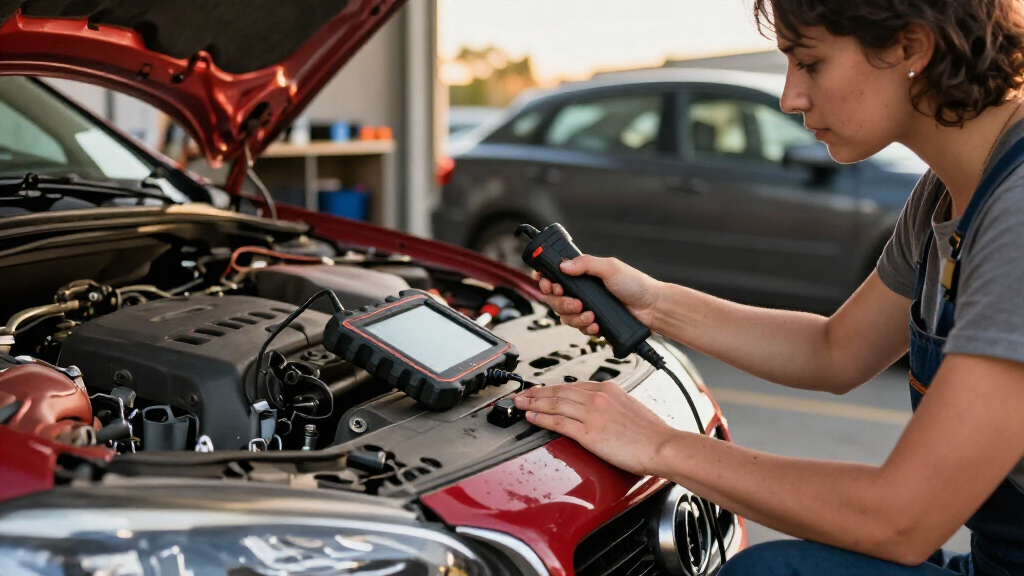
A car diagnostic scan tool reads information from a vehicle’s electronic control modules, including trouble codes and, on many tools, live sensor readings. More capable models can run certain tests or change selected settings. It helps narrow down where to investigate; it does not automatically identify the exact broken part.
Imagine your check-engine light comes on during a rainy commute and the reader displays an oxygen-sensor-related code. That code points toward a monitored condition or system. The sensor could be faulty, but damaged wiring, an exhaust leak, or another engine issue could create a similar result.
That distinction can save you money. Replacing a sensor because its name appears in a code is like replacing a smoke alarm because it detected smoke: the alarm may be working perfectly. A useful car diagnostic scan gives you a starting point for testing, not permission to skip the testing.
Depending on the tool, you may also see live data such as engine temperature or sensor readings while the car runs. Freeze-frame data can show the conditions captured when a fault appeared, such as engine load or speed. Those details help you and a mechanic recreate the moment the warning began.
A code names a clue, not a confirmed failed part. Use it to guide the next check, then verify the cause with vehicle-specific information and appropriate tests.
For instance, a code recorded during hard acceleration may lead a technician to investigate differently from one recorded while the engine idled in a driveway. The scan tool preserves part of the story; it cannot tell the whole story by itself.
Products Worth Considering

DEWALT 20V MAX XR Cordless 1/2-Inch Impact Wrench Kit (DCF900P1)

Chemical Guys TORQX Random Orbital Polisher Kit, 9-Piece

DEWALT 20V MAX XR Brushless Hammer Drill and Impact Driver Combo Kit with Two 4 Ah Batteries and 4 A Charger (DCK2112QQ2)
As an affiliate, we earn on qualifying purchases.
Know what a basic OBD-II reader will miss
In the United States, most cars and light trucks from model year 1996 onward use standardized OBD-II diagnostics for emissions-related systems. Many have a 16-pin diagnostic connector beneath the dashboard, although its precise location varies. A generic reader can often retrieve common engine codes through this shared system.
The word “often” matters. OBD-II does not mean every tool can communicate with every system in every car. A basic reader may show an engine code while leaving ABS, airbag, transmission, or body electronics out of reach.
Suppose a dashboard warning points to the anti-lock brakes, but your inexpensive reader reports “no codes.” That result may mean the tool only checked the engine computer, not that the braking system has nothing to report. The next move is to check the reader’s module coverage or have the relevant system scanned.
Other markets adopted diagnostic requirements on different schedules, and vehicles vary by make, model, year, and protocol. Even a tool that supports a feature may only support it on selected vehicles. Check the maker’s compatibility information for your exact car instead of relying on a box that says “all systems.”
Newer vehicles add more computers and sometimes security gateways that restrict access to certain diagnostic functions. A professional or brand-specific tool may need current software, credentials, or a subscription. The extra access can be useful, but the price and ongoing fees belong in your comparison.
Before buying, check whether the device can read the modules you care about, show enhanced manufacturer-specific codes, and receive updates. If you only need to read an occasional engine warning, a basic reader may fit. If you need an airbag diagnosis, that same reader could leave you staring at a blank screen.
Choose a tool that matches your car and your next step
The right scan tool depends on your vehicle and the work you want to do, from reading a common engine code to testing a specific system. A low price can suit a simple question, while broader module coverage and service functions tend to come with more capability and cost. Start with what you need the tool to access.
Here’s how the main types compare. Feature names can sound impressive, but support varies by vehicle, app, and software version. Verify the specific functions before you pay.
| Tool type | What it commonly offers | Good fit when… |
|---|---|---|
| Basic code reader | Common engine or emissions codes; sometimes code clearing | You want an affordable first clue about a check-engine light |
| Bluetooth or Wi-Fi adapter | Phone-based codes, live data, and dashboards, depending on the app | You want to view readings on a phone and have confirmed app compatibility |
| Professional scan tool | Broader vehicle coverage, more live data, active tests, or service functions | You work on several systems or need deeper diagnostic options |
| Brand-specific or OEM-level tool | Deeper access to a manufacturer’s modules and procedures, sometimes with account or subscription requirements | You need manufacturer-specific information and accept the access requirements |
For example, a driver who only wants to read an occasional engine light may not need a large workshop scanner. Someone maintaining an older car and checking data on a phone may prefer an adapter and an app that clearly lists supported vehicles and features.
Look beyond the headline feature count. Check make, model, year, and protocol support; whether the tool can access the relevant modules; and whether it shows freeze-frame data and emissions readiness monitors. If you want active tests or service resets, confirm support for those exact functions on your car.
Also check app compatibility, software updates, and any ongoing fees. A cheap adapter that depends on a paid app may cost more over time than its price suggests. Ask what the scan tool does for your specific vehicle, not just what the product label promises.
Follow these five steps before you clear a code
Before clearing a diagnostic code, record the code and freeze-frame information, then investigate the cause using vehicle-specific information and tests. Erasing a code does not repair the fault; it can also remove useful evidence and reset emissions readiness monitors.
- Write down the code. Save the exact characters and note which warning light appeared. If your reader shows freeze-frame information, capture those readings too.
- Look up the code for your vehicle. Use reliable, vehicle-specific service information. A short description on a reader may leave out important conditions or possible causes.
- Check the surrounding evidence. Compare live data and the recorded conditions with symptoms such as rough running, unusual noises, or a change in fuel use. A code points your attention; other evidence helps test the idea.
- Confirm the fault before replacing parts. Depending on the problem, this may call for wiring checks, mechanical inspection, or tests beyond a home reader. Ask a qualified mechanic when the procedure goes beyond your experience or tools.
- Repair, then clear and recheck when appropriate. After the underlying issue is fixed, clear the code if the repair procedure calls for it. Check for returning codes and allow readiness monitors to complete before an emissions inspection.
For example, if a reader shows an oxygen-sensor-related code, jot it down before touching the clear button. A mechanic can then compare the code and captured data against the car’s symptoms instead of starting with a blank diagnostic record.
Readiness monitors matter because they report whether the car has completed certain self-checks used in emissions testing. Clearing codes may reset those checks, so a light that briefly goes away does not mean your car will pass an inspection. The monitor status and local inspection rules matter too.
Treat active tests, adaptations, and service resets with care. A button on a scanner can prompt a real vehicle function, and the right procedure depends on the model. When a step affects brakes, airbags, or another safety system, use qualified help rather than experimenting from a menu.
Know when a scan tool isn’t enough for a safe repair
A scan tool can guide your next step, but safety-critical repairs need the right training and equipment. This is especially true for brakes, airbags, and the high-voltage systems in hybrid and electric vehicles. If a diagnosis reaches those areas, a certified or otherwise qualified mechanic can follow the correct service procedure.
Consider an airbag warning that appears alongside a code. Reading the code may identify a circuit or system that needs attention, but it does not make it safe to probe airbag wiring. Similarly, an ordinary engine reader may not have the coverage or procedures needed to diagnose a battery-management or high-voltage fault in an EV.
Modern cars also increasingly rely on software, networked modules, and manufacturer security gateways. A function may require approved credentials, a subscription, or a tool update. If a scanner cannot access the module, repeatedly trying generic options may not help; the car may require an authorized procedure or a shop with the correct equipment.
Check for open recalls when a warning or safety problem appears. In the United States, the NHTSA recall lookup lets you search by vehicle identification number (VIN). A recall check does not diagnose the fault, but it can show whether the manufacturer has announced a repair for a related safety issue.
One practical example: if an ABS warning comes on before a long trip, a basic reader that only checks engine codes can’t reassure you that the braking system is fine. Check the manual, arrange a scan with appropriate ABS coverage, and get the brakes inspected before relying on them.
Use the scan tool to decide what needs attention; use qualified service for hazardous systems. A clear next step is more useful than a risky guess.
Make the code useful instead of letting it send you shopping
The most useful way to treat a scan result is as a question to investigate, not a shopping list of replacement parts. That approach keeps you from confusing a system label with proof that a named component has failed. It also helps you explain the issue clearly if you take the vehicle to a shop.
For example, imagine your car hesitates on a hill and the reader returns a code tied to an engine sensor. Write down the code, note when the hesitation happens, and preserve any freeze-frame details. A mechanic can use that information alongside inspection and testing to decide whether the sensor, its wiring, or another condition deserves attention.
When you share the result, include the vehicle’s make, model, year, symptoms, and code. Mention whether the warning is steady or flashing and whether you cleared anything. These details turn “my scanner says sensor” into a more useful account of what the car actually did.
Keep realistic expectations about phone adapters, too. An app may plot live readings in colorful graphs, but a polished dashboard doesn’t guarantee broad vehicle coverage or a correct diagnosis. Check what the adapter, app, and car support together; one weak link can limit the result.
A scan tool reads the car’s report, while diagnosis weighs that report against the symptoms and the vehicle’s service information. You can use the first part at home, but a complex or safety-related fault may call for professional testing. The best result is not the most codes on a screen; it’s a well-supported next step.
Frequently Asked Questions
Can a scan tool tell me exactly which part to replace?
No. A trouble code points to a system or condition, not guaranteed proof that one part failed. For example, an oxygen-sensor-related code can involve the sensor, wiring, an exhaust leak, or another engine problem; confirm the cause before buying a replacement.
Will a basic OBD-II reader work on my car?
In the United States, most cars and light trucks from model year 1996 onward use OBD-II for common emissions-related diagnostics. A basic reader may still lack access to your car’s ABS, airbag, transmission, or manufacturer-specific systems. Check coverage for your exact make, model, and year.
Can I read car codes with my phone?
Yes, a Bluetooth or Wi-Fi adapter can connect to a compatible phone app and show codes or live data. What you can access depends on the adapter, app, and vehicle. Check app support and possible fees before you buy.
Does clearing a code turn off the check-engine light for good?
Clearing a code does not fix the fault. The light may return if the underlying problem remains, and clearing can erase freeze-frame evidence or reset emissions readiness monitors. Record the code and useful data before you clear it.
Can I use a scan tool to diagnose an EV or hybrid?
An ordinary engine-code reader may not access high-voltage or battery-management systems, and it cannot replace safe repair procedures. If the warning concerns a high-voltage system, use a qualified mechanic with the right training and equipment.
Conclusion
Remember this: a scan tool gives you evidence, not a parts order. Record what it finds, confirm what the tool can access, and use the code to guide the next check.
When a warning leads toward brakes, airbags, or high-voltage systems, put the reader down and get qualified help. A useful scan should leave you with a clearer question—and a safer answer.